


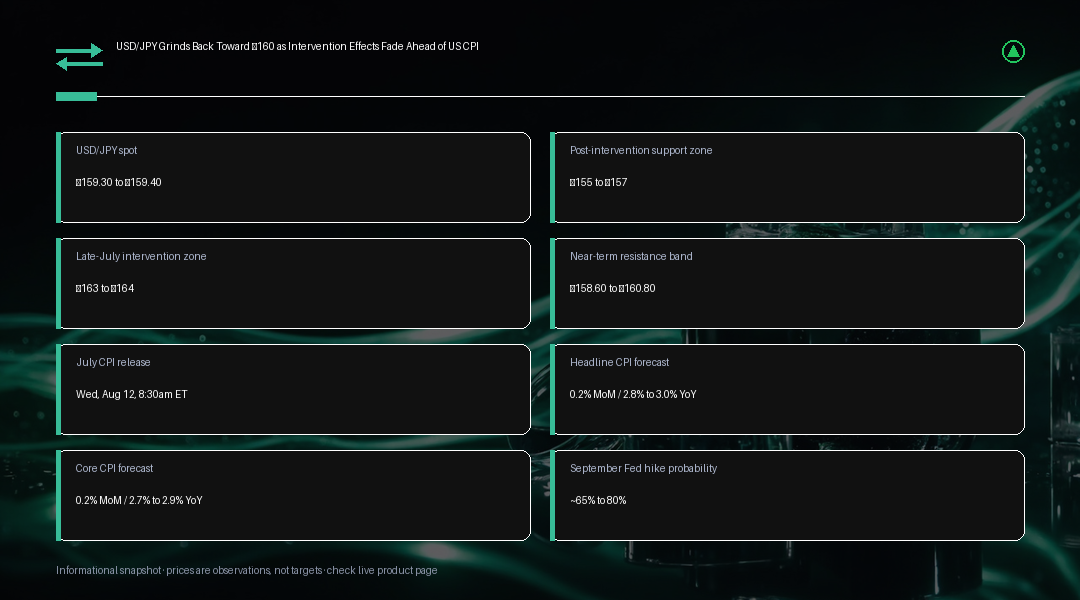
USD/JPY has climbed back to roughly ¥159.30 to ¥159.40 as of the second week of August 2026, clawing back a large share of the ground the dollar lost when Japanese and US authorities intervened jointly to defend the yen just weeks earlier. The pair's return toward the psychologically sensitive ¥160 area shows how quickly a policy-driven shock can lose momentum once the underlying interest-rate story reasserts itself.
The intervention itself was real and sizable. In late July and early August, Japan's finance ministry coordinated large-scale yen-buying operations with the US Treasury, pulling USD/JPY down from a roughly 40-year extreme near ¥163 to ¥164 into the mid-150s, in the ¥155 to ¥157 area, over several trading sessions rather than in one clean move. That kind of joint intervention forces short-term traders holding bearish yen positions to unwind quickly, and it did exactly that, compressing volatility and temporarily flattening the market's appetite for selling yen.
The problem for policymakers is that intervention changes positioning, not the interest-rate gap that created the imbalance in the first place. The Bank of Japan continues to hold policy rates near the floor, while the Federal Reserve's benchmark still sits in the 3.50% to 3.75% region, with rate-futures markets assigning a meaningfully elevated probability, in the region of 65% to 80%, to another quarter-point Fed increase in September. That gap keeps the classic yen carry trade attractive: borrow cheaply in yen, deploy the proceeds into higher-yielding dollar assets, and collect the spread as long as volatility stays contained. As memories of the intervention fade, traders have steadily rebuilt short-yen exposure, which is the direct mechanical reason USD/JPY has drifted back toward the upper end of the ¥155 to ¥157 zone.
The next scheduled catalyst is July's US Consumer Price Index report, due Wednesday, August 12 at 8:30 a.m. Eastern time. Consensus forecasts point to headline inflation rising roughly 0.2% on the month and landing near 2.8% to 3.0% year over year, while core inflation, which strips out food and energy, is expected to also rise about 0.2% monthly with an annual pace near 2.7% to 2.9%. These are estimates rather than confirmed figures, and the eventual print could easily land outside that band in either direction.
The way this data feeds into Fed expectations deserves a careful frame. Markets already lean toward a September hike as the base case, so a hotter-than-expected core print would not create hawkish expectations from scratch, it would reinforce and likely extend an already elevated probability, keeping upward pressure on Treasury yields and, by extension, on the dollar against the yen. A cooler print would work in the opposite direction, trimming the odds or eventual scale of further tightening rather than guaranteeing a full pause, since a single data point rarely settles a rate-setting committee's path on its own.
Labor-market momentum is part of the same conversation. Recent readings point to some cooling in US job growth, a trend that argues against aggressive tightening even as inflation stays sticky, though the exact scale of that slowdown should be treated as a general backdrop rather than a single precise headline figure.
Cross-asset signals are worth watching alongside the yen itself. When the Federal Reserve's rate path and US Treasury yields move, the ripple effects rarely stop at USD/JPY. A firmer dollar backed by a hotter CPI print tends to show up across other yen crosses and can spill into broader risk sentiment if it coincides with a faster repricing of the rate outlook. Conversely, if softer inflation data trims the odds of further Fed tightening, the same move that eases pressure on USD/JPY would likely show up as broader dollar softness elsewhere, since the underlying driver, the direction of US rate expectations, is common across the dollar complex rather than specific to the yen alone. That broader context matters for sizing any single-pair view around this week's data.
On the chart, traders widely treat ¥160 less as an arbitrary round number and more as a market-perceived sensitive zone, largely because it sits close to the area where authorities have already shown a willingness to act and have signaled they will not hesitate to act again. Resistance is generally mapped across the ¥158.60 to ¥160.80 band, with a deeper cluster around ¥163 to ¥164, the late-July extreme where the joint intervention was triggered. On the downside, initial support sits near ¥158 and ¥157, backed by a broader base around ¥155 to ¥157 that marks the post-intervention floor. None of these levels are official policy triggers; they are technical and psychological reference points that traders, and plausibly policymakers, are both watching.
Intervention is not powerless, it visibly altered positioning, volatility, and the near-term cost of betting against the yen. But without a narrower US-Japan rate gap, its effects tend to fade the way this move already has. July CPI is now the swing factor that decides whether dollar strength keeps pressing back toward ¥160, or whether the move stalls and gives the post-intervention floor another test.
Trading Insight
For traders, the setup into Wednesday's CPI print is genuinely two-sided rather than a one-way dollar trade. The carry-trade math still favors dollar strength as long as the Fed-BOJ rate gap stays this wide, which is why USD/JPY has recovered so much ground already, and a hot core CPI print that reinforces September hike odds would likely extend that move toward the ¥158.60 to ¥160.80 resistance band and open a path toward the ¥163 to ¥164 zone if momentum builds quickly. The counterweight is policy risk: the faster and more aggressively the pair approaches ¥160, the greater the chance that Tokyo and Washington view a fresh advance as unacceptable and step back in, which is exactly the kind of scenario that can flatten momentum traders who are right on direction but wrong on timing. A cooler-than-expected CPI print, by contrast, would likely pressure Treasury yields lower and give the yen room to retest the ¥155 to ¥157 support band, unwinding some of the recent carry-trade rebuild. Given that intervention has already proven it can move this pair several yen in a matter of sessions, position sizing and stop placement around the ¥160 and ¥155 zones deserve particular care into and immediately after the data. Traders should also frame their invalidation levels clearly before the release rather than after. A close back below the ¥155 to ¥157 support band would suggest the post-intervention floor is holding and that carry-trade rebuilding has stalled, while a sustained push through the ¥158.60 to ¥160.80 band on strong volume would be the clearer signal that the market is testing officials' tolerance again. Because the prior intervention showed authorities are willing to act with size, risk management around this release should weigh the probability of an official response as carefully as the probability of any particular CPI outcome.