


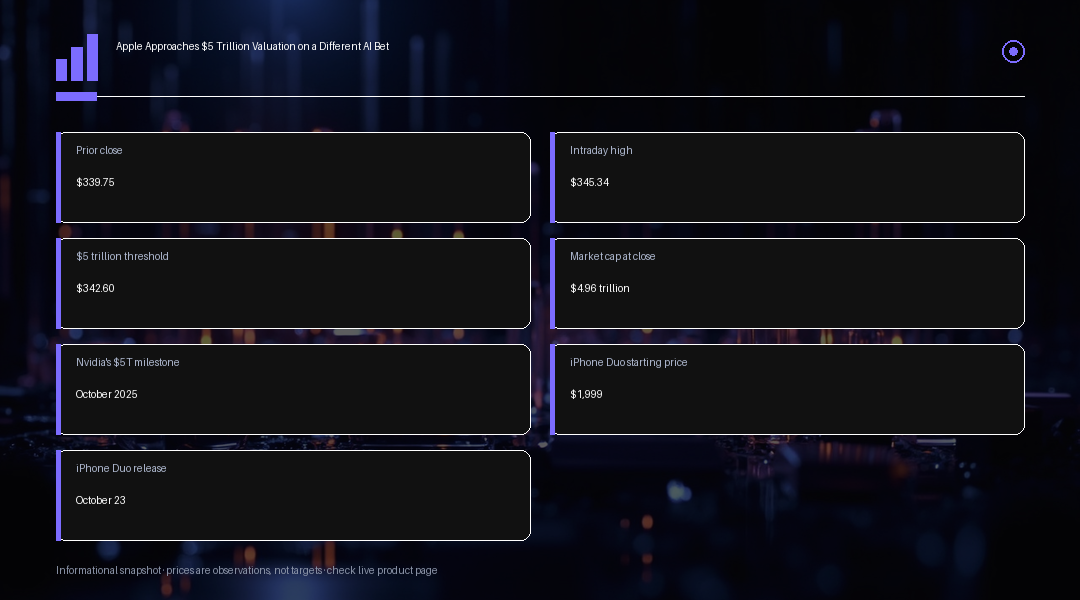
Apple shares closed at $339.75, up 0.2 percent, marking their highest finish in almost two months and valuing the company at $4.96 trillion. Based on the current share count, a closing price above roughly $342.60 would carry Apple's market capitalization through the $5 trillion threshold for the first time in a regular session. The stock briefly traded as high as $345.34 during the day, pushing its intraday value above that milestone before easing back, a pattern that has now played out on more than one occasion this quarter without yet producing a full session close above the mark. Nvidia remains the only company to have traded above $5 trillion, first crossing that level in October 2025, which underscores how rare this valuation tier still is.
What distinguishes Apple's approach from the rest of the mega-cap technology cohort is the shape of its AI investment. Microsoft, Amazon, Alphabet and Meta continue to pour capital into data centers, custom chips and power capacity, a strategy that has pressured near-term free cash flow across the group. Apple has instead leaned on custom silicon and on-device processing, positioning its newest high-end Mac Mini and Mac Studio models as an enterprise alternative to renting capacity from cloud providers. In a widely discussed demonstration, the company linked four Mac Studio units, each built around its M5 Ultra chip with 256 gigabytes of unified memory, into a single cluster capable of running a trillion-parameter model from one standard wall outlet.
The pitch to enterprise buyers is straightforward: rather than paying recurring per-token fees to a cloud provider, a company can run substantial AI workloads locally using hardware it already owns, with high-end configurations priced at roughly $20,000. The obstacle is distribution rather than capability. Macs still hold only about 4.6 percent of the enterprise desktop market against more than 91 percent for Windows, according to industry tracking data, which means Apple's local-inference strategy faces a steep climb before it can meaningfully dent the data center economics that Microsoft, Amazon and their peers currently depend on.
The valuation milestone also arrives during a leadership transition. John Ternus, a twenty-five year Apple veteran and former head of hardware engineering, formally became chief executive at the start of September, with Tim Cook moving into the role of executive chairman after roughly fifteen years running the company. That handover coincided with one of the more consequential product launches of Cook's tenure: the iPhone Duo, Apple's first foldable device, which combines a 7.6 inch inner display with a 5.4 inch outer screen and allows two applications to run side by side. The device starts at $1,999 for the base configuration, with preorders opening October 16 ahead of a broader release on October 23.
Pricing power is being tested on more than one front. Rising memory costs, driven in large part by the same AI infrastructure buildout that Apple is positioning against, have already forced the company to raise prices on its Pro-tier iPhones by roughly $100 per model this cycle. Component cost inflation of that scale is a genuine headwind even for a company with Apple's margin structure, and it raises the stakes for whether the $1,999 starting price on the iPhone Duo proves acceptable to mainstream buyers or ends up limiting volume to early adopters willing to pay a premium for the first-generation foldable form factor.
Trading around the $5 trillion level is likely to stay two-sided in the near term. A confirmed daily close above roughly $342.60 would be a genuine milestone, making Apple only the second company ever to close above that threshold, but the stock has already shown it can touch the level intraday without holding it, so traders should not assume the first print above the line will stick. The more durable questions, over the coming weeks, are whether enterprise customers actually adopt the Mac-cluster pitch at scale, whether the iPhone Duo can sustain demand at its price point once initial preorder enthusiasm fades, and whether further memory cost inflation forces another round of price increases across the product lineup.
The broader competitive backdrop reinforces why this valuation debate matters beyond a single ticker. Apple is now the second company in history to even approach the $5 trillion mark, following Nvidia's milestone close in October 2025, and the two companies represent very different bets on how AI value ultimately gets captured: Nvidia through the chips and infrastructure that power large-scale training and inference, Apple through the devices and on-device software that sit closest to the end user. Investors weighing Apple's premium multiple against that backdrop are, in effect, deciding whether a hardware-centric, privacy-oriented AI strategy can command the same enthusiasm that has flowed into infrastructure-heavy names over the past two years.
Execution risk is concentrated in a narrow window this autumn. The iPhone Duo's October 16 preorder open and October 23 release will offer the first hard read on consumer appetite for a $1,999 foldable, and any signs of soft demand would likely be interpreted through the lens of the broader memory-cost story, since component inflation is already squeezing margins on the existing Pro lineup. On the enterprise side, meaningful traction for the Mac Studio cluster pitch is likely to be a multi-quarter story rather than something that shows up in a single earnings print, so traders should treat commentary on enterprise AI adoption as an incremental data point rather than an immediate catalyst for the stock.
Trading Insight
The $342.60 area is the level to watch for confirmation of a genuine $5 trillion valuation rather than a fleeting intraday print, and a sustained move above it would likely draw comparisons with Nvidia's own milestone close from October 2025. Downside risk centers on valuation sensitivity at these levels: any disappointment around iPhone Duo preorder demand beginning October 16, or further evidence that rising memory and component costs are compressing margins, could trigger profit-taking given how far the stock has already run. The enterprise desktop share gap versus Windows also remains a multi-year overhang rather than a near-term catalyst, so traders should treat the Mac-cluster AI narrative as a slower-moving structural story rather than an immediate earnings driver.