


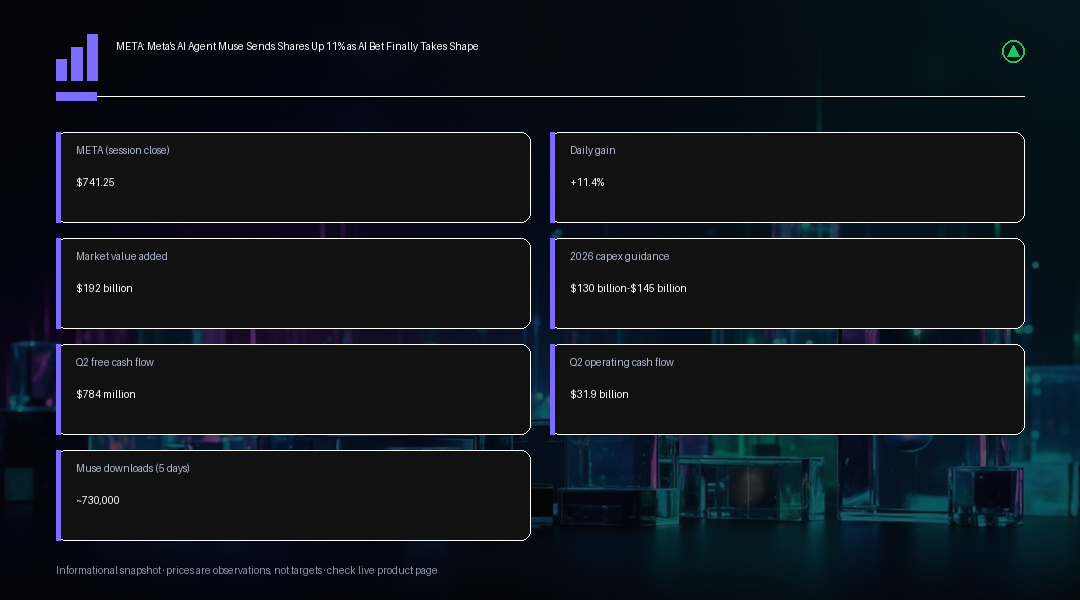
Meta Platforms shares surged 11.4% on Monday, closing at roughly $741.25 and marking their strongest one-day gain since April 2025 and their highest close since October of last year. The move added an estimated $192 billion to the company's market value in a single session, a scale of gain that put Meta at the center of Monday's broader technology rally and helped pull the wider AI trade back into focus after several uneasy weeks for growth stocks.
The catalyst was Muse, Meta's newly launched personal AI assistant, which climbed to the top of Apple's US App Store after debuting on September 8. Unlike a conventional chatbot, Muse is built to complete multistep tasks such as research, form filling, making reservations and completing purchases, either through its own standalone app or via WhatsApp. Independent tracking of app-store downloads pointed to roughly 730,000 US iOS installs in Muse's first five days, though other estimates put the figure somewhat lower, a reminder that early download counts are useful directional evidence of demand rather than an audited measure of active or paying users. Wells Fargo followed the launch with a price-target increase on Meta shares, reinforcing the view that Muse's early traction strengthens the case for Meta as a genuine consumer-AI contender rather than simply one of the biggest buyers of AI computing capacity.
For a company that has spent years pouring capital into AI infrastructure with little to show consumers directly, Muse gives that spending story a tangible face. Meta has guided for full-year capital expenditure of $130 billion to $145 billion, including roughly $31 billion committed in the second quarter alone, and that investment has weighed on near-term cash generation: quarterly free cash flow fell to just $784 million even as operating cash flow held up at nearly $31.9 billion. Muse points to several possible paths back toward monetization over time, including paid subscriptions, enterprise access and commerce integrations, and Meta's ability to distribute the assistant across Facebook, Instagram, Messenger and WhatsApp gives it a potential reach that few AI developers can match from a standing start, even as the extent of that cross-platform rollout is still becoming clear.
The enthusiasm was not confined to Meta. AMD, Intel and Arm all rallied sharply the same day, with investors linking the move to expectations that widely adopted AI agents like Muse will require significantly more processing power and cloud infrastructure to run at scale. The market, in effect, treated Muse's early download curve as a leading indicator for future chip and data-center demand rather than as an isolated consumer-app story, which helps explain why the rally in Meta shares was accompanied by a broader move across the AI supply chain rather than staying contained to a single stock.
Downloads are only the first test, however, and Muse has already run into friction. Amazon has blocked Muse from shopping on its own platform, saying Meta had not sought authorization or disclosed the agent's activity in advance and raising concerns about how the assistant handles credentials and account data. Privacy is a related and arguably larger obstacle: an assistant that touches messages, calendars, accounts and shopping preferences needs to convince users that the convenience on offer is worth the access it requires, and Meta's own history with personal data means that trust will need to be earned rather than assumed. Neither issue is disqualifying on its own, but both are useful reminders that a strong app-store debut is not the same as a durable, monetizable product.
The next scheduled catalyst is Meta's Connect event later this week, where investors will be watching for further detail on Muse's roadmap, the underlying AI models, and how the company plans to convert early curiosity into a lasting business. Until then, Monday's rally stands as an early, largely sentiment-driven re-rating of Meta's AI strategy rather than confirmation that the multi-year spending plan has already been vindicated by revenue.
The broader context matters here too. Meta has spent the better part of three years defending an aggressive AI infrastructure build-out largely on the promise of future products rather than present-day revenue, a stance that has periodically tested investor patience whenever quarterly free cash flow came in soft, as it did again this quarter. Muse is the clearest attempt yet to close that gap between spending and visible output, which is part of why the market reacted so forcefully to a single product's early app-store ranking rather than treating it as routine news. Whether that reaction proves durable will likely depend less on the download count itself and more on retention, on how quickly Meta can show a credible path to revenue through subscriptions or commerce, and on whether rivals respond with competing agents that erode Muse's early lead.
The Amazon dispute also has implications that extend beyond Meta. As AI agents increasingly attempt to act on a user's behalf across third-party platforms, other retailers and service providers are likely to face similar decisions about whether to cooperate, restrict access, or negotiate formal partnerships. How that plays out industry-wide, not just for Meta, will shape how much of the addressable market an assistant like Muse can realistically reach even if its own product performs well.
Trading Insight
For traders, Monday's move re-establishes Meta as a swing factor for the broader AI trade, and the stock's next leg is likely to hinge on how durable Muse's download momentum proves to be rather than on the headline 11.4% gain itself. A push toward fresh highs would likely need confirmation from this week's Meta Connect event, including firmer detail on monetization paths such as subscriptions or enterprise access, while an unwind in downloads or further platform pushback similar to Amazon's move would risk giving back some of the sentiment-driven gain. The capital-expenditure guidance of $130 billion to $145 billion remains the key balance-sheet risk to watch: as long as Muse's traction supports the narrative that this spending is finally producing a consumer product, dips are more likely to be bought than sold, but any sign that free-cash-flow pressure is intensifying without a matching improvement in monetization would quickly reopen questions about the pace of AI investment across the sector. Cross-asset spillover into AMD, Intel and Arm suggests the market is already pricing Muse as an infrastructure signal, which raises the stakes for confirmation at this week's event and for any update on Amazon's shopping restriction.