


Technology shares are starting the week on the front foot, and the early running is coming from Asia rather than Wall Street. The question hanging over the rally is whether it can survive a bond market that is sending a very different message.
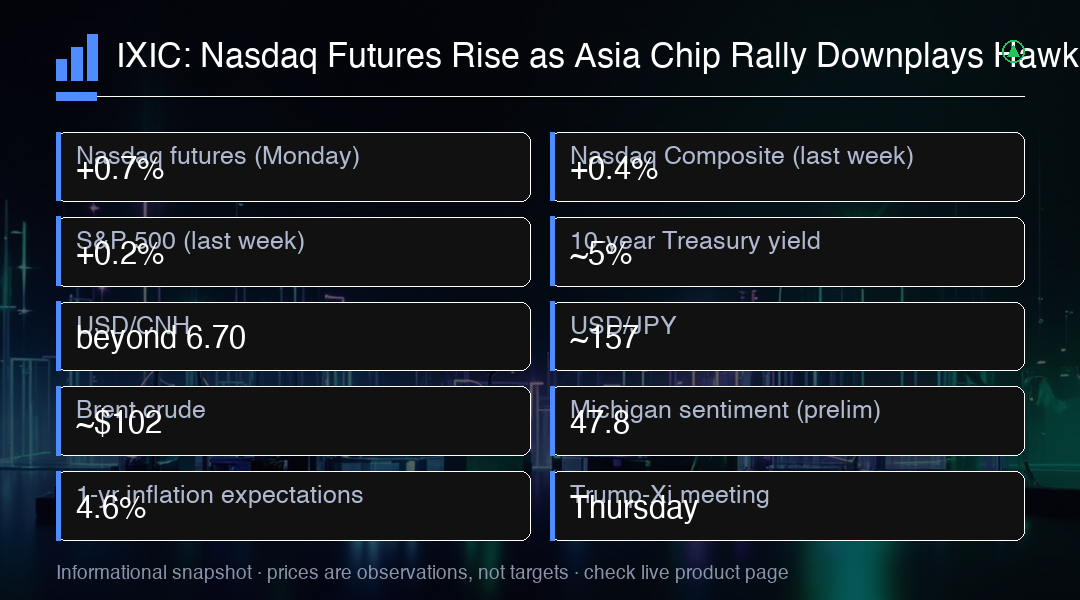
Nasdaq futures turned 0.7% higher on Monday, alongside notable gains in S&P 500 and Dow futures. That builds on a mixed finish last week, when the Nasdaq Composite rose 0.4% and the S&P 500 added 0.2%, while the Dow recorded its third consecutive weekly decline. The divergence between a resilient Nasdaq and a struggling Dow says something about where investors currently see the growth: concentrated in technology and semiconductors rather than the broader industrial economy.
Asia supplied Monday's early momentum. South Korea's Kospi gained roughly 1.8% as Samsung Electronics and SK Hynix advanced on renewed demand for AI-linked memory chips, while Taiwan's market also climbed with help from TSMC. Demand for AI chips and memory remains the market's preferred source of optimism heading into the new week, even as Japan sits out the action entirely, with markets closed for the Silver Week holiday from Monday through Wednesday.
The uncomfortable counterweight to all of this is the bond market. The benchmark 10-year Treasury yield remains close to 5% after the Federal Reserve raised interest rates last week, and traders are already positioning for the possibility of further increases in October and December. A market pricing in more hikes while simultaneously bidding up growth stocks is not necessarily a contradiction, but it is a tension that tends to resolve one way or the other, and this week's data flow will help determine which way that goes.
Currency and commodity markets are adding their own complications. China's yuan strengthened beyond 6.70 per dollar, its highest level in more than three years, with the People's Bank of China showing less resistance to appreciation ahead of Thursday's meeting between Donald Trump and Xi Jinping, where trade, AI export controls, supply chains and Middle East tensions are all expected to be on the agenda. The Japanese yen has moved in the opposite direction, trading near $157 even after the Bank of Japan lifted its policy rate to 1.25%, the highest level in 31 years. Cautious BOJ guidance disappointed yen bulls, and reported rate checks from Japanese authorities have put currency intervention back on traders' radar.
Commodities are reflecting the same push and pull. Brent crude fell around 2% toward $102 a barrel as Saudi exports recovered and some shipping traffic through the Strait of Hormuz resumed, easing a piece of the geopolitical risk premium that had been supporting oil. Gold softened as bond yields rose, while Bitcoin firmed to near $81,600, gaining roughly 1.5% alongside the broader move higher in technology shares, a reminder that risk appetite has been improving across multiple asset classes at once, not just in equities.
Not every AI-adjacent story is having a good week, however. China is slowing the pace of humanoid-robot IPO approvals as regulators question whether some of the state-linked demand behind these listings represents sustainable commercial revenue. Unitree Robotics, which delivered one of the year's most explosive stock market debuts before regulatory and commercial-reality concerns caught up with it, has now fallen 55% from its post-listing peak, an illustration of how quickly an exciting AI-adjacent growth story can turn into an uncomfortable valuation exercise once the market starts asking harder questions.
Corporate earnings add another layer to watch. Costco reports Thursday in one of the week's most closely watched results, with attention centered on membership growth, consumer spending trends, and whether the company announces another special dividend. Costco shares are up modestly for the year but remain well below their May record, which likely leaves investors less forgiving of any disappointment this time around.
The gap between the Nasdaq's resilience and the Dow's third straight weekly decline is itself a signal worth watching. It suggests capital is rotating toward a narrower set of AI and semiconductor-linked winners rather than broadening out across the market, a pattern that has defined much of this year's price action. That kind of narrow leadership can keep working for a long time, but it also means the index-level numbers can mask a much choppier picture underneath the surface for stocks outside the AI theme.
Given how much macro data lands this week, from PMIs to the Trump-Xi meeting to Friday's sentiment and durable-goods releases, traders leaning into the Nasdaq's current strength should treat this as a headline-risk week rather than a one-way trend. Defined risk, whether through tighter stops around this week's key data releases or reduced position sizing heading into Thursday's session, is the more disciplined way to participate in a rally that is being driven as much by Asian chip sentiment as by anything happening in US markets directly.
The macro calendar is dense from here. Wednesday brings preliminary US manufacturing and services PMIs for September; strong activity paired with rising input prices would reinforce expectations for additional Fed tightening, while weaker growth without cooling inflation would raise the less welcome prospect of stagflation. Thursday is the busiest single session of the week: beyond the Trump-Xi meeting, US jobless claims and new-home sales data are due, and central banks in Switzerland, Sweden, Norway, Mexico and South Africa are all scheduled to announce policy decisions, giving currency traders plenty to track.
Friday closes the week with August durable-goods orders and the final University of Michigan consumer-sentiment survey. The preliminary read on that survey already fell 7.5% to 47.8, its second-lowest reading on record, while one-year inflation expectations climbed to 4.6%. A downward revision to the final number would deepen growth concerns, while a further rise in inflation expectations would hand the Fed additional justification to stay hawkish into year-end.
Putting the pieces together, Nasdaq futures carry a constructive short-term bias as long as the Asia-driven chip rally holds and Treasury yields stay range-bound near current levels. A hawkish PMI surprise, a disappointing Trump-Xi outcome, or a sharp move higher in yields would all be capable of testing that resilience quickly, and this week offers no shortage of opportunities for exactly that kind of surprise.
Trade Nasdaq-linked volatility around this week's data flow and central-bank decisions with MC Markets, using real-time pricing and risk-management tools built for fast-moving index markets.
Trading Insight
Nasdaq futures carry a constructive short-term bias while Monday's Asia-driven chip rally holds and the 10-year Treasury yield stays contained near 5%. A hawkish surprise from Wednesday's preliminary PMIs, a disappointing Trump-Xi meeting outcome on Thursday, or a fresh leg higher in Treasury yields would all be key risks capable of reversing the constructive tone this week. Costco's Thursday earnings and Friday's final Michigan sentiment/durable-goods data are additional volatility catalysts to watch into the weekend.