


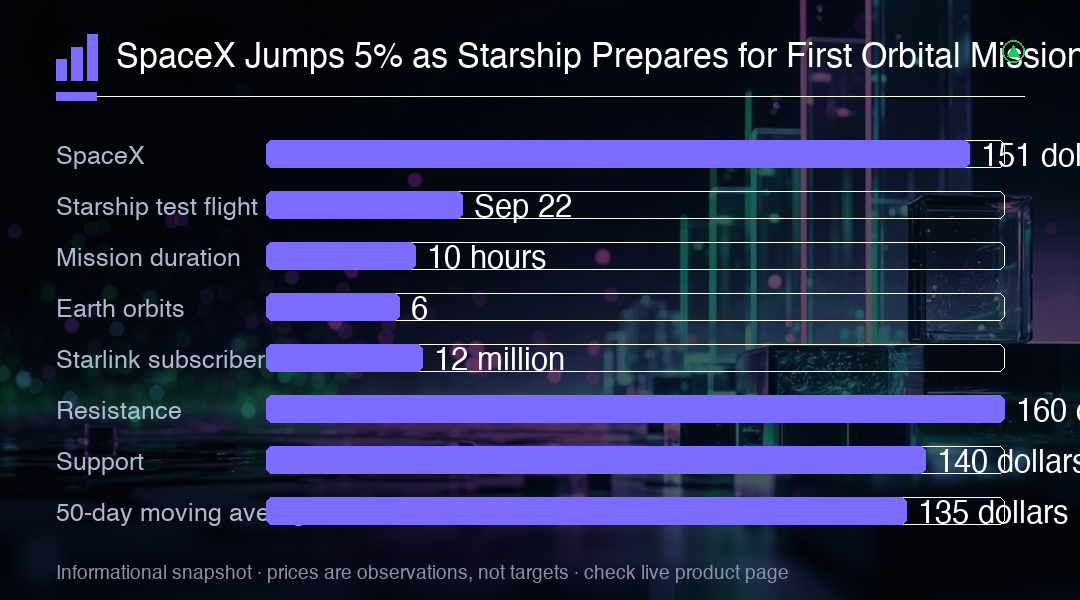
SpaceX shares climbed more than 5% to roughly 151 dollars after the company scheduled Starship's 14th test flight for September 22. The planned 10-hour mission will target six Earth orbits and attempt to deploy production-ready Starlink V3 satellites. If successful, it would become Starship's first revenue-generating flight and its first sustained orbital mission. V3 satellites promise substantially greater capacity than earlier Starlink hardware, but their size makes Falcon 9 launches inefficient. Starship is designed to deploy them in much larger batches, potentially accelerating expansion of a broadband network that already serves more than 12 million subscribers.
Starship can theoretically carry more than 100 metric tons into orbit. Its real economic promise comes from making both stages rapidly reusable. Recovering the hardware could lower launch costs, increase flight frequency and allow SpaceX to deploy satellites without paying an outside launch provider. That advantage could reinforce SpaceX's unusual business model: it owns the rockets, launches its own satellites and sells connectivity through Starlink. Execution remains the important qualification. A successful September flight would demonstrate progress, not fully reusable commercial operations. Investors must still account for development costs, regulatory approvals, manufacturing capacity and the possibility that schedules continue slipping.
ARK Invest CEO Cathie Wood said Starship could eventually generate 10 trillion dollars in annual revenue by 2030, assuming 10,000 launches per year carrying economic value of 1 billion dollars each. Elon Musk responded that the estimate was "not impossible." The arithmetic is straightforward but the assumptions are doing most of the work. Ten thousand annual launches would require around 27 every day, far beyond anything demonstrated by the industry. But also, 1 billion dollars of value per flight should not be confused with the price customers would necessarily pay SpaceX.
The wider space economy is attracting money too. Impulse Space, founded by former SpaceX propulsion chief Tom Mueller, expanded its Series D financing by 308 million dollars, taking the round to 808 million dollars and valuing the company at approximately 5.4 billion dollars. Impulse develops spacecraft that transport satellites and other payloads after launch, addressing the increasingly important journey between reaching orbit and arriving at the required destination. Its Caravan 2 and Caravan 3 Helios rideshare missions for 2028 are already fully booked. The funding provides a useful read-through for SpaceX. Cheaper, more frequent launches are creating demand for an ecosystem of orbital transport and satellite services around them.
Looking ahead, the key levels to watch for SpaceX stock are the recent high near 151 dollars and the psychological 150 dollar level. A sustained move above 150 dollars could open the door to a retest of the all-time highs near 160 dollars. On the downside, the 140 dollar level is the first psychological support, followed by the 50-day moving average near 135 dollars. The options market is pricing in elevated volatility around the September 22 test flight, suggesting traders are bracing for significant price swings. The put-call skew indicates that investors are hedging for downside risk, but there is also significant interest in upside calls.
For traders, the key takeaway is that SpaceX's near-term trajectory hinges on the success of the September 22 Starship test flight. A successful mission could spark a rally toward 160 dollars, while a failure or delay may trigger a pullback to 140 dollars. The broader space economy is also providing tailwinds, with companies like Impulse Space attracting significant investment. This creates a setup for potentially significant volatility around the test flight, and position sizing and risk management become crucial in this environment.
From a broader perspective, the investment case for SpaceX extends beyond the immediate test flight. The company's vertical integration, from rocket manufacturing to satellite deployment and broadband services, creates a unique competitive advantage that few other companies can match. The Starship program, while risky, has the potential to fundamentally alter the economics of space access. If the company can achieve rapid reusability, it could reduce launch costs by an order of magnitude, opening up new markets and applications that are currently prohibitively expensive. This could include space tourism, asteroid mining, and even colonization of Mars.
However, investors should be mindful of the risks. The Starship program is highly experimental, and setbacks are common in aerospace development. A failed test flight could delay the program by months or even years, which would weigh on the stock. Additionally, regulatory hurdles could slow the pace of launches, and competition from other space companies could erode SpaceX's market share. The valuation is already pricing in significant growth, and any disappointment could lead to a sharp correction. Key levels to watch are 160 dollars resistance and 140 dollars support.
The competitive landscape in the space industry is intensifying. Companies like Blue Origin, Rocket Lab, and Reliable Robotics are all developing reusable rocket technology, though none have yet achieved the scale or reusability of SpaceX. The global space economy is projected to be worth over $1 trillion by 2040, and SpaceX is well-positioned to capture a significant share of this market. The key levels to watch are 160 dollars resistance and 140 dollars support. A break above 160 could open the door to 170, while a break below 140 could expose 130.
The stock's valuation is also worth considering. At current levels, SpaceX is pricing in significant growth over the next several years. While the company's track record of innovation is impressive, any setback could weigh on investor sentiment. The September 22 test flight is a critical event that could determine the stock's near-term direction. A successful mission could validate the bullish thesis and spark a rally toward 160 dollars. A failure could trigger a sharp correction toward 135-140 dollars. Traders should position their exposure carefully heading into the event.
Trading Insight
SpaceX's near-term trajectory hinges on the success of the September 22 Starship test flight. A successful mission could spark a rally toward 160 dollars, while a failure or delay may trigger a pullback to 140 dollars. The broader space economy is also providing tailwinds, with companies like Impulse Space attracting significant investment. The options market is pricing in elevated volatility around the test flight.