


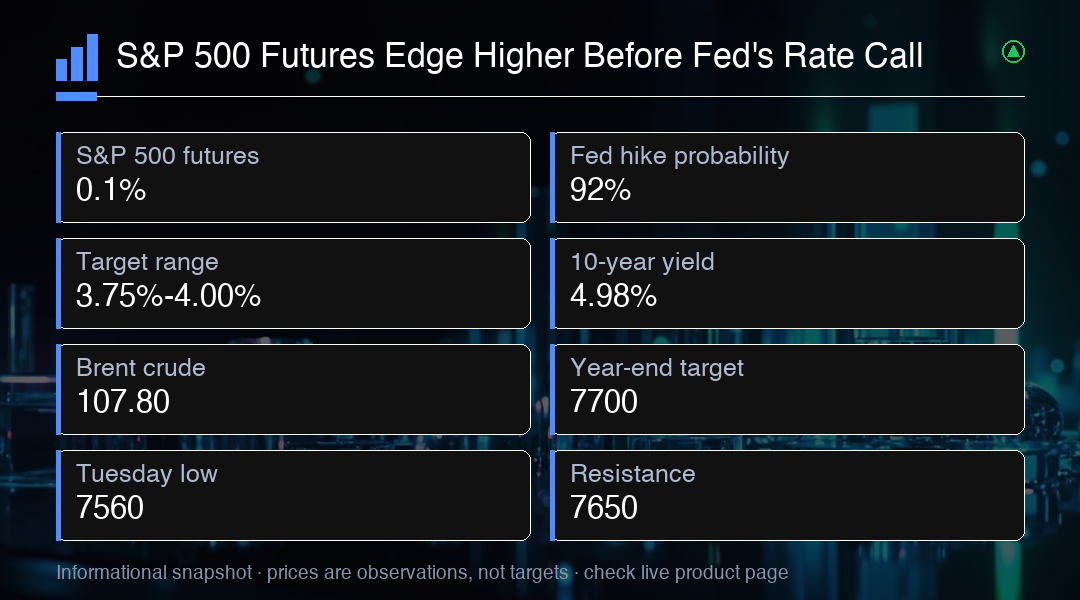
S&P 500 futures rose around 0.1% Wednesday, with Nasdaq 100 and Dow futures also fractionally higher. The calm follows another difficult session: the S&P 500 fell 0.5%, the Nasdaq Composite lost 0.8% and the Dow declined 0.6% as investors reduced risk before the Fed. Traders assign approximately a 92% probability to a 25-basis-point increase, which would lift the federal-funds target to 3.75%-4.00%. It would be the first hike since July 2023, an impressive policy reversal considering markets were still debating rate cuts earlier this year. The decision arrives at 2:00 p.m. ET, followed by Chair Kevin Warsh's press conference. The vote, updated dot plot and inflation projections may matter more than the hike itself.
The 10-year Treasury yield reached 5.04% Tuesday, its highest since 2007, before easing toward 4.98%. A 5% risk-free return gives investors a credible alternative to equities and raises the discount rate used to value future earnings : particularly inconvenient for expensive technology companies. Brent crude eased 0.9% to approximately 107.80 after US inventories unexpectedly increased by 7.1 million barrels, against expectations for a 1.6-million-barrel decline. For the S&P 500, prolonged disruption would favor energy producers while squeezing airlines, transport companies, manufacturers and consumer margins.
Asian trading was cautious. Japan's Nikkei hovered around flat as SoftBank dropped 4.2% and Kioxia lost 3.9%, extending the retreat in AI-linked shares. Energy company Eneos gained 3.8% and trading house Mitsui advanced 3%, another sign that leadership is rotating toward commodity exposure. The dollar held near recent highs, with EUR/USD around 1.1535, GBP/USD near 1.3470 and USD/JPY close to 155.43. The Bank of Japan is expected to raise rates to 1.25% Friday, meaning global markets could receive two major hikes within 48 hours. Gold remained near 4330 despite elevated yields, while Bitcoin fell roughly 2.5% toward 75900 after briefly testing 75000.
Broader expectations are becoming less ambitious. Wells Fargo reduced its year-end S&P 500 target to 7700 from 7950, arguing the economic cycle is entering its later stages and lacks strong new catalysts. With the index near 7600, that forecast leaves only modest upside from current levels. Right now, the immediate reference points are Tuesday's low near 7560 and the 7500 psychological area beneath it. Resistance sits around 7650-7700. The clean bullish combination would be a quarter-point hike, limited follow-up guidance and a retreat in yields; the bearish version is higher-for-longer with 108 oil attached.
For equity investors, the key challenge is that the Fed is navigating between competing priorities. On one hand, inflation remains above target, which argues for continued tightening. On the other hand, the economy is showing signs of slowing, which could argue for a more cautious approach. The dot plot will be closely watched for clues about the Fed's thinking. If the median dot shows only one more hike this year, that could be taken as a dovish signal. If it shows two or more, that could spook equity markets. The yield curve is also worth watching: if the 2s10s curve steepens after the decision, that could signal growing confidence in the economic outlook.
The rotation toward commodity exposure is a notable theme in recent sessions. Energy stocks have outperformed the broader market, while technology names have lagged. This could continue if oil prices remain elevated and the Fed maintains its hawkish stance. Investors should also keep an eye on the VIX, which has been rising ahead of the Fed decision. A spike in implied volatility could create opportunities for options sellers, but it also signals that the market is bracing for a potentially volatile session. The key level for the S&P 500 to watch is 7650, which has acted as both support and resistance in recent weeks.
The earnings season is approaching, and investors will be looking for signs that companies can maintain their profit margins in the face of rising input costs. The energy sector has been a bright spot, with oil prices above 100 dollars per barrel boosting the profits of energy producers. However, higher energy costs are a headwind for other sectors, particularly airlines, transportation companies, and manufacturers. The consumer discretionary sector is also under pressure, as higher interest rates and elevated inflation weigh on consumer spending.
The Federal Reserve's balance sheet reduction is another factor that could influence equity markets. As the Fed continues to shrink its holdings of Treasury securities and mortgage-backed securities, liquidity is being removed from the financial system. This could put upward pressure on long-term interest rates and make it more expensive for companies to borrow. The pace of balance sheet reduction will be closely watched by investors, as any acceleration could spook markets. For now, the immediate focus is on the Fed's rate decision and the guidance that accompanies it.
The earnings season is approaching, and investors will be looking for signs that companies can maintain their profit margins in the face of rising input costs. The energy sector has been a bright spot, with oil prices above 100 dollars per barrel boosting the profits of energy producers. However, higher energy costs are a headwind for other sectors, particularly airlines, transportation companies, and manufacturers. The consumer discretionary sector is also under pressure, as higher interest rates and elevated inflation weigh on consumer spending.
The Federal Reserve's balance sheet reduction is another factor that could influence equity markets. As the Fed continues to shrink its holdings of Treasury securities and mortgage-backed securities, liquidity is being removed from the financial system. This could put upward pressure on long-term interest rates and make it more expensive for companies to borrow. The pace of balance sheet reduction will be closely watched by investors, as any acceleration could spook markets.
Trading Insight
S&P 500 futures are pricing in a Fed hike, but the guidance will matter more than the decision. A dovish hike could spark a relief rally, while a hawkish stance may trigger further selling. Key levels are 7560 support and 7650-7700 resistance. The rotation toward commodity exposure is a notable theme, with energy stocks outperforming as oil remains elevated.