


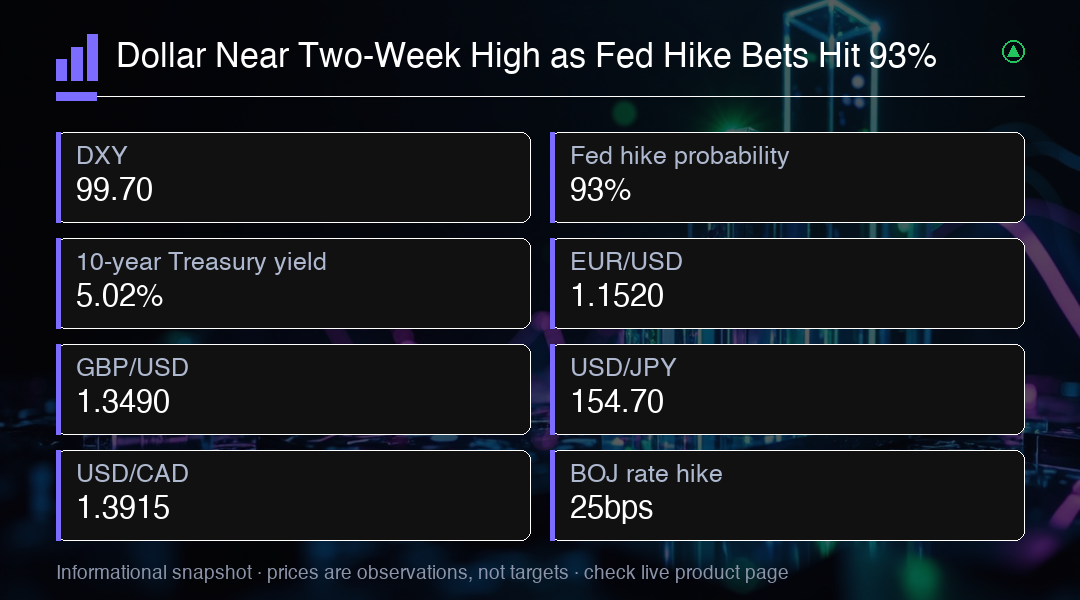
The US dollar index traded near a two-week high around 99.70 Tuesday. Higher oil prices, rising Treasury yields and weaker appetite for risk all supported the greenback as investors prepared for the Federal Reserve's latest policy decision. Markets now assign roughly a 93% probability to a quarter-point rate increase Wednesday, which would be the Fed's first hike in more than three years. Strong August employment, firmer inflation and renewed energy pressure have dismantled the previous case for leaving rates unchanged. The latest jobs report showed the economy added more positions than expected, keeping the labor market tight and giving the Fed room to tighten further without risking a sharp rise in unemployment. The unemployment rate remains near historic lows, and wage growth continues to run above the Fed's comfort zone.
The benchmark 10-year Treasury yield hit 5.02% this morning for the first time since 2007. Higher yields make dollar-denominated bonds more attractive, encouraging capital inflows while raising borrowing costs across the wider global economy. Across the board, the euro slipped to 1.1520, meaning one euro bought just under 1.16. The European Central Bank has already tightened policy, but the dollar retained the advantage as US yields climbed and investors sought shelter from weaker equity markets. The ECB faces its own dilemma, with growth in the eurozone slowing but inflation still above target. This divergence in central bank policy is a key driver of the dollar's strength.
Sterling eased to around 1.3490, while the yen advanced to roughly 154.70. The yen has pulled back from a seven-month high ahead of Friday's Bank of Japan meeting, where policymakers are widely expected to raise their policy rate by 25 basis points to 1.25%. The Canadian dollar traded near 1.3915. Rising oil would normally support the Canadian dollar because Canada is a major crude exporter, but broad US dollar strength and higher Treasury yields outweighed that benefit. The Bank of Canada is also in a tightening cycle, but the Fed's more aggressive stance has kept the dollar bid against the loonie.
Before the Fed even opens its mouth, the market has already decided there is a 93% chance of a quarter-point hike. The real question is what comes next. If the Fed signals a pause, the dollar could give back some of its recent gains. If it hints at more hikes to come, the greenback could push even higher. Wednesday's Fed guidance now decides whether the rally has legs to run. The dollar's recent strength has also been supported by a flight to safe-haven assets amid renewed concerns about the global growth outlook. Geopolitical tensions in the Middle East and uncertainty about China's economic trajectory have added to the demand for dollars.
For traders, the key variable is the Fed's forward guidance. A dovish hike could weaken the dollar and boost risk assets, while a hawkish stance would extend the greenback's rally. The Bank of Japan meeting on Friday adds another catalyst, with the yen's direction likely to influence broader FX sentiment. Currency markets are pricing in diverging central bank paths, with the Fed potentially pausing while the BOJ tightens further. The options market is pricing in elevated volatility around both central bank decisions. The dollar's strength is also being supported by safe-haven flows amid geopolitical uncertainty. Looking ahead, the 100 level in DXY is a key psychological barrier that could act as both a target and a resistance level.
Looking at the technical picture, the DXY has broken above its 50-day moving average and is now testing the 200-day moving average just below 100. A sustained break above this level could trigger a move toward the yearly highs near 102. On the other hand, a rejection at this level could lead to a retracement toward the 98 support zone. The relative strength index is approaching overbought territory, which could cap upside in the near term.
The British pound has been under pressure from concerns about the UK economy's growth outlook. The Bank of England faces a delicate balancing act, with inflation still above target but growth slowing. Governor Bailey's recent comments suggest that the BoE is in no hurry to cut rates, which could provide some support for sterling in the near term. However, the pound's performance against the dollar will largely depend on the Fed's stance.
For dollar traders, the key risk event is not just the rate decision but also the quarterly dot plot and economic projections. Fed Chair Powell's press conference will be scrutinized for clues about the path of policy in 2027 and beyond. Any hints that the Fed is considering a more hawkish stance could send the dollar sharply higher, while dovish signals could trigger a broad-based selloff.
The Canadian dollar has been caught in the crossfire between rising oil prices and a strong US dollar. Canada's economy is heavily influenced by commodity prices, and the recent surge in crude oil has provided some support for the loonie. However, the Bank of Canada's recent dovish pivot has weighed on the currency, and USD/CAD could continue to trend higher if the Fed maintains its hawkish stance. The Canadian housing market is also a concern, with high household debt levels making the economy vulnerable to higher interest rates.
Trading Insight
For traders, the key variable is the Fed's forward guidance. A dovish hike could weaken the dollar and boost risk assets, while a hawkish stance would extend the greenback's rally. The Bank of Japan meeting on Friday adds another catalyst, with the yen's direction likely to influence broader FX sentiment. Currency markets are pricing in diverging central bank paths, with the Fed potentially pausing while the BOJ tightens further. The options market is pricing in elevated volatility around both central bank decisions. The dollar's strength is also being supported by safe-haven flows amid geopolitical uncertainty. The 100 level in DXY is a key psychological barrier to watch.