


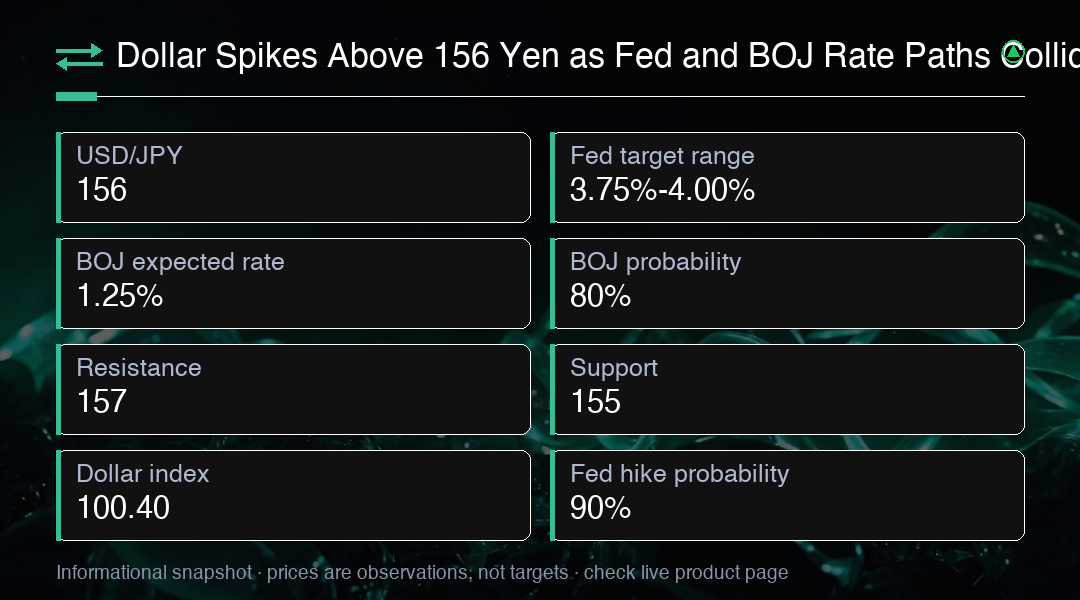
USD/JPY climbed toward 156 Thursday, up from roughly 155.10 at Wednesday's close, as the dollar reached a seven-week high against a basket of major currencies. Higher US rates and a surprisingly firm policy outlook restored some of the dollar's yield advantage. The yen has washed out some 300 pips from its valuation against the dollar in just three days. The Federal Reserve unanimously raised its policy rate by 25 basis points to 3.75%-4.00%, delivering its first increase since 2023. Policymakers also indicated that at least one more hike may be needed this year, pushing traders to reconsider hopes for an early end to tightening.
Even with Japan preparing to tighten, US yields remain substantially higher, making dollar-denominated assets more attractive and keeping upward pressure on the dollar-yen. The Bank of Japan is widely expected to raise its benchmark rate from 1.00% to 1.25% on Friday, which would be its highest level in 31 years. Markets place roughly an 80% probability on the move, leaving limited scope for the hike itself to surprise. The larger catalyst will be Governor Kazuo Ueda's press conference. A clear signal that inflation risks require additional increases could strengthen the yen. Cautious language or an emphasis on gradualism could weaken it.
Economists expect the policy rate to reach 1.5% by March 2027 and 1.75% during the following quarter. That trajectory would reduce the gap with the US, but only slowly unless the BOJ signals that inflation warrants a faster pace. The 156 area is the first important resistance zone, followed by roughly 156.50 and 157.00. A sustained move above those levels would strengthen the dollar's momentum, although it would also increase the risk of sharper warnings or action from Japanese authorities. Initial support sits around 155, with 154.50 and 154 below it.
The Fed's hawkish stance has broader implications for currency markets. The dollar index climbed to 100.40, its highest in seven weeks, as traders assigned roughly a 90% probability to another Fed increase this year. EUR/USD fell below 1.15, sterling weakened ahead of the BoE and USD/JPY topped 156 despite expectations for Japanese tightening. Gold recovered above 4,300 after its post-Fed decline. Bullion is balancing a stronger dollar and higher policy rates against geopolitical risk, fiscal concerns and easing long-term yields.
For USD/JPY traders, the key variable is the BOJ's forward guidance. A hawkish Ueda press conference could pull the pair toward 154.50, while dovish language may spark a rally toward 157. The options market is pricing in elevated volatility around the BOJ decision, suggesting traders are bracing for significant price swings. The put-call skew indicates that investors are hedging for downside risk, but there is also significant interest in upside calls. Position sizing and risk management become crucial in this environment.
Looking ahead, the interplay between Fed and BOJ policy will continue to drive USD/JPY in the weeks ahead. If the Fed signals another hike this year and the BOJ remains cautious, the dollar could bid higher against the yen. Conversely, if the BOJ signals a faster pace of tightening, the yen could strengthen. The key levels to watch are 156 resistance and 155 support. A sustained break above 156 could open the door to 157, while a break below 155 could expose 154.50.
The yen's weakness is also a concern for Japanese policymakers. A weak yen increases import costs, which could fuel inflation and erode household purchasing power. However, a weak yen also benefits Japanese exporters, making their products more competitive in international markets. This creates a delicate balancing act for the BOJ. If it tightens too aggressively, it could hurt exporters and slow economic growth. If it is too cautious, inflation could become entrenched. The central bank's decision is further complicated by the global economic outlook, which remains uncertain.
For traders, the key is to monitor the BOJ's forward guidance closely. If Ueda signals a faster pace of tightening, the yen could strengthen significantly, pulling USD/JPY toward 154.50 or lower. If he emphasizes caution, the dollar could bid higher, pushing the pair toward 157. The options market is pricing in elevated volatility, which suggests that traders are expecting a significant move. Position sizing and risk management are essential in this environment.
The yen's recent weakness has been driven by a combination of factors, including the interest rate differential between the US and Japan, the strength of the US economy, and the perception that the BOJ will remain cautious in its tightening. However, if the central bank signals a more hawkish stance, the yen could strengthen significantly. The key levels to watch are 156 resistance and 155 support. A break above 156 could open the door to 157, while a break below 155 could expose 154.50.
For position traders, the current environment requires careful risk management. The elevated options premiums suggest that the market is pricing in a significant move, but the direction remains highly uncertain. Stop-loss orders below 155 could help limit downside risk, while keeping some dry powder available to buy any dips could be a prudent strategy for longer-term investors. The interplay between real yields, the dollar, and BOJ policy will continue to drive USD/JPY in the weeks ahead. Position sizing and risk management are essential.
From a technical perspective, the USD/JPY pair is testing key resistance at 156. A sustained break above this level could open the door to 157 and potentially the yearly highs near 158. On the downside, initial support sits at 155, with 154.50 and 154 below it. The pair's near-term direction will likely be determined by the interplay between Fed and BOJ policy, as well as broader risk sentiment in global markets.
Trading Insight
USD/JPY's near-term direction hinges on the BOJ's forward guidance. A hawkish Ueda press conference could pull the pair toward 154.50, while dovish language may spark a rally toward 157. The options market is pricing in elevated volatility around the BOJ decision. Key levels are 156 resistance and 155 support.