


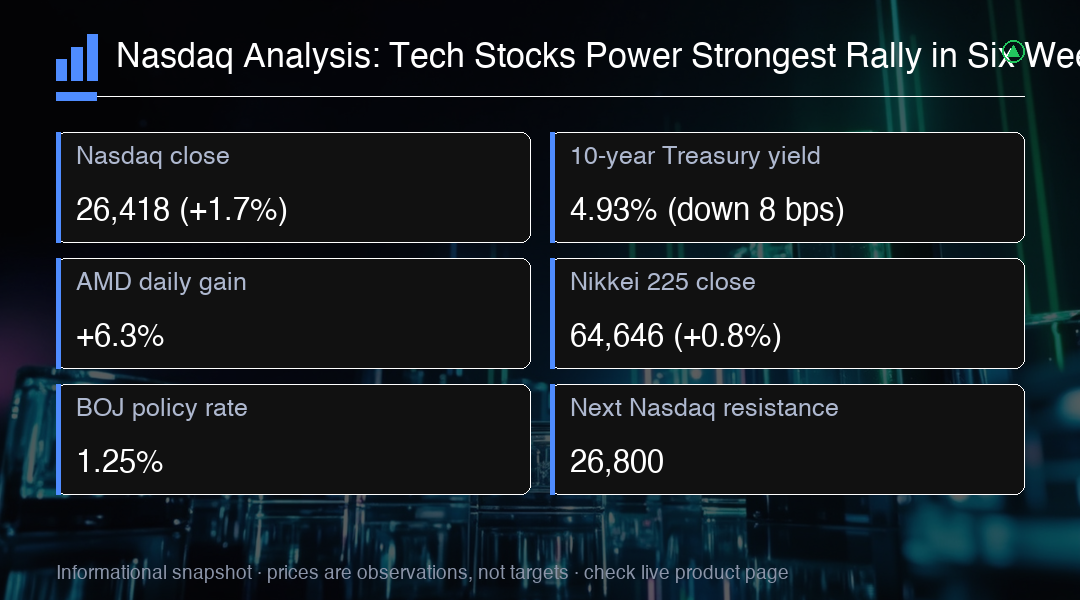
The Nasdaq Composite delivered its most decisive performance in six sessions on Thursday, surging 1.7 percent to close at 26,418 as a broad-based rebound in technology shares coincided with a pullback in Treasury yields and easing energy prices. The rally, the strongest since early August, propelled the tech-heavy index to fresh highs for the month and reignited bullish sentiment across growth sectors that had come under sustained pressure throughout the third quarter.
The advance was not confined to a single pocket of the equity market. The broad S&P 500 added 1.1 percent to build on its recent consolidation pattern, while the Dow Jones Industrial Average tacked on 316 points, reflecting a rare session in which both growth and value participation aligned in the same direction. The catalyst, according to market participants, was a confluence of receding yields, softer crude inventories, and a dovish tilt from the Bank of Japan that eased fears of a disorderly unwinding of yen carry trades that had previously rattled global risk appetite.
The most closely watched macro variable for rate-sensitive technology equities moved firmly in the right direction. The benchmark 10-year US Treasury yield fell eight basis points to 4.93 percent, retreating from the psychologically significant 5.01 percent threshold that had capped equity advances throughout the prior week. The decline in borrowing costs reduced the discount rate applied to future corporate earnings, a mechanical tailwind for growth stocks whose valuations are weighted toward cash flows further out on the yield curve.
The drop in yields was reinforced by a surprise build in US crude inventories that pushed West Texas Intermediate futures below the 78-dollar-per-barrel level. Lower energy costs dampened near-term inflation expectations and reinforced the growing narrative that the Federal Reserve may have sufficient room to maintain its current policy trajectory without resorting to additional tightening. For a market that had been pricing in elevated rates for an extended period, the combination of softer yields and cheaper oil was sufficient to unlock sidelined capital and drive a sharp rotation back into high-beta growth names.
Within the Nasdaq complex, semiconductor names provided the bulk of the index's upside. Advanced Micro Devices rallied 6.3 percent to extend a streak of aggressive outperformance driven by artificial-intelligence infrastructure demand and a broadening data-center buildout cycle. Nvidia, the sector's undisputed bellwether, added 2 percent in above-average trading volume, reclaiming key technical levels that had acted as stubborn resistance throughout August. The Philadelphia Semiconductor Index rose 3.4 percent, marking its best single-session performance in four weeks and signaling that the institutional rotation back into chip names may still have room to run.
The semiconductor rally was supported by incremental order-flow data from Asian supply-chain partners that suggested fabrication utilization rates are set to climb into year-end. Investors had been underweight chip names since the sector's late-summer correction, and Thursday's price action suggests that positioning is being adjusted aggressively to the upside as the fundamental backdrop for AI capital expenditure continues to strengthen. The results echo a broader theme in equity markets: that the artificial-intelligence investment cycle, while prone to sharp corrections, remains structurally intact and is entering a new phase of geographic and customer diversification.
In a move that carried significant implications for global risk appetite and currency markets, the Bank of Japan raised its policy rate to 1.25 percent. The decision initially rattled markets but was ultimately absorbed without the violent yen strengthening that traders had feared. The central bank's accompanying statement emphasized a gradual pace of further normalization, which limited the carry-trade unwinding that had triggered sharp equity declines in early August and forced a rapid de-risking of leveraged positions across multiple asset classes.
The Nikkei 225 rose 0.8 percent to close at 64,646, reflecting market relief that the BOJ's tightening cycle will be measured rather than abrupt. The steadier yen environment removes one of the key overhangs that had kept a lid on US equity multiples over the past month. For Nasdaq analysis specifically, the stabilization of the yen is critical because it reduces the risk of forced liquidation in US technology holdings by Japanese institutional investors who had been hedging their dollar exposure at increasingly unattractive levels.
From a technical perspective, Thursday's breakout above the 26,200 level opens a path toward the 26,800 zone, which represents the next band of resistance drawn from the July highs. A sustained move above that level would confirm that the August-to-September consolidation has resolved to the upside and potentially target the all-time high region near 27,000, a psychologically important threshold that could trigger additional momentum buying from systematic and trend-following strategies.
However, seasoned observers caution that the current rally is not without vulnerabilities. The move in Treasury yields, while constructive for equity multiples, remains within a broader uptrend that has defined the past twelve months. Any reversal back above the 5.0 percent level in the 10-year would likely cap equity upside and reignite concerns about valuation compression. Similarly, the semiconductor rotation has been sharp and concentrated, and profit-taking near the 26,800 resistance area should be expected as short-term traders look to monetize gains.
Looking ahead, US equity futures were flat in Asian trading on Friday, suggesting that Thursday's move was a genuine repricing rather than a short-lived short squeeze. The fact that the advance occurred on above-average breadth, with advancers outpacing decliners by a three-to-one margin on the Nasdaq, supports the thesis that the rally has room to run and is being driven by broad-based institutional participation rather than narrow speculative activity.
For the coming sessions, the path of least resistance appears to be higher. The combination of moderating yields, easing energy costs, and a measured Bank of Japan provides a favorable backdrop for growth equities heading into the final quarter. Thursday's action suggests that institutional allocators are rebuilding exposure to the technology complex, and follow-through buying will be critical to confirming that this marks the start of a sustained advance rather than a one-day reversal in an otherwise range-bound market. Traders will be watching the 10-year yield closely, as any re-acceleration toward 5.10 percent would likely invalidate the constructive setup and force a reassessment of the current risk-on positioning.
Trading Insight
Thursday's breakout confirms a short-term bullish bias for the NAS100, with the 26,200 level now acting as immediate support. The convergence of lower yields, softer oil, and a stabilized yen creates a favorable macro backdrop. A sustained push above 26,800 would open the door to a retest of the all-time highs near 27,000. Traders should monitor the 10-year yield for any reversal above 5.0%, which would threaten the current setup. The 6.3% surge in AMD and broad semiconductor strength suggest that sector rotation into chip names remains a key theme worth tracking.