


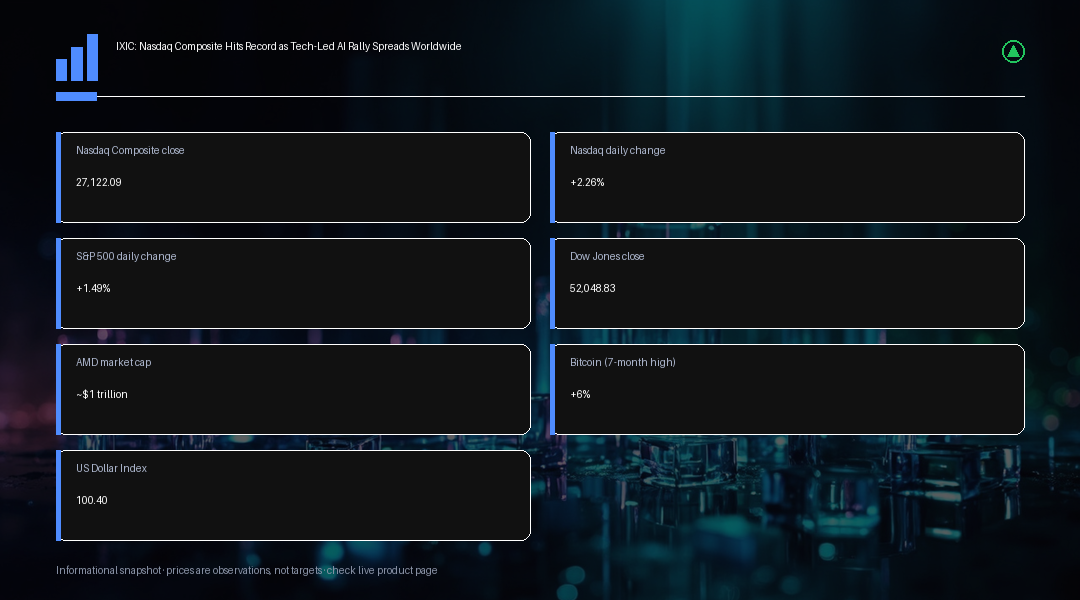
The Nasdaq Composite surged 2.26% on Monday to a record close of 27,122.09, its first record finish since June, as renewed enthusiasm for AI-linked shares lifted Wall Street and encouraged buyers who had been sitting on the sidelines through several uneasy sessions. The S&P 500 added 1.49% and the Dow Jones Industrial Average rose 0.71% to 52,048.83, while Nasdaq futures were still pointing about 0.4% higher in early Tuesday trading, extending the advance into a second session.
The spark was Meta's Muse AI assistant, whose strong early reception and an accompanying Wells Fargo price-target increase sent Meta shares up 11.4% and reignited the wider semiconductor trade. AMD rallied roughly 10% and moved toward a $1 trillion market capitalization, Intel climbed about 12.2%, Arm surged around 17%, and the Philadelphia Semiconductor Index advanced 4.3%. Investors linked the move across chipmakers to expectations that broader adoption of AI agents will translate into materially higher demand for processors and cloud infrastructure, treating Monday's session as much as an infrastructure story as a single-stock rally.
The rally carried into Asian trading, with South Korea's Kospi gaining nearly 2% and Taiwan's benchmark rising 1.3%. China's CSI 300 added 0.75% and Hong Kong's Hang Seng advanced 0.4%, with regional AI-linked names outperforming the broader market, while Japanese exchanges remained closed for a holiday and missed the session entirely. The breadth of the move, spanning US megacaps, semiconductor suppliers and Asian technology names alike, pointed to a rally reinforced by more than one catalyst rather than a single headline.
Bitcoin added to the risk-on tone, rising more than 6% to its highest level in over seven months as it pushed through resistance that had capped previous advances earlier in the year. The US dollar, meanwhile, held its ground despite the broader appetite for risk assets: the dollar index remained close to a seven-week high near 100.40 and USD/JPY traded around 157.40, an unusual combination given that a strong risk-on rally would typically be expected to reduce demand for defensive currencies. Falling oil prices and retreating Treasury yields were cited as additional supportive factors for equities, alongside broader geopolitical developments including expectations around upcoming US-China and US-Iran discussions.
The record close is the Nasdaq's first since early June, a detail that adds useful context for traders assessing how much of the current advance reflects a genuine re-rating of AI-linked earnings power versus a rebound from an oversold, uneasy stretch for growth stocks. Because much of Monday's move traces back to enthusiasm around a single product launch, the durability of the rally will depend on whether Muse's early traction, and the AI-agent theme more broadly, continues to translate into concrete demand signals for chipmakers and cloud providers rather than fading as a one-session sentiment spike.
It is worth being precise about how much of Monday's advance can be attributed to a single catalyst. Meta's Muse launch was the clearest headline driver, but investors also pointed to falling oil prices, retreating Treasury yields and a generally calmer geopolitical backdrop as supportive conditions that had been building before the session began. That combination of factors, rather than any single announcement, is a more reliable explanation for why the rally had the breadth it did across software, semiconductors and regional Asian markets rather than staying confined to Meta and its immediate AI-agent peers.
The move also illustrates how tightly linked the AI-agent theme has become across asset classes this year. A consumer product launch at a single social-media company was enough to move semiconductor names, index futures, and even Bitcoin in the same direction on the same day, a level of cross-asset correlation that traders should treat as a feature of the current market structure rather than a coincidence. That correlation cuts both ways: just as good news at one AI-linked company can lift the group, a stumble, whether from Meta or from any of the chipmakers that rallied alongside it, has the potential to pull the same assets back down together.
For index-level positioning, the record close also raises the bar for what would qualify as a disappointment. With the Nasdaq now at an all-time high and the rally underpinned by expectations of durable AI-agent demand, upcoming data points, including this week's flash PMI releases and any incremental detail from Meta Connect, will be measured against an increasingly optimistic baseline. That dynamic tends to raise volatility risk around scheduled events even when the underlying economic backdrop, marked by a resilient dollar and stable Treasury yields, has not changed dramatically session to session.
None of this means the rally is without risk. A record high built substantially on a single company's product launch is inherently more fragile than one built on broad-based earnings improvement, and traders should be alert to the possibility that Monday's move gets partially unwound if Meta Connect fails to deliver fresh detail or if any of the chipmakers that rallied alongside Meta report disappointing guidance in the weeks ahead. Until then, the combination of a record Nasdaq close, a firmer Bitcoin and a resilient dollar leaves the market in an unusually broad risk-on posture that will be tested by the next round of scheduled data and central-bank commentary.
Trading Insight
For traders, the breadth of Monday's rally, spanning software, semiconductors and Asian equities together with a firmer Bitcoin, is a more important signal than the headline index gain itself, because it suggests positioning had become stretched to the downside rather than reflecting a single-stock event. A push toward fresh Nasdaq highs would likely need continued confirmation from AI-adjacent earnings and capital-expenditure commentary, including this week's Meta Connect event, while a reversal in chip names or a stalling in Muse's download momentum would be the clearest early warning that Monday's move was sentiment-driven rather than structural. The dollar's resilience alongside the equity rally is also worth watching: a break of the dollar index below the 100 level would suggest falling oil prices and softer Treasury yields are starting to dominate the macro narrative, which would likely support further upside in risk assets, while a renewed dollar bid alongside softening breadth in technology shares would be the more cautious combination for index bulls to watch heading into flash PMI data and scheduled Federal Reserve commentary later this week.