


EUR/USD slid toward $1.1430 this week, its weakest level in ten weeks, extending a decline of roughly 280 pips, or about 2.4 percent, over the past month. The move has unfolded in an orderly fashion rather than through a single sharp break, consistent with a gradual rebuilding of long-dollar positioning as traders reassess how much further US interest rates may need to rise. The dollar index has climbed toward a multi-week high above 100.60 during the same stretch, underscoring how broad-based the greenback's advance has been rather than a story confined to the single currency pair.
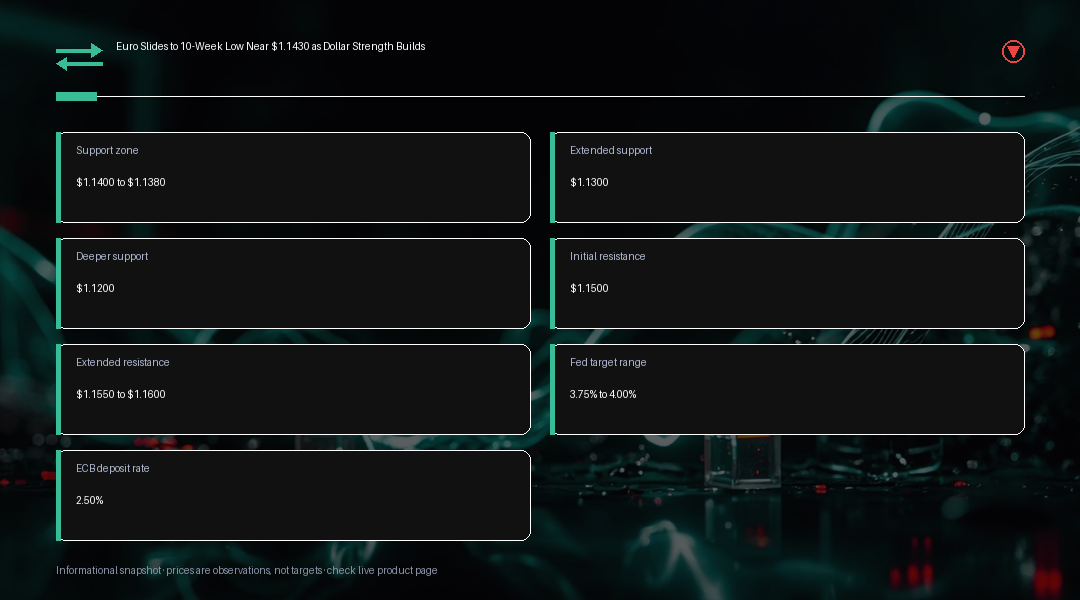
The catalyst behind the latest leg lower is a widening policy gap between the Federal Reserve and the European Central Bank. The Fed raised its target range by a quarter point to 3.75 percent to 4.00 percent in mid-September, and its updated projections showed most policymakers still expect at least one more increase before year-end. Market pricing for an additional move at the Fed's next meeting has hovered near the 50 percent mark in the days since the decision, though that probability is time-sensitive and shifts with each new data print, so it should be read as a market-implied snapshot rather than a locked-in outcome.
The European Central Bank has also tightened policy, lifting its deposit rate to 2.50 percent, yet the move has done comparatively little to support the euro. ECB officials, including Vice President Boris Vujcic, have cautioned that persistently high energy costs could eventually weigh on household consumption and broader economic growth, complicating the case that higher European rates are unambiguously currency-positive. In effect, US tightening is being priced against a backdrop of resilient American growth, while European tightening is being priced against a backdrop of energy-driven growth risk, and that asymmetry is what has kept the rate differential working in the dollar's favor.
Energy remains an important secondary driver for the pair given Europe's greater reliance on imported energy compared with the more energy-independent United States. Reports late this week pointed to a possible, though unconfirmed, easing of tension around the Strait of Hormuz, a development that could reduce the immediate energy premium weighing on the euro area if it materializes. Traders should treat that possibility as conditional rather than settled, since a durable resolution would need to hold for the structural improvement in Europe's terms of trade to show up meaningfully in the currency.
From a technical standpoint, the pair's next major test sits in the $1.1400 to $1.1380 zone, an area that combines a round psychological level with the region around the prior month's lows. A daily close beneath that band would point to a deeper corrective phase toward $1.1300 and, if selling pressure extends, the broader $1.1200 region. On the upside, $1.1500 is the first level that would begin to ease the immediate bearish tone, with further recovery levels at $1.1550 and $1.1600 marking the point at which the broader downtrend would come into question.
For active traders, the setup argues for a conditional rather than one-directional read. While EUR/USD remains capped below the $1.1500 and $1.1600 levels, rallies are more likely to attract sellers as long as Fed policy expectations and dollar safe-haven demand stay firm. A sustained break of $1.1400 would reinforce the bearish structure and open the door to the lower support bands, while a recovery back above $1.1500 would meaningfully reduce near-term downside pressure and invite a reassessment of the trend. Key swing factors to monitor include upcoming US economic releases, any shift in Fed rhetoric around the pace of further tightening, ECB communication on the growth-inflation trade-off, and headlines around European energy supply.
It is worth separating what is confirmed from what remains market interpretation. The Fed's rate decision and the ECB's deposit rate move are settled facts, and the roughly 280 pip decline over the past month is a straightforward reading of the price chart. The 53 percent hike probability, by contrast, is a snapshot of futures pricing that can shift meaningfully within days as fresh inflation and labor market data arrive, and the Strait of Hormuz reporting remains conditional rather than a confirmed change in energy supply. Treating these categories differently helps explain why the pair can still see two-way volatility even while the broader dollar-strength narrative remains intact.
Positioning discipline matters more than usual given how many moving parts are feeding into this trade at once. A trader leaning into continued dollar strength is effectively expressing a view on three things simultaneously: that the Fed follows through on further tightening, that the ECB's hands stay tied by energy-linked growth concerns, and that no durable de-escalation in regional energy risk emerges to relieve pressure on the euro. Because any one of those three assumptions could shift on short notice, scaling into positions around the defined support and resistance bands, rather than committing full size on a single signal, is the more conservative way to trade this setup over the coming sessions.
Trading Insight
The dominant theme is a policy and growth divergence rather than a single data point, so positioning should be built around the $1.1400 and $1.1500 boundaries rather than around any one headline. A confirmed break of support would favor continuation toward $1.1300 and $1.1200, while a reclaim of $1.1500 and then $1.1550 to $1.1600 would be the signal that the corrective phase is stalling. Risk management matters given the amount of event risk still ahead: further Fed commentary, ECB officials addressing the energy-growth trade-off, and any tangible progress on regional energy supply could each move the pair quickly in either direction, and leveraged forex positions should be sized accordingly. As with any macro-driven currency trade, traders should also watch correlated markets such as the dollar index and euro-area bond yields for confirmation, since a genuine shift in the policy divergence story tends to show up across several related instruments at once rather than in EUR/USD alone.