


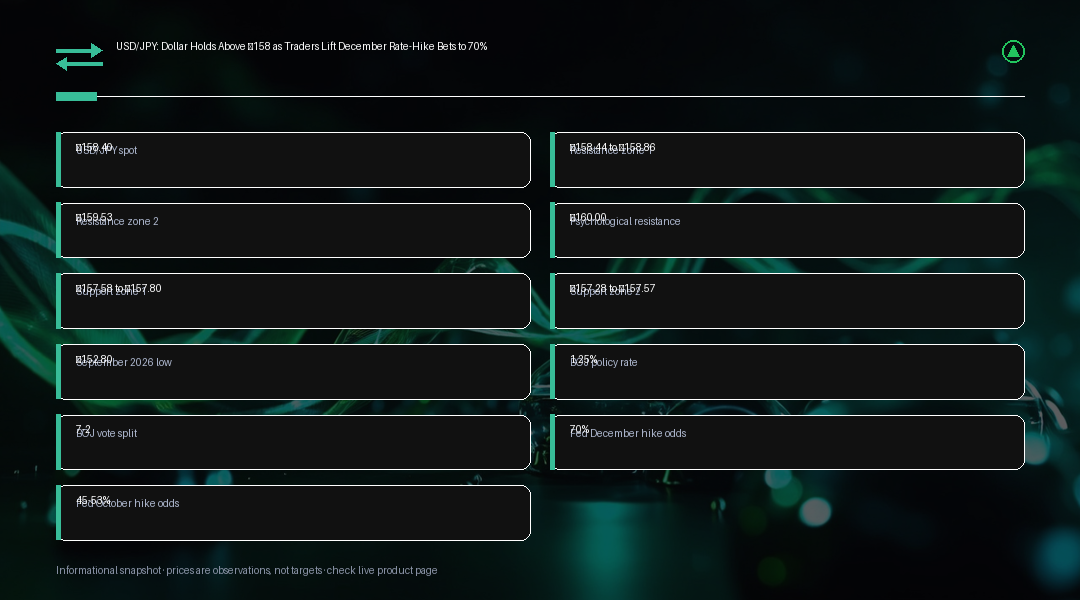
USD/JPY: Dollar Holds Above ¥158 as Traders Lift December Rate-Hike Bets to 70% The dollar-yen pair was trading near ¥158.40 as of September 24, 2026, consolidating a recovery that has carried the pair from a September low around ¥152.80 back into the upper 158 handle. The move reflects a widening policy gap between the Federal Reserve and the Bank of Japan, and traders are now framing the next leg of the trade around how quickly, and how far, that gap can extend into year-end. Fed pricing has been the main engine behind the dollar's advance. Odds of an October rate increase have risen from roughly 37% earlier in September to near 45-53% currently, while the probability of at least one more Fed hike by December has climbed toward 70%. That repricing has been driven by persistent inflation readings, resilient US activity data and firmer energy prices, all of which have pushed Treasury yields higher and improved the dollar's carry advantage over the yen. The distinction between the October and December windows matters for positioning: the market is not yet convinced the Fed moves at its very next meeting, but it is increasingly confident that one more hike arrives before the year is out. The immediate test for the dollar leg of this trade is whether upcoming US data confirms that repricing. Firm inflation, employment or activity numbers would likely keep Treasury yields elevated and continue to support the dollar's advantage over lower-yielding currencies including the yen. A softer data surprise, on the other hand, could unwind part of the move quickly, particularly if traders conclude that a year-end Fed hike is already priced in and there is little room left to add to dollar longs on the back of it. On the Japanese side of the equation, the Bank of Japan raised its policy rate by 25 basis points to 1.25% on September 18, 2026, the highest level in 31 years, but the decision was far from unanimous, passing on a 7-2 vote. Governor Kazuo Ueda offered only limited guidance on the pace of any further increases, saying the central bank intends to assess conditions meeting by meeting rather than commit to a preset schedule. For currency traders, that lack of a clear path matters more than the size of the move itself. If the BOJ continues to hike cautiously while the Fed remains willing to tighten further, the interest-rate differential can continue to favor dollar strength even after this month's increase. Japanese officials are watching the yen's slide closely. Finance Minister Satsuki Katayama, retained in a September 16 cabinet reshuffle, has repeatedly warned that Tokyo stands ready to act against excessive currency moves, and authorities have already conducted rate checks with commercial banks, a step that is often read as a precursor to more direct intervention. That backdrop adds a layer of two-way risk to what otherwise looks like a straightforward dollar-strength trade: a sudden verbal escalation or an actual intervention could trigger a sharp, fast reversal regardless of the underlying rate story. From a technical standpoint, the pair is approaching a cluster of resistance between ¥158.44 and ¥158.86, which lines up with the 200-day and 50-day moving averages, with the 100-day average near ¥159.53 forming the next barrier above that. A sustained break above ¥159.53, the 100-day moving average, would open the door toward the psychologically significant ¥160.00 level and a larger Fibonacci-based extension beyond it. On the downside, initial support sits between ¥157.58 and ¥157.80, with a secondary shelf around ¥157.28 to ¥157.57. A break below that zone would weaken the current recovery structure and put the September low near ¥152.80 back in focus as the larger downside reference for the move. Beyond the immediate technical setup, the broader macro backdrop reinforces why this dollar-yen move has drawn such close attention from traders across asset classes. The Fed's policy path is being read alongside other US data points, including labor-market resilience and elevated energy costs, both of which keep upward pressure on inflation expectations and, in turn, on the front end of the Treasury curve. A widening gap between US and Japanese short-term rates has historically been one of the more reliable drivers of sustained USD/JPY trends, and the current setup, with the Fed still willing to consider another move while the Bank of Japan signals only gradual, data-dependent steps, fits that pattern closely. That said, currency markets rarely move in a straight line once intervention risk becomes a live consideration, and Japanese officials have shown in the past that verbal warnings can slow a trend even before any actual market operation takes place. Traders extending dollar-yen exposure toward the ¥160.00 area should therefore weigh not only the Fed-BOJ rate story but also the political tolerance in Tokyo for further yen weakness heading into the final quarter of the year. Traders should treat any approach toward ¥160 as a policy-risk event rather than a simple technical breakout, given how closely Tokyo is watching the pair at these levels. The bullish dollar case remains strongest while US rate expectations continue to firm and the Bank of Japan stays cautious on the pace of further hikes. A softer US data surprise, a more hawkish tone from Governor Ueda, or another round of Japanese rate checks could each produce a fast reversal in either direction, so position sizing around these levels should account for that binary policy risk sitting on top of the usual data calendar.
Trading Insight
The dominant driver here is the widening gap between how quickly the Fed and the Bank of Japan are each willing to move, so the trade is best framed around that policy divergence rather than any single headline. Active traders should watch the ¥158.44 to ¥158.86 resistance band as the near-term battleground: a clean close above it opens the path toward ¥159.53 and then the psychologically important ¥160.00 level, while rejection there would put the ¥157.58 to ¥157.80 support shelf back in play. A confirmed break below ¥157.28 would shift the focus toward the September low near ¥152.80. Because both the Fed's December pricing and the Bank of Japan's meeting-by-meeting guidance remain fluid, traders should size positions with an eye on intervention risk from Japanese authorities, who have already conducted rate checks and could escalate quickly if the yen weakens further. Cross-asset confirmation from US Treasury yields and the broader dollar index can help validate whether a move in USD/JPY reflects genuine policy repricing or a shorter-term technical extension, and any leveraged exposure around the ¥160.00 area should account for the possibility of a fast, policy-driven reversal rather than a smooth technical breakout.