


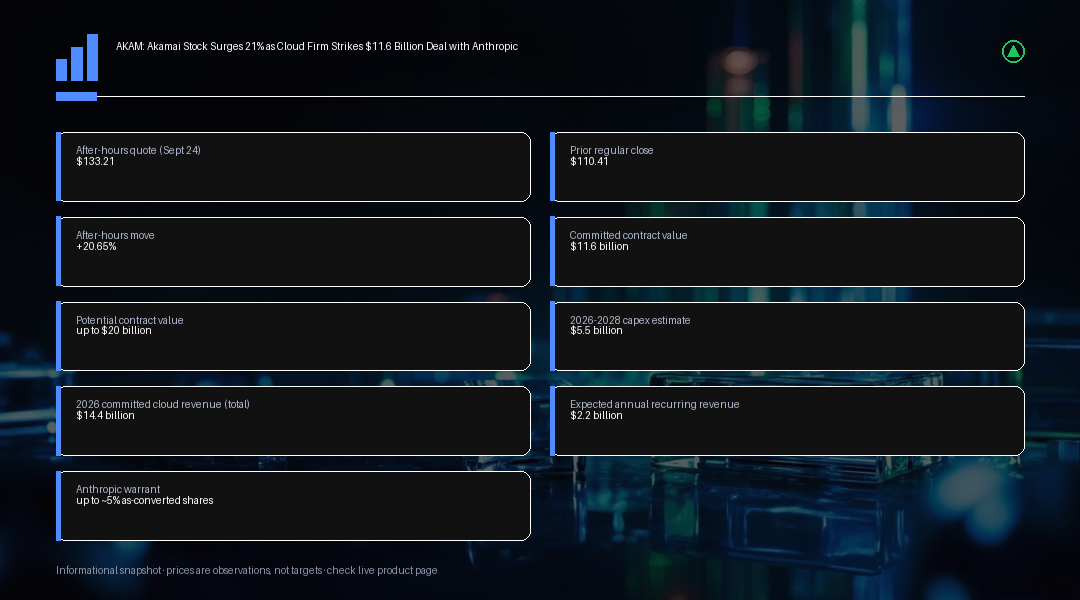
Akamai shares jumped sharply in after-hours trading on September 24, quoted around $133.21 versus a $110.41 regular-session close, a move of about 20.65 percent, after the company disclosed a seven-year, $11.6 billion contractual commitment from Anthropic covering cloud infrastructure capacity. The agreement expands an existing relationship between the two companies and stands as the largest contract in Akamai's history, with a potential path to $20 billion in total value if Anthropic exercises an additional $9 billion of purchases on mutually agreed terms.
The deal gives Akamai a meaningfully larger role behind one of the fastest-growing customers in artificial intelligence. Anthropic will draw on Akamai's distributed cloud infrastructure and software to support rapidly expanding compute workloads tied to its Claude model family, and for Akamai, landing one of the sector's largest AI buyers narrows the gap between its cloud business and the hyperscale incumbents, Amazon, Microsoft and Google, that have dominated AI infrastructure spending to date.
One detail largely missing from initial headlines is a warrant Anthropic received as part of the arrangement: non-voting convertible preferred stock that could convert into up to roughly 5 percent of Akamai's common shares on an as-converted basis, with vesting tied to the initial commitment and further vesting linked to any expansion toward the $20 billion ceiling. That warrant is a real economic term of the deal and a potential dilution factor for existing shareholders, even as it also signals how much value Akamai was willing to share to secure the relationship.
Revenue from the agreement will arrive well after the headline number. Akamai has said the contract carries no impact on its 2026 revenue guidance, with initial revenue expected in the second half of 2027, in a range of roughly $150 million to $300 million, before ramping toward an annualized run rate near $1.7 billion by the end of 2028. Management has described the structure as take-or-pay once capacity ramps, meaning Anthropic would be obligated to pay for agreed computing capacity as it comes online, though the full contractual detail behind that characterization has not been independently reviewed and should be treated as management's stated framing for now.
Layered on top of other cloud-infrastructure contracts signed this year, Akamai's total committed cloud revenue now stands at roughly $14.4 billion, which the company expects to generate about $2.2 billion in annual recurring revenue once fully operational. That would represent a meaningful shift in Akamai's overall growth profile if it plays out as management expects, transforming a business long overshadowed by larger cloud rivals into a more credible infrastructure partner for AI-native companies.
Building that capacity will not be inexpensive. Akamai has guided to roughly $5.5 billion of capital expenditure tied to the Anthropic commitment spread across the 2026 to 2028 window, including about $1.7 billion in the fourth quarter of 2026, largely to secure memory and other critical components, followed by $3.1 billion during 2027 and a further $700 million in 2028 as the remaining capacity comes online. Management has flagged that margins could face temporary pressure during this buildout, since data centers, equipment and power all need to be in place before the corresponding revenue reaches full speed.
Akamai has also pointed to power requirements as a scale indicator, estimating that its recently signed AI-cloud contracts will require between 95 and 105 megawatts of capacity, with an expected benchmark of roughly $22 million in annual revenue per megawatt once fully ramped. Those figures have not been independently verified from primary materials reviewed for this analysis and should be treated as company-disclosed estimates rather than confirmed facts pending further disclosure.
The deal also has to be read against the backdrop of a broader AI infrastructure spending race in which every major cloud provider, and now several specialized infrastructure players, are racing to sign long-duration compute commitments with the handful of frontier AI labs capable of consuming capacity at scale. Anthropic joins a list of AI developers that have struck multi-billion-dollar infrastructure agreements this year, and for a company the size of Akamai, capturing even a portion of that spending is transformative in a way it would not be for a hyperscaler many times its size. That scarcity dynamic, a relatively small number of AI buyers with enormous compute needs, is part of why investors reward headline commitments like this one so quickly, even before the associated revenue shows up in reported numbers.
It also raises a set of questions that will matter more as the contract details become clearer over coming quarters. Customer concentration is one: a single seven-year commitment this large ties a meaningful share of Akamai's future growth to the continued success and capital position of one customer, Anthropic, whose own funding and revenue trajectory investors will need to track alongside Akamai's own execution. Execution risk is another: building 95 to 105 megawatts of dedicated capacity on a multi-year timeline is a substantial operational undertaking, and any slippage in the 2026 to 2028 capex schedule would likely delay the revenue ramp that is currently expected to begin in the second half of 2027.
For now, the market's reaction treats the announcement as a clear net positive, lifting Akamai's shares by roughly a fifth in a single after-hours session. Whether that repricing holds will likely depend less on the headline $11.6 billion figure and more on how cleanly Akamai can execute the buildout, how the warrant and any future contract amendments are eventually disclosed in full, and whether the promised annual recurring revenue of about $2.2 billion across its 2026 cloud-infrastructure book starts to show up in reported results on the timeline management has laid out.
For a cloud infrastructure business that has spent years competing in the shadow of the largest hyperscalers, a headline deal of this size with one of the AI sector's most closely watched customers is a significant vote of confidence, even as the real financial payoff will take years, not quarters, to show up in Akamai's numbers. The market's after-hours reaction reflects optimism about that longer-term trajectory as much as it reflects any change to Akamai's near-term earnings picture.
Trading Insight
The headline number, $11.6 billion over seven years with a possible path to $20 billion, is the reason Akamai jumped in after-hours trading, but traders should not read that as an immediate earnings catalyst. Akamai has said the deal carries no impact on 2026 revenue guidance, with meaningful contribution not expected until the second half of 2027 and a fuller ramp only by the end of 2028. That gap between the headline commitment and the cash-flow timeline is exactly why the stock's after-hours pop needs to be treated as a repricing of Akamai's multi-year growth story rather than confirmation that near-term numbers are about to jump. The warrant Anthropic received, worth up to roughly 5 percent of Akamai's shares on an as-converted basis, is also worth watching as a dilution factor once more contract detail becomes public. Traders following AKAM into upcoming earnings updates should focus on capex execution through 2028, whether the take-or-pay structure holds up as described, and how the deal is layered against Akamai's other 2026 cloud-infrastructure wins, which already total roughly $14.4 billion in committed revenue.