


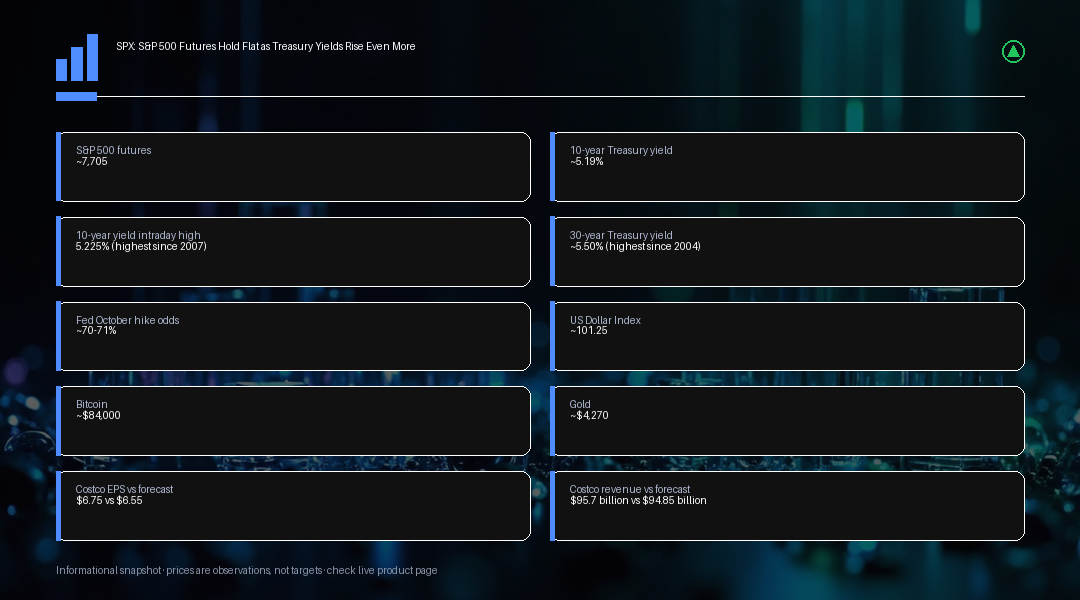
S&P 500 futures were little changed near 7,705 on Friday after the cash index finished the prior session almost perfectly flat, a calm surface that masks a much more dramatic story unfolding in bonds. Equities pared sharper intraday losses earlier in the week on reports that the United States and Iran were exploring a path toward reopening the Strait of Hormuz, and with no major scheduled catalysts on Friday's calendar, traders largely used the session to pause and regroup after a volatile stretch.
The bigger move by far is happening in Treasuries. The 10-year yield climbed to roughly 5.19 percent after touching an intraday high of 5.225 percent, its highest level since 2007. The 30-year yield reached about 5.50 percent, a level last seen in 2004, and average US mortgage rates have moved back above 7 percent as a result. Markets were pricing in roughly a 70 to 71 percent probability of another Federal Reserve rate hike at the October meeting, up sharply from about 53 percent earlier in the same week, with more than 90 basis points of additional tightening priced across the cycle. The idea that September's hike would be a one-and-done move has clearly lost favor in a hurry.
Asia produced a mixed session overnight. Japan's Nikkei gained about 1 percent, Hong Kong's Hang Seng fell roughly 1 percent, and Australian shares lost about 0.6 percent, while mainland China, South Korea and Taiwan were closed for a holiday, leaving the region's broader tone roughly balanced. High-level talks between the US and China in Washington have so far delivered little visible progress on trade, artificial intelligence, Taiwan or Iran, and that lack of a breakthrough weighed modestly on sentiment in Hong Kong without triggering a sharper risk-off reaction elsewhere.
The pressure from rising bond yields is not confined to the United States. Japan's 10-year yield has pushed above 3.1 percent, its highest level since 1996, while Australia's 10-year yield sits near 5.4 percent, close to a multi-year high of its own. Higher yields globally raise financing costs and reduce the relative appeal of richly valued equities, a dynamic that weighs disproportionately on technology and other long-duration growth stocks whose expected profits sit further out on the horizon.
The US dollar has firmed alongside the move in yields, with the Dollar Index heading for a weekly gain of roughly 1 percent near 101.25, its strongest level since late July. A stronger dollar supports the currency itself but creates an additional headwind for US multinationals by reducing the translated value of revenue earned overseas. Oil prices added another layer to the inflation picture after Brent crude surged roughly 3 percent on Thursday following a Houthi missile attack on Saudi Arabia, before easing back into a broad range in the region of $100 to $106 a barrel on Friday. Energy producers benefit from the higher prices, but the wider index faces the offsetting risk of stronger inflation and potentially tighter Fed policy as a result.
Bitcoin held around $84,000 while gold stayed on the back foot near $4,270 an ounce early Friday, both consistent with an environment where climbing Treasury yields make non-yielding and speculative assets harder to defend. A further leg higher in yields would likely keep pressure on both markets, since the opportunity cost of holding non-income-generating assets rises alongside real rates.
Beneath the index-level calm, single-stock catalysts drove real dispersion. Akamai surged in extended trading after disclosing a seven-year, $11.6 billion cloud-infrastructure agreement with Anthropic, a deal with a potential path to $20 billion in total value. Costco reported quarterly earnings of $6.75 a share on revenue of $95.7 billion, both ahead of forecasts of $6.55 and $94.85 billion respectively, though the muted after-hours reaction suggested investors wanted more than a solid but unspectacular quarter from a stock already carrying a premium valuation. Meta gained about 4.5 percent on Thursday as enthusiasm continued to build around its Muse AI product, while Oracle fell nearly 5 percent and several semiconductor names weakened under the pressure of higher yields.
Periods where equity indices hold steady while bond yields climb sharply are not unprecedented, but they have historically tended to be transitional rather than stable states. In past cycles, a sustained push in long-term yields toward multi-decade highs has eventually forced a re-rating in equities, either through a valuation reset in the most rate-sensitive, long-duration corners of the market or through a broader risk-off move once yields reach a level that visibly damages growth expectations. With the 10-year yield now at its highest since 2007 and the 30-year at levels last seen in 2004, the S&P 500's ability to stay near record territory increasingly depends on earnings growth, and particularly AI-linked capital spending, continuing to outrun the drag from higher discount rates.
The risk scenario worth watching is a further acceleration in Fed-hike pricing beyond the current 70 to 71 percent probability for October. If incoming inflation or labor data pushes that probability decisively higher, or if the Fed itself signals a more hawkish reaction function at its next meeting, the resulting move in yields could happen quickly enough to force a more disorderly repricing across equities, credit and currency markets simultaneously, rather than the relatively contained cross-asset adjustment seen so far this week. Conversely, any softening in the data that pulls hike odds back down would likely be read as a relief catalyst for both bonds and the more rate-sensitive parts of the equity market.
For now, traders are left balancing a resilient headline index against a bond market sending an increasingly urgent signal, and Friday's flat futures print should be read as a pause for information rather than a resolution of that tension one way or the other.
Taken together, Friday's session captures a market where the index itself is holding steady even as the ground underneath it, interest rates, is shifting quickly. That combination, calm equity indices layered on top of a rapidly repricing bond market, tends not to last indefinitely, and traders should watch whether equities eventually catch up to the message coming from Treasuries rather than assuming the current calm will persist on its own.
Trading Insight
The headline story for the S&P 500 is not really about equities at all, it is about how long stocks can stay calm while bond yields keep climbing to multi-decade highs. As long as the 10-year yield keeps grinding higher toward and past the 5.2 percent area, equity valuations, and particularly the long-duration growth and AI-linked names that have led this cycle, face a rising discount-rate headwind even if index-level price action looks orderly on the surface. Traders should watch whether the roughly 70 percent market-implied probability of another Fed hike in October keeps climbing on incoming data, since a further repricing higher in that probability would likely translate directly into renewed pressure on both bonds and rate-sensitive equity sectors. Single-stock catalysts, including the Akamai-Anthropic cloud deal, Costco's earnings beat, and Meta's continued Muse-driven rally, are adding two-way dispersion beneath the index-level calm, and that stock-picking environment may persist as long as the broader yield story keeps the overall index range-bound rather than trending cleanly in either direction.