


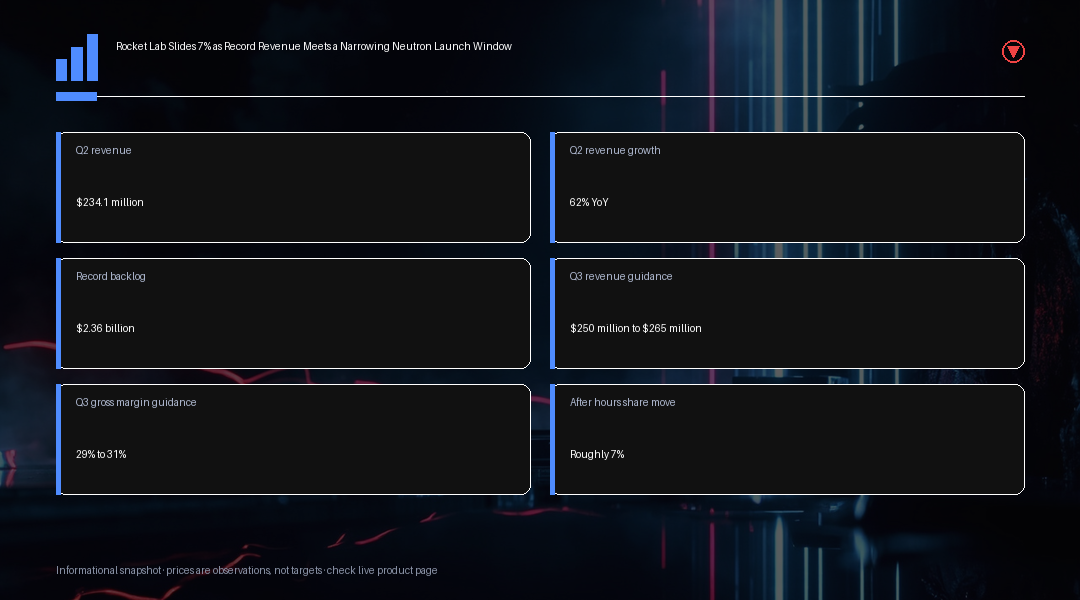
Rocket Lab delivered one of its strongest quarters on record, and the market still found reasons to sell the stock. Second quarter revenue reached $234.1 million, up 62 percent from a year earlier and ahead of the roughly $231.6 million Wall Street had penciled in. Shares still fell as much as 7 percent in after hours trading before paring some of that decline, a reminder that growth investors in the space sector are being asked to look well past the headline print.
The company's net loss came in at $49.3 million, or 8 cents per share, an improvement from the $66.4 million loss posted a year earlier but still wider than the roughly 3 cent per share loss analysts expected. Part of that shortfall traces back to close to $8.6 million in mergers and acquisitions related transaction costs tied to the Mynaric and Motiv deals and the pending acquisition of Iridium, rather than a deterioration in the core launch and space systems business. Gross margin for the quarter reached 41.5 percent, comfortably above the 38 percent analysts had forecast, showing the company is keeping more of every sales dollar even as heavy investment keeps the overall business unprofitable.
Segment detail told a similarly strong story. Product revenue, which covers satellite manufacturing and components, nearly doubled to $181.3 million, while launch and other services revenue reached $52.7 million. Backlog, the contracted work still awaiting delivery, jumped 137 percent from a year earlier to a record $2.36 billion, beating expectations of roughly $2.29 billion. That backlog growth matters because it gives investors a forward looking read on demand that a single quarter of revenue cannot capture on its own.
Guidance is where the market's attention shifted. Rocket Lab pointed to third quarter revenue of $250 million to $265 million, above the $238.5 million Wall Street forecast, which on its own reads as a clean beat and raise. The complication sits in profitability. Third quarter gross margin guidance came in at 29 percent to 31 percent on a GAAP basis, well below the roughly 37.6 percent consensus, with non-GAAP gross margin guided to 35 percent to 37 percent. Projected adjusted EBITDA losses of $17 million to $23 million were also wider than expected. Put simply, the top line is accelerating faster than the bottom line, a pattern that tends to make growth investors nervous even when revenue is beating estimates.
The other swing factor is Neutron, Rocket Lab's reusable medium lift rocket designed to challenge SpaceX's Falcon 9. Management shifted its language this quarter, moving from talk of a first flight within the fourth quarter of 2026 to a target of delivering the rocket to the launch pad during that same window. No replacement launch date has been offered, and the company has acknowledged that the odds of an end of year maiden flight are narrowing. Some analysts now see a real chance the debut slips into 2027. Neutron carries outsized importance for the investment case because it would let Rocket Lab compete for larger payloads and national security missions, and eventually launch its own satellite constellations instead of paying a competitor for the ride.
Rocket Lab is also working to close its roughly $8 billion acquisition of Iridium, a deal that would add satellites, spectrum, and recurring communications revenue to a business that has so far been built primarily around launch services and spacecraft components. The logic of diversifying beyond a single reusable rocket program is sound, but a deal of that size also raises the execution bar at exactly the moment the company is trying to prove Neutron can fly.
None of this changes the fact that Rocket Lab's core business is scaling quickly. Record revenue, a record backlog, and margin expansion in the existing product lines all point to a company that is winning share in a growing space economy. The tension for traders is that the market is pricing Rocket Lab as much on Neutron's timeline and on future profitability as it is on current results, which means headline beats on revenue can still be overshadowed by any hint of delay or margin pressure.
Positioning heading into the print is also part of the story. Rocket Lab shares had rallied sharply in the weeks before this report as investors priced in continued momentum in satellite manufacturing and optimism around Neutron's development progress. When a stock has already run up on optimistic expectations, even a genuinely strong quarter can trigger a sell the news reaction if any single data point, in this case the Neutron timeline language and the softer margin guidance, gives bulls a reason to lock in gains. That dynamic is common across high growth, pre profitability names and is worth separating from any judgment about the underlying health of the business.
Risk framing matters here as much as the bullish case. Rocket Lab remains a pre profitability company whose valuation depends heavily on execution against ambitious targets, and Neutron in particular carries real technical and schedule risk that has already resulted in one delay earlier in the year tied to a stage one tank issue. A further slip into 2027, or any additional setback during pad integration and testing, would remove a key near term catalyst that bulls have been counting on to diversify Rocket Lab's business beyond its existing small launch vehicle. Investors should also watch how the pending Iridium acquisition progresses, since a deal of that size introduces its own integration and financing risk on top of the operational challenge of bringing a new rocket to market.
Trading Insight
For active traders, the setup argues for treating Rocket Lab as two overlapping stories rather than one. The core launch and space systems business is executing well, evidenced by record revenue, a record backlog, and gross margin that beat expectations, and that part of the story supports the stock on dips tied purely to sentiment. The Neutron program is the more binary catalyst. Because management has not committed to a new first flight date and has openly said the year end launch window is narrowing, every future update on Neutron, whether a fresh timeline, a static fire test, or a confirmed slip into 2027, is likely to trigger outsized share price reactions in either direction. The softer third quarter margin guidance also deserves attention, since a widening gap between fast revenue growth and slower profitability improvement is the kind of signal that can cap valuation multiples even when the top line keeps beating estimates. Traders should watch for concrete Neutron milestones, updates on the Iridium transaction timeline, and whether the next quarter's margin guidance stabilizes or continues to slip, since those three threads are likely to matter more for near term price action than the backward looking revenue beat.