


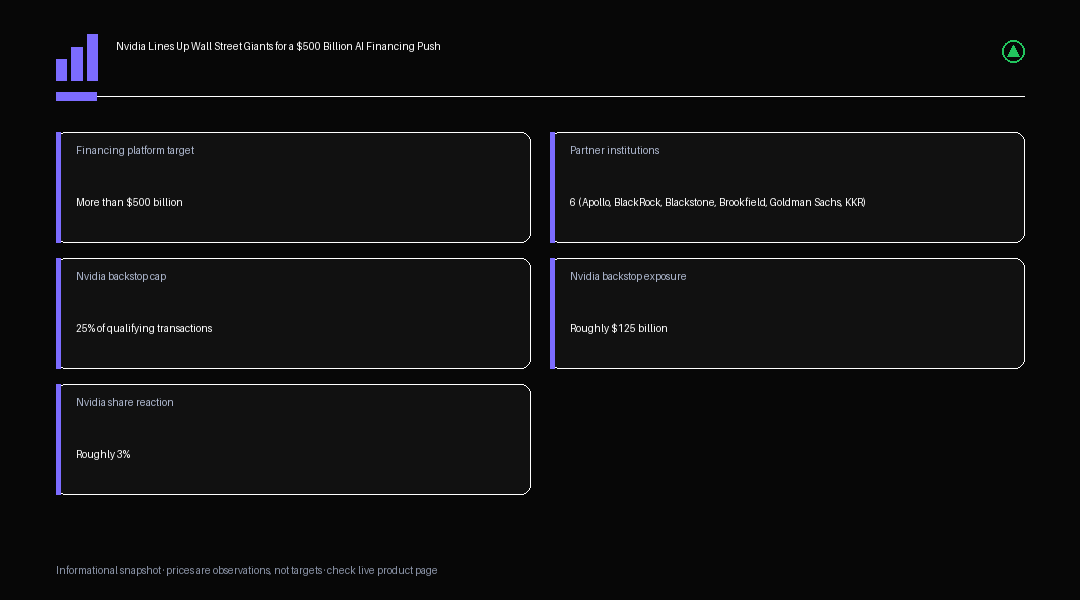
Nvidia is no longer content with simply selling the chips that power the artificial intelligence buildout. The company confirmed a partnership with six major financial institutions, Apollo, BlackRock, Blackstone, Brookfield, Goldman Sachs, and KKR, to launch compute financing platforms aimed at mobilizing more than $500 billion in third party capital for AI infrastructure. The goal is to help AI labs, cloud providers, enterprises, and governments fund the data centers Nvidia calls AI factories, facilities packed with chips, networking gear, and power systems that turn electricity into tokens, revenue, and occasionally a coherent chatbot answer.
The fine print matters here. The $500 billion figure is a mobilization target built on preliminary agreements rather than capital that has already changed hands. Individual contributions from each partner, the specific financing terms, and the deployment timeline for any of this money have not been disclosed. What has been confirmed is Nvidia's own exposure. Chief executive Jensen Huang said the company has the option to backstop up to 25 percent of qualifying transactions, a figure that could total roughly $125 billion if fully utilized. A backstop of that kind functions as a financial safety net, stepping in if a financed project struggles to find buyers or secure additional funding.
The structure is designed to work in Nvidia's favor on several levels. By helping arrange financing rather than carrying the full construction cost on its own balance sheet, Nvidia can give customers cheaper access to its computing hardware while keeping the heaviest capital spending with outside partners. For the banks and asset managers involved, long term data center leases and usage based fees offer a chance to turn AI demand into something closer to infrastructure style, contracted returns, an asset class institutional investors tend to favor for its predictability.
It also turns Nvidia into something resembling an ecosystem banker, an entity that helps finance the very infrastructure needed to buy more of its own products. That dual role is precisely what has investors debating the idea of circular financing, a dynamic in which a supplier helps fund the customers that then purchase its goods. Used well, that kind of financing can accelerate genuine demand that would otherwise take years to build organically. Used poorly, it can blur the line between organic demand and vendor supported purchasing, making it harder for outside observers to judge how much of the AI infrastructure boom reflects real end user need.
The market's initial reaction leaned skeptical. Nvidia shares fell roughly 3 percent following the announcement, even as Apollo and Blackstone each gained more than 3 percent and KKR also advanced. That split reaction suggests investors see clearer, more direct upside for the financial partners collecting fees and structuring the deals than for Nvidia itself, which is taking on financial exposure in exchange for demand that may or may not materialize at the scale implied by the $500 billion headline number.
For now, the practical items to track are the ones that will determine whether this initiative becomes a genuine growth accelerant or a source of balance sheet risk. Binding financial commitments from each partner, the specific terms of Nvidia's guarantee obligations, the credit quality of the companies borrowing to build these data centers, and eventual utilization rates once the facilities are built will all matter far more than the headline mobilization target. Power availability is another practical constraint that could slow deployment regardless of how much capital is arranged, since AI data centers of this scale require enormous and consistent electricity supply that is not always readily available near desirable locations.
If the financed data centers fill up with paying customers and stay busy, the flywheel Nvidia is describing works exactly as intended, reinforcing chip demand while spreading construction risk across a broad coalition of financial partners. If capacity is built faster than genuine demand can absorb it, the same $500 billion figure risks becoming an expensive monument to overbuilding rather than a durable source of future Nvidia revenue.
The announcement also needs to be read against the backdrop of Nvidia's broader position in the AI supply chain. The company has spent the past several years converting overwhelming demand for its graphics processing units into record revenue and profit growth, and this financing initiative is best understood as an attempt to remove one of the last bottlenecks standing between that demand and realized sales, namely the sheer cost of building the data centers needed to house the hardware. By helping arrange financing rather than requiring customers to fund construction entirely on their own balance sheets, Nvidia is effectively trying to widen the funnel of buyers who can afford to build AI infrastructure at scale.
The risk side of that equation deserves equal weight. A backstop obligation of up to roughly $125 billion is a meaningful contingent liability, even if it never needs to be fully called upon. Should a meaningful share of the financed data center capacity struggle to find paying tenants, whether due to a slowdown in AI adoption, oversupply of compute relative to demand, or simply project execution failures, Nvidia could find itself absorbing losses on deals it helped structure rather than merely selling chips into them. That is a fundamentally different risk profile than Nvidia's traditional hardware sales business, and it is the central reason the stock's initial reaction to the announcement was negative even though the deal is designed to expand Nvidia's addressable market over time.
Trading Insight
Nvidia's after the announcement drop of roughly 3 percent, alongside gains for financing partners like Apollo and Blackstone, signals that traders are still working out who benefits most from this arrangement. The key variable to monitor is disclosure quality. As Nvidia and its partners begin naming specific projects, borrowers, and financing terms tied to the $500 billion target, the market will have a much better basis for judging real demand versus vendor supported purchasing. Until then, expect continued volatility around any headline that touches the phrase circular financing, since that framing has become a lightning rod for concerns about whether reported AI infrastructure demand is fully organic. Traders should also watch utilization data from Nvidia's existing large scale customers, since strong utilization would support the thesis that new capacity financed through this platform will find real paying demand, while any signs of oversupply in AI compute would raise the stakes on Nvidia's 25 percent backstop exposure.