


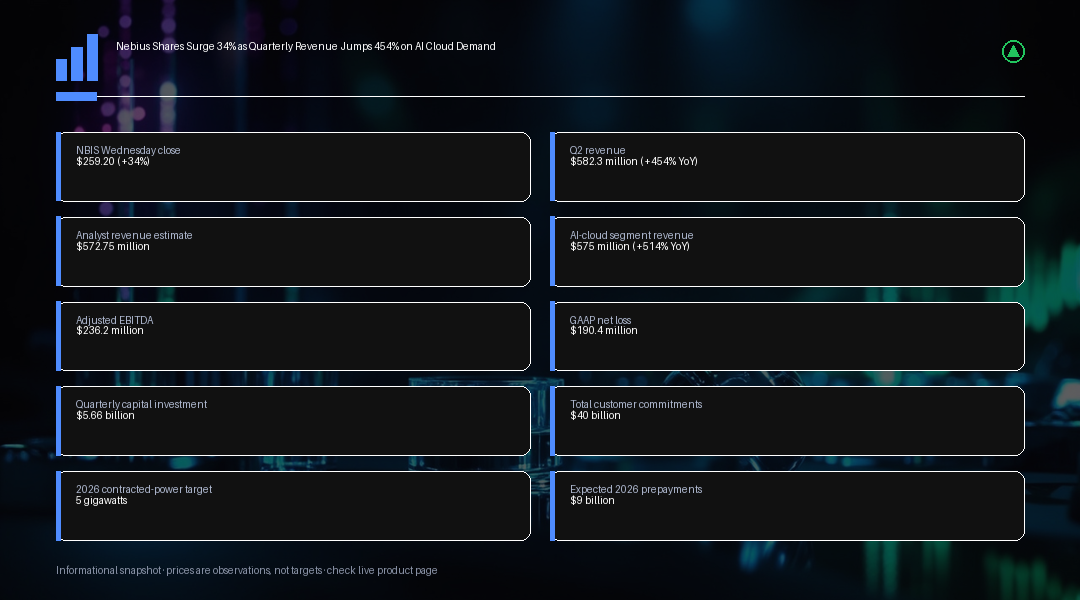
Shares of Nebius (NBIS) surged roughly 34% on Wednesday, closing at $259.20, after the AI-cloud infrastructure company reported second-quarter revenue of $582.3 million, up 454% from a year earlier and above the $572.75 million analysts had expected. The size of the beat, combined with the pace of growth, is clear evidence that demand for AI computing capacity continues to run ahead of what providers can build.
The AI-cloud segment did most of the heavy lifting. Revenue from Nebius's core AI business rose 514% year over year to roughly $575 million, now accounting for close to 98% of total group revenue. Adjusted EBITDA, a measure of underlying operating profitability before financing and accounting charges, reached approximately $236.2 million, a sharp turnaround from a $21.0 million loss in the same quarter a year earlier. Profitability at this scale, this early in an aggressive infrastructure buildout, is what is drawing investor attention beyond the headline growth number.
None of this comes free. Nebius posted a GAAP net loss of approximately $190.4 million for the quarter, a reminder that scaling AI infrastructure remains a capital-intensive business even as revenue and adjusted profitability improve quickly. Capital purchases and infrastructure investment totaled approximately $5.66 billion during the quarter, funding the data-center capacity, networking, and computing hardware needed to keep pace with customer demand.
Management pointed to a rapidly filling order book as evidence that this spending is being met with genuine demand rather than speculative buildout. The company signed four new AI-cloud contracts during the quarter averaging more than $1 billion each, helping push total customer commitments to more than $40 billion, nearly four times higher than before. Nebius also said it expects to collect more than $9 billion in customer prepayments during 2026, a piece of forward guidance rather than cash already in hand, but one that would give the company unusually strong visibility into near-term cash flow if it holds.
On the capacity side, Nebius raised its year-end 2026 contracted-power target to 5 gigawatts, with plans to add more than 1 gigawatt of additional capacity annually starting in 2027. That contracted figure is larger than the amount of power actually connected and running today, which the company still expects to reach somewhere in the 800-megawatt to 1-gigawatt range by the end of this year, a useful reminder that secured power and operating power are two different numbers. For scale, one gigawatt is roughly enough electricity to power 750,000 US homes, though in Nebius's case that capacity goes toward racks of AI accelerators rather than kitchen appliances. Chief executive Arkady Volozh told investors the company could sell its entire 2027 capacity under today's commercial terms, a striking claim that should be read as management's outlook rather than a locked-in result.
The broader competitive backdrop helps explain why the market is rewarding this level of spending rather than punishing it. Nebius operates alongside CoreWeave, the major cloud hyperscalers, and a growing list of AI-infrastructure-focused entrants, all racing to secure chips, power, and data-center space before the next wave of AI model training and deployment arrives. Elsewhere in the AI-investing world, a prominent hedge fund that had counted Nebius among its largest holdings reportedly sold down its public-equity book earlier this summer amid broader AI-stock volatility and margin pressure, a reminder that even strong operating results have not insulated the stock, or the sector, from sharp swings driven by positioning as much as fundamentals.
This quarter's results also help explain why Nebius shares have been treated as a bellwether for the broader AI-infrastructure trade rather than a standalone story. When a company shows that customers are willing to sign multi-year, multi-billion-dollar contracts and prepay for capacity months or years in advance, it reinforces the market's read that AI computing demand is structurally under-supplied rather than a short-term bubble in disguise. That framing has knock-on effects across the sector, feeding into how investors price other AI-cloud and chip-adjacent names whenever a report like this one lands.
Valuation discipline still matters, even in a demand environment this strong. A stock that moves 34% in a single session is pricing in a great deal of future execution, not just the quarter that has already been reported. Investors weighing fresh exposure after such a move need to separate the company's genuinely strong operating trajectory from the risk that near-term price action has already absorbed several quarters of good news at once, leaving less room for error if delivery timelines slip or a major customer relationship changes terms.
The bull and bear cases here are both straightforward. The bull case is that AI developers need computing capacity faster than the market can supply it, and Nebius has the contracts, the prepayments, and the capacity roadmap to keep capturing that demand. The bear case is that $5.66 billion of quarterly spending, a GAAP net loss, and a capacity plan that depends on continued customer follow-through are not small risks, particularly if financing conditions for AI infrastructure tighten or a single large customer relationship falters.
Trading Insight
Wednesday's move shows traders reading this print primarily as a demand story, and the underlying numbers support that read: a 454% revenue increase, adjusted EBITDA swinging from a loss to more than $236.2 million, and customer commitments above $40 billion are difficult to frame as anything but bullish for near-term AI-infrastructure demand. The more important question for the weeks ahead is how the market treats the spending side of the ledger, roughly $5.66 billion of quarterly capital investment against a still-sizable GAAP net loss, now that the initial earnings reaction has passed. As long as the contracted-power buildout stays on schedule toward the 5-gigawatt year-end target and the four newly signed $1-billion-plus contracts convert into delivered, billed revenue on schedule, the current spending pace looks financeable against genuinely contracted demand rather than speculative capacity. Any sign that connected operating power is falling meaningfully behind the 5-gigawatt contracted target, that the expected $9 billion of 2026 prepayments is not materializing, or that competition from CoreWeave and the hyperscalers is compressing pricing would shift the narrative from an AI-demand story toward a balance-sheet and execution-risk story. Given the size of Wednesday's move, traders should expect a wider-than-usual range of outcomes around the next quarterly update, with backlog conversion and capital-spending guidance likely to matter more for the stock's next major move than the headline revenue growth rate alone.