


Gold has crossed the psychologically important $4,400 per troy ounce area, but the break itself is only the first signal. What matters next is acceptance: can XAUUSD close above the level, absorb a pullback, and keep the dollar and real-yield backdrop from turning against it?
That distinction is especially useful for crypto and global macro traders. Gold can rise with defensive demand, but it can also stall when bond yields climb or the US dollar rebounds. A round-number breakout becomes more credible when price, rates, currency, and risk sentiment tell the same story.
Key takeaways
- A move through $4,400 needs closes and successful retests to become a durable breakout.
- Iran risk and a softer dollar can support gold, while rising real yields can cap it.
- July US CPI is the next test of whether the macro backdrop confirms or rejects the move.
Did gold really break above $4,400?
Yes, but the exact print depends on the instrument and observation time. During an Asia/Taipei check on 12 August 2026, the verified MC Markets product page rendered XAUUSD around $4,401.5. Separate futures quotes were higher, illustrating why spot-style XAUUSD, exchange-traded futures, and dealer prices should not be treated as one interchangeable number.
The move also completes a short recovery sequence. On 6 August, Investing.com cited spot gold near $4,330.97 and framed a sustained move above $4,355 as the test that could bring $4,400 into view. Crossing the round number therefore marks progress from an earlier resistance band—not proof that the market will continue in a straight line.
Why is gold rising now?
Three forces are overlapping: geopolitical hedging, a softer-dollar narrative, and positioning ahead of US inflation data. The approved market evidence connected the latest gold and oil rise with Iran tensions, dollar weakness, and the approaching CPI release. Each can support gold, but they work through different channels.
Geopolitical stress can lift demand for liquid stores of value. A weaker dollar makes a dollar-priced ounce cheaper for non-US buyers. Softer real yields reduce the opportunity cost of holding a non-yielding asset. The World Gold Council uses the dollar and real yields as central variables in its 2026 scenarios and says investment flows remain a major swing factor.
There is a structural layer beneath the short-term move. The World Gold Council estimated that central banks bought a net 244 tonnes in the first quarter of 2026. Its June survey also found 89% of reserve managers expected global central-bank gold holdings to increase over the following 12 months. Those figures do not set tomorrow's price, but they help explain why pullbacks can meet demand even when short-term momentum cools.
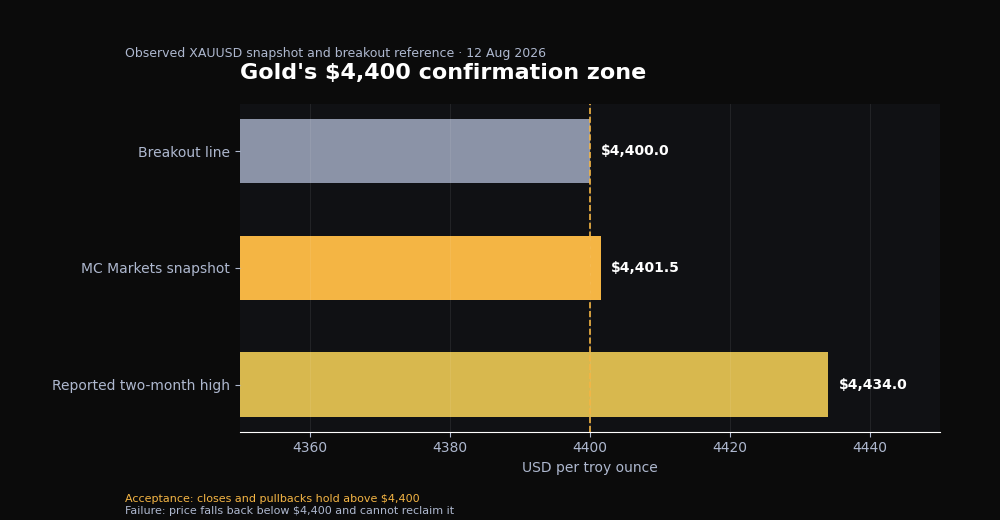
The values are dated reference points, not a continuous price series. Prices vary by venue and can change quickly.
What would confirm the breakout?
Confirmation would come from repeated acceptance above $4,400, not a single intraday spike. A daily close above the zone, followed by a shallow pullback that holds or quickly reclaims it, would show that former resistance is attracting buyers. The signal is stronger if the US dollar stays soft and real yields do not accelerate higher.
Momentum alone is less persuasive ahead of a major release. The US Bureau of Labor Statistics scheduled July 2026 CPI for 12 August at 08:30 Eastern Time. The prior report showed headline CPI down 0.4% month on month in June but still up 3.5% year on year; core CPI was unchanged on the month and up 2.6% year on year. A softer-than-feared July print could ease rate pressure, while a hotter print could lift yields and test gold's hold above $4,400.
What would turn it into a false breakout?
A fast return below $4,400 followed by failed attempts to reclaim it would weaken the breakout case. The warning becomes clearer if the dollar and real yields rise together or if geopolitical risk fades without underlying investment demand taking over.
Oil matters here too. Renewed Iran tension can lift both gold and crude, but a persistent oil shock may also raise inflation expectations and bond yields. That creates a two-sided effect: haven demand supports gold while higher real rates raise its opportunity cost. Traders should therefore avoid reducing the setup to “oil up, gold up.” The rates response determines which force dominates.
Which signals matter next?
| Signal | Breakout confirmation | Failure warning |
|---|---|---|
| XAUUSD around $4,400 | Daily acceptance and successful retest | Close below, then failed reclaim |
| US dollar | Soft or falling | Broad rebound |
| US real yields | Stable or easing | Sharp move higher |
| July CPI | Does not force a hawkish rates repricing | Hot surprise lifts yields and dollar |
| Iran and oil risk | Haven demand persists without a yield shock | De-escalation removes premium, or oil lifts real-rate pressure |
What does the move mean for crypto and global assets?
Gold above $4,400 is most informative when compared with the dollar, yields, Bitcoin, and equities. Gold rising while the dollar and real yields fall points to easier financial conditions and can coexist with stronger crypto and growth assets. Gold rising while oil, yields, and volatility rise is more defensive: it may signal hedging rather than broad risk appetite.
Bitcoin and gold can both benefit from currency-debasement or reserve-diversification narratives, but their short-term behavior is not identical. Bitcoin remains more sensitive to liquidity and leverage, while gold has deeper official-sector demand. The cross-asset question is therefore not whether one must replace the other, but which macro driver is leading the session.
Final thoughts
$4,400 is now a live test rather than a distant target. The constructive case needs price to spend time above it while the dollar and real yields remain cooperative. The cautious case begins with a failed reclaim, especially if CPI pushes the rates backdrop higher. Let the market show whether the breakout is being accepted before treating the round number as durable support.