


The latest crypto headline is not a breakout: Bitcoin remained close to $64,000 after the July U.S. inflation report removed one immediate macro threat but did not unlock broad follow-through. Headline CPI rose only 0.1% in July, yet the dollar, Treasury yields and daily fund flows still left traders with a mixed signal rather than a clean risk-on turn.
That makes this a useful breaking-news case study. The point is not to repeat every item on the feed. It is to sort the verified release from the first price reaction, then ask whether spot demand confirms it. Bitcoin pricing and product details are available on the BTC product page.
Key takeaways
- July CPI rose 0.1% month over month and 3.4% over 12 months; energy fell 1.5%.
- Bitcoin stayed around $64,000 instead of repeating its stronger reaction to June CPI.
- ETF flows, yields, the dollar and participation now matter more than another isolated headline.
What did the July CPI report actually say?
The report was softer in its headline mix, but it did not declare inflation defeated. The U.S. Bureau of Labor Statistics said the Consumer Price Index rose 0.1% in July after falling 0.4% in June. The 12-month rate was 3.4%. Core CPI, excluding food and energy, increased 0.2% for the month.
The components explain why the first reaction was restrained. Energy prices fell 1.5%, helping keep the headline number low, while shelter rose 0.1% and accounted for roughly two-thirds of the monthly all-items increase. Gasoline dropped 2.9% during July, but a single month of cheaper energy does not settle the path of inflation or policy.
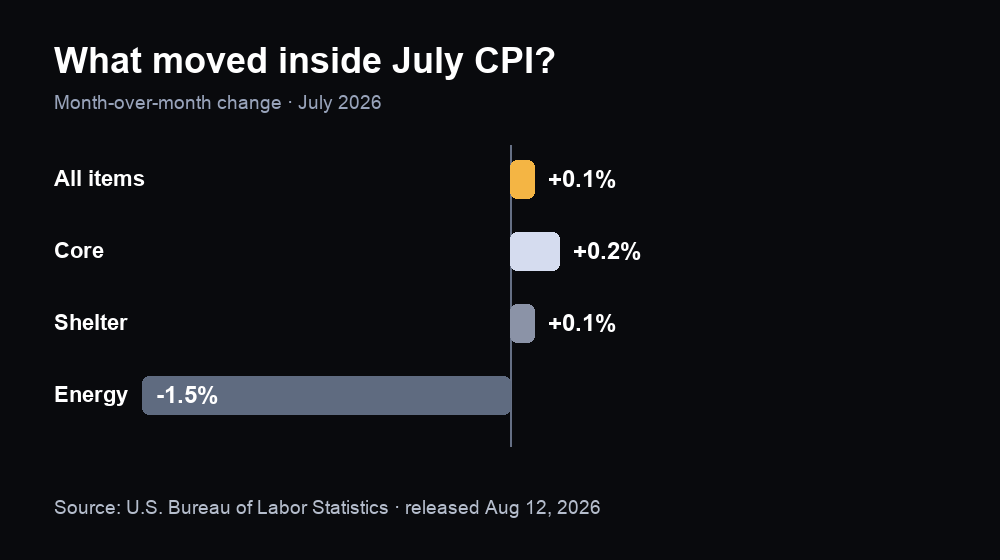
Month-over-month U.S. CPI changes for July 2026, released by the Bureau of Labor Statistics at 8:30 a.m. ET on August 12.
Why did Bitcoin stay near $64,000?
Bitcoin had already priced in a benign inflation result, so an in-line report brought relief without surprise. A market snapshot on August 12 placed BTC at $63,584, up just 0.08% over 24 hours, with dominance at 56.3%. Another post-release account put Bitcoin near $64,000 and described the wider crypto market as largely unchanged.
The muted response stands out against the previous inflation release. After June CPI cooled more than expected, CoinDesk reported that Bitcoin rose about 3.6% to nearly $64,800 as near-term rate-hike expectations dropped sharply. July's data did not deliver the same surprise. It confirmed a less threatening inflation path, but traders had less positioning to unwind.
Price location also matters. Bitcoin traded roughly between $63,900 and $65,900 in the week into CPI, according to a dated market recap. A close near the lower part of that range after an ostensibly supportive release is not necessarily bearish; it simply means the macro news did not overpower the existing balance between buyers and sellers.
Did ETF demand confirm the CPI relief?
Not yet, because the most recent daily flow interrupted an improving streak. U.S. spot Bitcoin ETFs had attracted about $626 million over August 3–5, then a further $137.6 million on August 6, according to data cited from SoSoValue and Farside Investors. That four-day run helped Bitcoin reclaim $65,000 earlier in the month.
But the sequence later flipped. A market recap reported a $144.6 million net outflow on August 10 after a seven-day, $455.3 million inflow streak. One negative day does not invalidate the prior demand. It does show why “ETF inflows are back” is too broad a conclusion: flows can follow risk appetite, rebalance around events and reverse quickly.
The cleaner test is persistence. Several sessions of net buying while Bitcoin holds its range would show that regulated demand is absorbing available supply. Alternating inflows and outflows while price remains flat would describe stabilization, not a decisive institutional bid.
Why do yields and the dollar still matter?
Bitcoin remains sensitive to the return available on cash and government bonds. Higher Treasury yields raise the opportunity cost of holding a volatile asset with no contractual income. A firmer dollar can also tighten global financial conditions, especially when leveraged traders fund positions in dollars.
The August 12 evening snapshot explicitly described a firmer U.S. dollar index and higher yields as counterweights to Bitcoin's slightly positive 24-hour move. That tension explains why a softer CPI headline was not enough by itself. Energy fell during July, but the annual inflation rate remained above the Federal Reserve's 2% goal, and core prices still increased.
For traders, the transmission chain is more useful than a slogan: inflation data changes policy expectations; policy expectations move front-end yields and the dollar; those markets influence risk appetite; Bitcoin then reveals whether crypto-specific demand is strong enough to resist the macro impulse.
Which crypto headlines deserve less weight?
Single incidents in smaller assets should not automatically become a Bitcoin thesis. The latest feed included an XRP bridge exploit, tokenization announcements, crypto ATM rules and institutional infrastructure stories. Each can matter to its own token, company or sector, but their impact on BTC depends on whether they alter liquidity, market access, custody confidence or systemic risk.
The same filter applies to chart commentary. A post saying Bitcoin has crossed below a cloud or sits under support describes one technical method, not a verified market fact. It becomes more useful when spot volume, derivatives positioning and closes across multiple sessions agree with it. Until then, it belongs in the evidence set, not in the conclusion.
What would turn this update into a stronger signal?
Follow-through requires price, participation and macro conditions to stop contradicting one another. The table separates what changed with the release from what remains unresolved.
| Signal | Latest dated observation | Stronger confirmation | Reason for caution |
|---|---|---|---|
| Inflation | July CPI +0.1% MoM; +3.4% YoY | Core and shelter continue to cool | Annual inflation remains above target |
| Bitcoin | About $63,584–$64,000 on Aug 12 | Holds or advances with broader participation | Muted reaction despite supportive headline CPI |
| Spot ETF flows | −$144.6M on Aug 10 after a seven-day inflow streak | Net buying resumes across several sessions | One-day reversals keep the signal choppy |
| Yields and dollar | Described as firmer in the Aug 12 evening snapshot | Both ease without a growth scare | Further strength raises the cost of risk |
| News flow | Mixed policy, infrastructure and security items | Developments improve broad market access or liquidity | Asset-specific headlines are mistaken for a BTC catalyst |
All observations are tied to their stated windows. Crypto prices, yields and ETF flows can change after publication.
Final thoughts
July CPI gave Bitcoin a less hostile macro backdrop, not a completed bullish argument. The important breaking news is the mismatch: inflation's internal mix softened, while Bitcoin and fund flows remained hesitant. That gap can resolve through stronger spot demand or through renewed pressure from yields and the dollar. Until one side produces follow-through, the most honest read is that Bitcoin absorbed the news near $64,000 without yet converting it into a new trend.