


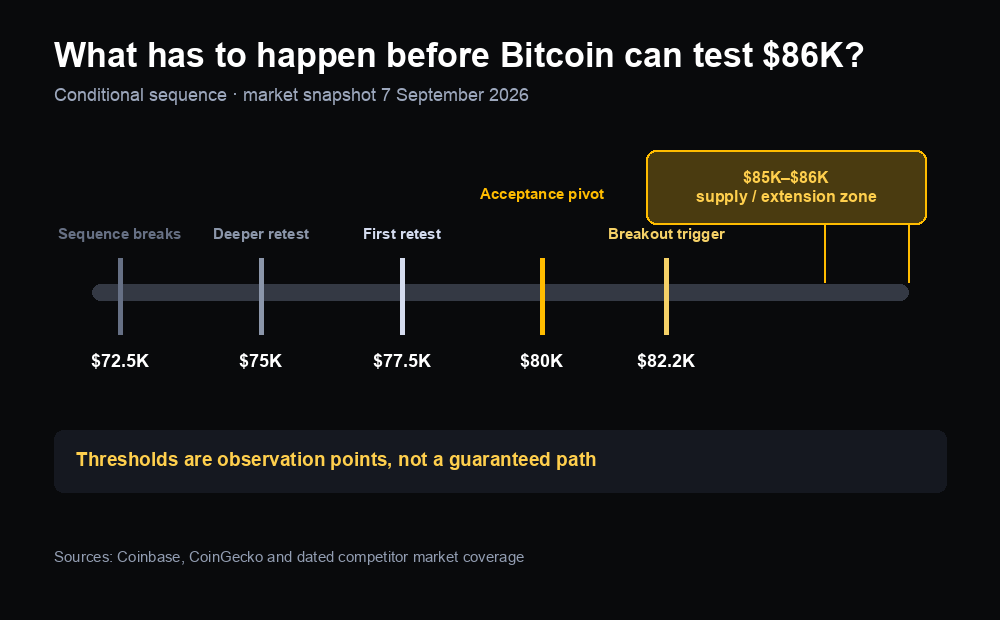
Bitcoin is testing the $80,000 area after a fast late-August advance and an early-September push above $82,000. A move to $86,000 is possible, but it is not unlocked by one more “final dump.” BTC first needs to hold near $80,000, clear the roughly $82,200 ceiling and absorb supply between $85,000 and $86,000.
That sequence matters more than the headline target. A pullback can improve the setup if buyers defend it; the same decline can invalidate the setup if support gives way. This Bitcoin price prediction therefore uses observable triggers rather than assuming the next selloff must be the last.
Key takeaways
- $80K is the immediate acceptance test; about $82.2K is the breakout trigger.
- $77.5K–$75K is the constructive retest band, not proof of an automatic rebound.
- $85K–$86K is an overhead supply zone; sustained trade below $72.5K breaks the bullish sequence.
Can Bitcoin reach $86,000?
Yes, but only as a conditional extension above the current range—not as a guaranteed destination. Coinbase’s public BTC-USD snapshot at 10:31:50 GMT+8 on 7 September showed a last price of $79,990.07, with a 24-hour high of $80,564.24 and low of $79,250. CoinGecko’s snapshot at the same minute showed $80,028, up about 0.12% over 24 hours. The small venue difference is normal; both place the live pivot near $80,000.
The first job is acceptance. Bitcoin.com’s 6 September Bitstamp review placed immediate resistance between $80,335 and $82,239 after the market rejected an early-September high around $82,239. That makes roughly $82,200 the cleaner confirmation line. A brief wick is not enough: the stronger signal would be a close above the area followed by continued trade above it.
From a rounded $80,000 reference, $86,000 is a 7.5% extension. That is well within Bitcoin’s historical volatility, but distance alone does not make the target likely. The path still runs through the $85,000–$86,000 band that several current forecasts identify as overhead supply.
Would another Bitcoin pullback be the “final dump”?
No one can identify a final pullback in real time; the label becomes valid only in hindsight. What traders can observe is whether demand appears at previously contested prices. In the current setup, the first meaningful retest area is around $77,500, followed by a deeper $75,000–$76,500 band highlighted across recent September outlooks.
A constructive retest would show a narrower range, buyers returning before the prior breakout base fails, and price reclaiming $80,000 after the dip. A weak retest would spend more time below $77,500, struggle to recover $80,000 and eventually expose $75,000. The market is not obliged to bounce simply because a decline looks sharp on a short-term chart.
The deeper line is around $72,500. CoinGecko includes that threshold in its September prediction-market ladder, while current technical coverage clusters longer-term support in the low-$70,000s. Sustained trade below that area would change the structure from “retest within a breakout” to “failed breakout seeking deeper support.” Calling that move a bullish final dump would ignore the invalidation.
The practical distinction: a pullback is constructive only if the market subsequently reclaims the levels it lost. The rebound confirms the retest—not the size or drama of the decline.
What would confirm the move above $82,200?
Confirmation would require price acceptance, better participation and follow-through beyond a single thin-liquidity move. Bitcoin.com noted that weekend volume had contracted as BTC balanced near $80,000 on 6 September. A breakout during a fuller liquidity window carries more information than a brief weekend spike.
Price should also stay above the breakout area after the first test. If BTC clears $82,200 but immediately returns below $80,000, the move is more consistent with another liquidity sweep than with acceptance. If it holds above $82,200 and subsequent pullbacks stop higher, the $85,000–$86,000 zone becomes the next measurable test.
Prediction-market odds can add a sentiment read, but they are not a substitute for price confirmation. CoinGecko’s page explicitly describes its Polymarket-derived thresholds as market sentiment rather than guaranteed forecasts. Odds move with positioning, contract rules and time remaining; they do not create spot demand.
Which scenarios matter before the $86K test?
Three branches cover the useful range: direct breakout, controlled retest and failed structure. They are mutually testable and do not require guessing the next candle.
| Scenario | What must happen | What it would imply | What cancels it |
|---|---|---|---|
| Direct breakout | BTC holds $80K, closes above about $82.2K and remains above the breakout area | $85K–$86K becomes the next supply test | Immediate rejection back below $80K |
| Controlled retest | BTC pulls back into $77.5K–$75K, stabilizes and reclaims $80K | The dip may have reset short-term positioning without breaking the larger advance | Repeated failure to recover $77.5K, then $75K |
| Failed structure | BTC accepts below $75K and sustains trade under $72.5K | The $86K sequence is deferred; deeper support becomes the focus | A fast reclaim of $75K followed by acceptance above $80K |
The macro calendar can accelerate any branch. The Federal Reserve’s official schedule places the next FOMC meeting on 15–16 September 2026. Rate expectations often affect the dollar, yields and risk appetite together, so a BTC breakout immediately before the decision may remain vulnerable to repricing after it.
How should traders read the forecast as prices change?
Update the sequence, not the target. Above $82,200 with follow-through, attention shifts to supply at $85,000–$86,000. Below $80,000, the question becomes whether $77,500–$75,000 attracts demand. Below $72,500, the original path has failed and should not be rescued with a more dramatic narrative.
Because Bitcoin trades continuously, timestamps matter. The Coinbase and CoinGecko readings in this article are snapshots, not fixed reference prices. For the current platform quote and product details, use the BTC product page. For context on the earlier rally phase, see Bitcoin’s biggest weekly gain in three years and the follow-up on Bitcoin’s 50-day moving-average reclaim.
Final thoughts
The honest $86K case is less exciting than “one final dump,” but more useful. Bitcoin must show that $80K is accepted, that $82.2K can become support rather than a ceiling, and that buyers can absorb the $85K–$86K zone. Until those steps occur, $86K remains a scenario—not a promise.