


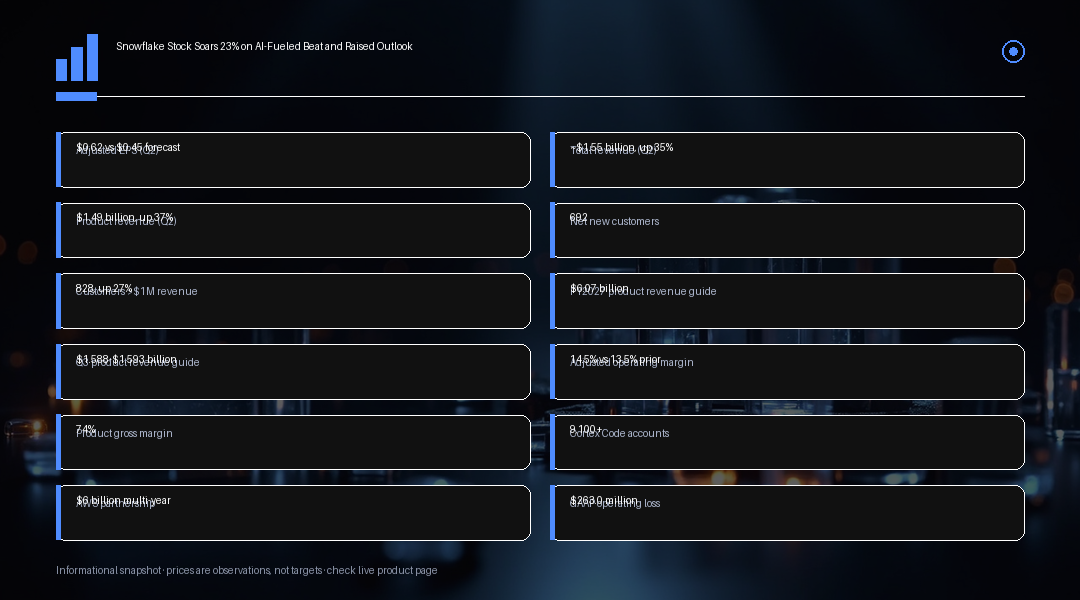
Snowflake shares rose more than 20% in extended trading after the company reported Q2 fiscal 2027 results that exceeded Wall Street expectations and raised its full-year product-revenue outlook. The cloud-data platform delivered adjusted earnings of $0.62 per share against a $0.45 consensus estimate, while total revenue climbed approximately 35% year over year to roughly $1.55 billion, topping the $1.48 billion Wall Street estimate.
Product revenue : the core measure of customer spending on Snowflake's platform : jumped 37% to $1.49 billion, marking a third consecutive quarter of acceleration. That reversal matters for a company whose consumption-based model previously suffered when customers optimized their cloud bills. This time, enterprise budgets appear to be expanding rather than contracting, and the platform's consumption-based pricing is capturing that expansion directly. The acceleration is particularly notable because it comes after several quarters of deceleration that had weighed on the stock and raised questions about the durability of the consumption model.
Snowflake added 692 net new customers during the quarter, including 14 members of the Forbes Global 2000. The company now counts 828 customers generating more than $1 million in annual product revenue, up 27% from a year earlier. The enterprise base is deepening, and the average relationship is growing, which provides a more predictable revenue floor under the consumption model. Apparently, the snowball becomes easier to roll once enterprise budgets join in, and the company is now benefiting from that compounding effect across a broader base. The net revenue retention rate is improving as existing customers expand their usage.
Management said AI products generated roughly half of Snowflake's recent growth acceleration. Cortex Code, its AI coding assistant, has reached more than 9,100 accounts, while the collaborative enterprise tool CoWork is used by approximately 5,800. AI is becoming an accelerant for the consumption-based model rather than a disruptor, as customers store and process more data to feed their AI pipelines. The data-cloud thesis is increasingly an AI-data thesis, and Snowflake is positioned at the intersection of those two secular trends. The company's AI product portfolio is expanding, and the monetization of those products is still in its early stages.
The business model helps explain the upside. Companies must organize, govern and process their data before deploying useful AI systems. Those workloads generate additional computing and storage activity on Snowflake's platform. AI therefore creates new revenue while increasing demand for the company's existing services. Snowflake also has a $6 billion multi-year agreement with Amazon Web Services covering cloud infrastructure, AI development and customer migrations. The arrangement gives Snowflake capacity and distribution while helping businesses move from experimental chatbots toward production-grade applications. The AWS partnership is a durable competitive advantage that is difficult for rivals to replicate.
Snowflake lifted its fiscal 2027 product-revenue forecast to $6.07 billion from $5.84 billion, implying growth of approximately 36%. Third-quarter product revenue is expected between $1.588 billion and $1.593 billion, well above the roughly $1.5 billion analysts anticipated. The company also raised its adjusted operating-margin outlook to 14.5% from 13.5%, suggesting revenue is growing faster than operating costs. However, AI workloads require more computing power, prompting Snowflake to lower its product gross-margin forecast to 74%. The margin trade-off : lower gross margins in exchange for AI-driven scale : is one the market is willing to accept given the growth trajectory. The key question is whether gross margins stabilize at 74% or continue to drift lower as AI workloads become a larger share of the mix.
The company remains unprofitable under GAAP, reporting a Q2 GAAP operating loss of $263.0 million and a net loss of $191.7 million. Stock-based compensation remains elevated. Still, the adjusted profitability trend is improving, and the cash-flow profile supports the growth investment. The company's GAAP losses are a known quantity that the market has largely looked through given the growth rate and the size of the opportunity. The path to GAAP profitability is visible, even if the exact timing remains uncertain.
For traders watching SNOW, the raised guidance and AI-driven consumption acceleration are the key takeaways. The stock's extended-session surge reflects a market that had priced in more caution around cloud optimization headwinds. The margin trajectory and the pace of AI-product adoption will determine whether the post-earnings repricing holds. On a trailing basis, the stock remains expensive, but the growth-rate acceleration and raised outlook are the dominant near-term drivers. The risk is that the bar is now raised, and any stumble in the growth trajectory could trigger a sharp reversal.
Looking ahead, the key metrics to watch are quarterly product-revenue growth rates, net new customer additions, and the trajectory of AI-product contribution to overall consumption. The raised FY2027 guidance provides a higher floor, but the stock's post-earnings move has already priced in much of the good news. Sustained momentum will require continued acceleration in AI-driven consumption and further progress toward GAAP profitability. The competitive landscape is also worth monitoring, as larger cloud platforms are building competing data-cloud offerings, though Snowflake's neutrality across multiple clouds remains a differentiator.
From a positioning standpoint, the post-earnings move has likely cleaned out weak hands and reset expectations higher. The stock's implied volatility will compress as the earnings overhang lifts, which could create a more favorable setup for momentum traders. The key support level to watch is the pre-earnings consolidation zone, which should now act as a floor on any pullback.
The competitive landscape is also worth monitoring, as larger cloud platforms are building competing data-cloud offerings, though Snowflake's neutrality across multiple clouds remains a meaningful differentiator in a market where enterprises increasingly avoid single-cloud lock-in.
The bottom line for traders: Snowflake's Q2 print was a clear beat with raised guidance, and the market's extended-session response reflects a reassessment of the stock's near-term trajectory. The AI-driven consumption acceleration is real, the enterprise base is deepening, and the margin trajectory is improving. The risk is that the bar is now higher, and any stumble in the growth trajectory could trigger a sharp reversal. For now, the breakout is powerful, and the raised FY2027 guidance provides a higher floor under the stock.
Trading Insight
For traders watching SNOW, the raised guidance and AI-driven consumption acceleration are the key takeaways. The margin trajectory and pace of AI-product adoption will determine whether the post-earnings repricing holds.