


Bitcoin traded at $81,173.68 on Thursday, down 2.74% over the past 24 hours as traders weighed Federal Reserve rate expectations and broader risk sentiment across cryptocurrency markets. The pullback extended a volatile week for the world's largest cryptocurrency, which has now alternated between sharp rallies and steep corrections since the start of October. Trading volume has surged compared to recent weeks, reflecting heightened uncertainty among both retail and institutional participants. Market participants continue to debate whether the current pullback represents a healthy correction within a broader uptrend or the beginning of a more sustained downturn.
The decline came as US inflation data released Wednesday showed annual CPI at 3.7%, above expectations of 3.6%. The hotter reading fueled bets on additional Fed rate hikes, which traditionally weigh on risk assets including cryptocurrencies. The dollar strengthened against major currencies following the data, adding pressure to Bitcoin and other digital assets. US 10-year Treasury yields climbed to 4.85%, making yield-bearing assets more attractive relative to non-yielding cryptocurrencies. Traders are now pricing a 65% probability of another 25 basis point rate increase at the November Fed meeting, up from just 40% before the inflation report was released.
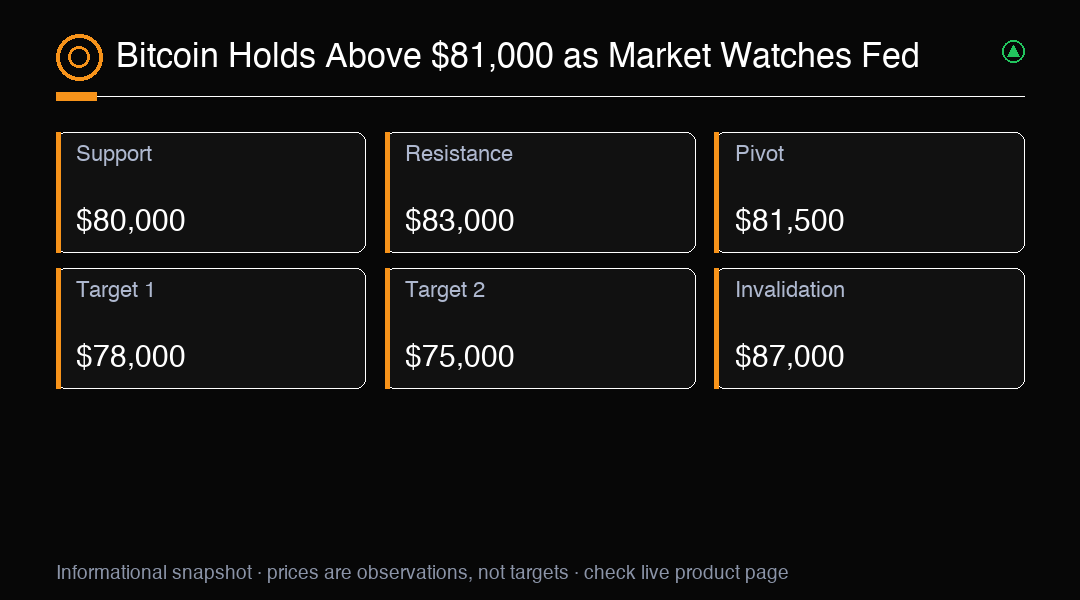
Despite the pullback, Bitcoin remains well above its recent lows set in late September when the cryptocurrency briefly dipped below $76,000. The cryptocurrency had rallied to $86,200 earlier this month before the current correction began, meaning it has retraced roughly 5.8% from that peak. Key support is now seen at $80,000, a psychological level that has drawn buying interest on multiple occasions since August. A sustained break below this level could signal deeper losses, while holding here may attract dip buyers looking for a floor. The $80,000 mark carries significant psychological weight and has acted as a reliable floor during previous corrections this year.
Ethereum traded at $2,480, down 3.1% over 24 hours, mirroring Bitcoin's weakness across the broader market. The total cryptocurrency market capitalization slipped 2.8% to $2.85 trillion, with most major altcoins posting losses during the session. Solana fell 4.2% to $128.50 and XRP dropped 3.5% to $0.52, continuing a pattern of underperformance relative to Bitcoin during periods of market stress. Traditionally, altcoins tend to fall harder than Bitcoin during broad selloffs, and the current session proved no exception. Ethereum's decline was notable given its recent momentum around network upgrades, suggesting macro factors are currently dominating project-specific catalysts.
Analysts note that Bitcoin's correlation with US equities has increased significantly in recent months, making it more sensitive to macroeconomic data and Federal Reserve policy shifts. When technology stocks fall, Bitcoin often follows, as both are viewed as risk-on assets by institutional investors who allocate capital based on liquidity conditions. This correlation has been particularly pronounced during 2026, as Bitcoin's growing institutional adoption has linked it more tightly to traditional finance. Some market observers argue this correlation undermines Bitcoin's narrative as an uncorrelated alternative asset, while others view it as a natural maturation of the cryptocurrency market.
The fear and greed index, a widely watched sentiment gauge that aggregates volatility, momentum, volume and social media data, dropped to 42 on Thursday, signaling fear in the market. This reading is down from 55 (neutral) just a week ago and well below the 72 (greed) level recorded in early October when Bitcoin was approaching its monthly high. Historically, extreme fear readings below 30 have marked local bottoms, though the timing and duration of such bottoms remains uncertain. The current shift from greed to fear in just days reflects how quickly sentiment can change when macroeconomic data catches the market off guard.
On-chain data shows that long-term holders are not selling into the weakness, with wallets holding Bitcoin for over a year continuing to accumulate at current levels. Exchange outflows have increased notably over the past week, suggesting investors are moving coins to cold storage rather than preparing to sell. This pattern could indicate conviction among institutional buyers who view the current pullback as a temporary setback within a longer-term bullish thesis. Additionally, the supply of Bitcoin on exchanges has fallen to its lowest level since early 2024, reducing the immediate selling pressure from short-term traders.
ETF flows remain a key driver of Bitcoin price action and closely watched indicator of institutional sentiment. US spot Bitcoin ETFs recorded $420 million in net outflows this week, marking the largest weekly withdrawal since August and reflecting the growing sensitivity of these vehicles to macroeconomic shifts. However, cumulative inflows since the ETFs launched remain positive at $18.2 billion, suggesting institutional interest persists despite near-term volatility. Analysts emphasize that these outflows, while significant, represent a small fraction of the total assets under management, indicating most institutional investors are holding their positions through the current turbulence.
The options market shows increased demand for put protection, with the 25-delta skew shifting further negative as traders pay more for downside insurance than upside exposure. Implied volatility has risen to 65%, up from just 52% last week, reflecting heightened uncertainty and expectations of larger price swings in the near term. This jump in volatility suggests market participants are bracing for further downside while remaining uncertain about the duration of the current correction. Some options strategists note that elevated volatility premiums can create opportunities for sellers, though timing such trades requires careful risk management.
Looking ahead, Thursday's PPI report and upcoming Fed speeches could provide catalysts that determine Bitcoin's next major move. If inflation data comes in cooler than expected, it could ease rate pressure and lift cryptocurrencies as traders reassess the likelihood of further tightening. Conversely, another hot reading could push Bitcoin below the critical $80,000 support and open the door to deeper losses toward the $78,000 level. Fed officials are scheduled to speak at multiple events next week, with traders watching for any hints about the committee's thinking on the pace of future rate decisions.
From a technical perspective, Bitcoin is testing a key support zone between $80,000 and $81,000 that has held firm during each pullback since late July. A decisive break below $80,000 could open the door to a retest of $78,000, which marked the low point of the September correction. Conversely, a reclaim of $83,000 would signal a return to the recent uptrend and potentially put Bitcoin back on a path toward the $86,000 level. Traders are closely watching volume patterns and moving averages to determine whether the current support will hold.
Overall, Bitcoin remains in a broad range between $75,000 and $87,000 that has been established over the past three months as the market digests shifting macroeconomic expectations. Traders are watching whether the current pullback finds support at current levels or breaks lower toward the bottom of that range. The Federal Reserve's policy path, inflation trajectory and the upcoming PPI data will likely determine Bitcoin's direction in the coming weeks. Market participants are advised to manage position sizes carefully and maintain disciplined risk management during this period of heightened volatility.
Trading Insight
Bitcoin is testing $80,000 support amid Fed rate concerns and ETF outflows. Watch Thursday's PPI data. Range remains $75,000 to $87,000.