


KEY POINTS: Nasdaq futures were down roughly 1% Tuesday, extending a cautious mood beyond Monday's US session. The Nasdaq Composite fell 0.4% to 27,245.90 Monday, losing 120 points as semiconductor stocks weakened. South Korea's Kospi sank more than 6%, triggering a five-minute trading suspension that underscored the breadth of the selling pressure across global markets. The combination of weak Asian chip stocks, a firm dollar and approaching bank earnings created a difficult backdrop for risk assets.
European futures slipped 0.4% Tuesday, tracking the weakness in Asian markets where chipmakers tumbled. The S&P 500 edged down 0.1% to 7,807.24 Monday, while the Dow added 196 points to 51,850.55. That split shows investors rotating between sectors rather than selling equities uniformly, a pattern that often persists when uncertainty about the macro outlook remains elevated and traders await clearer signals from earnings and economic data. The divergence between the Dow and the Nasdaq is particularly noteworthy because it suggests that value-oriented investors are finding opportunities even as growth-oriented investors reduce exposure to technology.
Micron dropped 3.9% and Lumentum almost 11%, putting pressure on the AI infrastructure trade. Reports of technological advances at Chinese memory producer CXMT intensified competition concerns, particularly in the memory segment where pricing dynamics are already under pressure. The combination of weak earnings guidance and rising competition created a difficult backdrop for semiconductor investors, particularly those with exposure to the memory and optical segments of the market. The declines in these two names were among the sharpest in the technology sector and contributed significantly to the Nasdaq's underperformance.
Meta gained 3.4%, ending four consecutive losing sessions after introducing its Muse Wonder AI models. Salesforce climbed more than 4% following a Bank of America upgrade. Both moves suggest investors still reward AI businesses when product launches or clearer strategies strengthen the earnings case, even when the broader technology sector faces pressure. The divergence between Meta and the chip names highlights how stock-specific catalysts can override sector-wide weakness, and it suggests that the market is becoming more selective rather than indiscriminately selling all technology exposure.
Outside technology, Chipotle fell roughly 4% after Starbucks denied plans to buy the restaurant chain. The denial removes a takeover catalyst and returns attention to each company's operating performance. Starbucks remains focused on its turnaround under Brian Niccol, who previously led Chipotle and now faces the challenge of restoring growth at the coffee chain. The episode illustrates how quickly sentiment can shift when a widely discussed takeover narrative is contradicted by the companies involved, and it serves as a reminder that market speculation about mergers and acquisitions can create both opportunities and risks for investors.
South Korea's Kospi sank more than 6%, triggering a five-minute trading suspension. Japan's Nikkei lost nearly 3% and Taiwan's benchmark fell 2%. Tuesday's Asian-session snapshots apparently dragged futures trading elsewhere, with the sharp moves in the Kospi drawing particular attention from global investors. The circuit breaker in Seoul is a reminder that stress in one market can quickly transmit to others through correlated positioning, and it highlights the interconnected nature of global equity markets in an era of rapid information flow and algorithmic trading.
The dollar index held near an 18-month high above 102.50 in early Asian trading. EUR/USD traded around $1.1159, GBP/USD near $1.3209 and USD/JPY around 158.50 yen. The strong dollar added to pressure on risk assets, particularly for companies with significant international revenue exposure. A sustained period of dollar strength can compress profitability for multinational corporations and reduce the competitiveness of US exports, which is particularly relevant for technology companies that derive a substantial portion of their revenue from overseas markets.
Brent crude eased toward $106 a barrel, retaining most of Monday's advance. Traders weighed Gulf supply risks against the prospects of additional Russian diesel reaching global markets. Gold slipped toward $4,164 an ounce and silver hovered around $60, with dollar strength weighing on precious metals. The combination of a firm dollar and elevated bond yields reduces the appeal of non-yielding assets, which is particularly relevant for gold at current levels. The decline in precious metals also reflects the broader risk-off sentiment that has characterized recent trading sessions.
Bitcoin recovered toward $82,900 after losing about 2.3% Monday. The orange coin's rebound offers some resistance to the broader weakness, although one recovery session provides limited evidence of a durable change in sentiment. The move nonetheless provided a modest positive signal for risk appetite, particularly among traders who view Bitcoin as a leading indicator for broader speculative positioning. The cryptocurrency's ability to recover while traditional markets remain under pressure suggests that some investors are looking for alternative sources of return.
JPMorgan, Goldman Sachs, Citigroup and Wells Fargo report Tuesday, opening the big-bank earnings season. Beyond headline profits, traders should watch loan demand, deposit costs, trading revenue and provisions for bad loans. The results will set the tone for the remainder of the earnings season and provide a read on the health of the US consumer and corporate borrower. Strong bank earnings could provide support for the broader market, while disappointing results could reinforce the cautious mood that has prevailed in recent sessions.
Wednesday's US CPI report arrives at 8:30 a.m. ET, with forecasts pointing to annual headline inflation around 3.7% and core inflation near 2.5%. Markets assign roughly a 20% probability to an October Fed hike and almost 90% to a December increase, making surprises consequential for stocks, currencies and metals. A hotter reading could revive pressure on bonds and equities, while a softer print could trigger a relief rally. The CPI report is likely to be the most significant economic event of the week and could determine the direction of markets in the near term.
ASML reports Wednesday and TSMC Thursday, providing important checks on semiconductor orders and AI investment. Analysts expect TSMC's quarterly profit to rise around 65%, reflecting strong demand for advanced chips. Thursday brings US producer prices and retail sales, testing inflation pressures and consumer resilience. The 10-year Treasury yield eased toward 5.20% Tuesday, which could provide some support for equity valuations if the decline continues. The combination of earnings results and economic data will shape the market outlook for the remainder of the month.
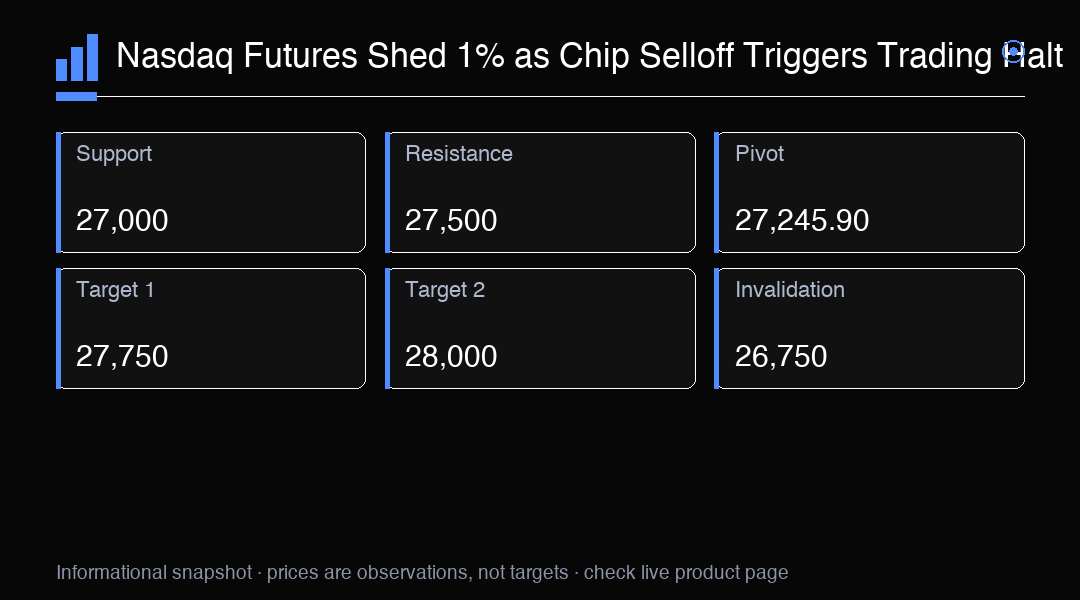
Trading Insight
Nasdaq futures are down roughly 1% with the chip selloff in Asia triggering a trading halt in South Korea. The 27,245.90 level is the key pivot, with support at 27,000 and resistance at 27,500. A break below 27,000 could expose 26,750, while a recovery above 27,500 would target 27,750. Watch Wednesday's CPI report at 8:30 a.m. ET and Thursday's TSMC earnings for direction.