


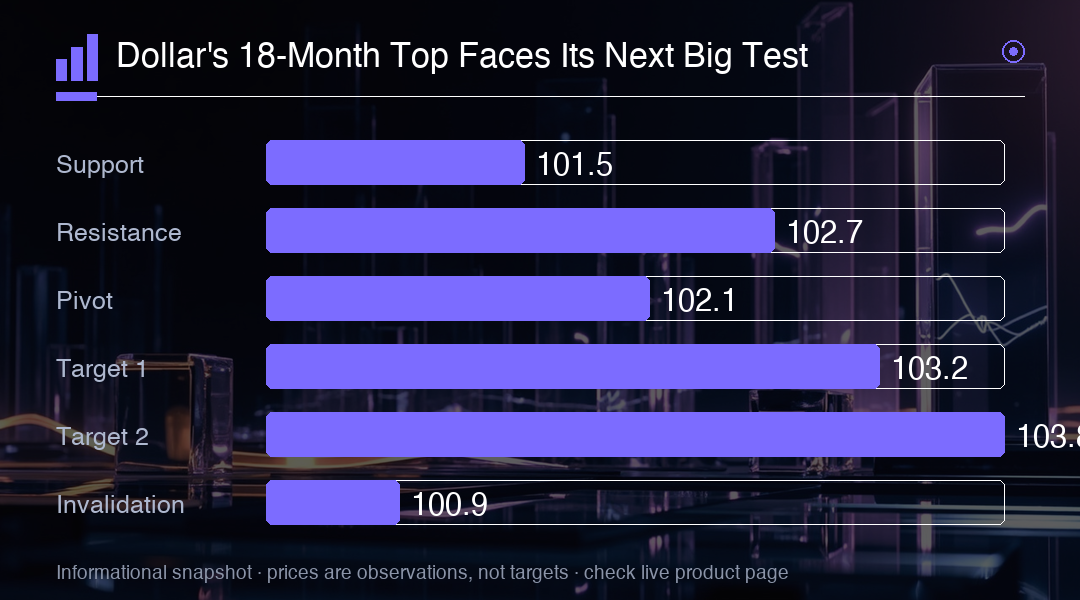
The US dollar index DXY hovered near 102.1 early Monday, holding close to the 18-month high reached last week. The euro accounts for 57.6% of the index's weighting, making EUR/USD the dominant driver of any move in the basket. Wednesday's US CPI report at 8:30 a.m. ET is the next major test for the greenback, with economists forecasting annual headline inflation of 3.7% and core inflation of 2.5%. A print above those estimates could reignite the dollar rally, while a miss could unwind some of the recent gains.
Trading was subdued on Monday with Japan on holiday, leaving the dollar index in a narrow band around the 102.1 level throughout the Asian and European sessions. The 18-month high reached last week remains the key reference point for traders deciding whether the rally has further to run or is due for a pause. Thin liquidity during the Japanese holiday can exaggerate moves in USD/JPY, which closed near 158.10 yen as Japanese markets were closed for the annual Sports Day holiday.
The dollar index measures the greenback against six currencies, with an important imbalance in its construction that every trader should understand. The euro carries a 57.6% weighting, meaning that EUR/USD alone can swing the index more than all five other components combined on any given day. The yen, pound, Canadian dollar, Swedish krona and Swiss franc make up the remainder, each with a far smaller influence on the daily reading. This concentration risk means that eurozone economic data and European Central Bank policy expectations can dominate the index direction even when the underlying US fundamentals have not changed.
Across the major pairs, EUR/USD traded around $1.1210 and GBP/USD near 1.3245, while USD/JPY stood at 158.10 yen and USD/CAD around C1.4250. The readings send mixed signals about dollar direction that require careful interpretation. Rising EUR/USD or GBP/USD indicates dollar weakness because those pairs price the dollar in foreign currency terms, while rising USD/JPY or USD/CAD indicates dollar strength because those pairs price foreign currency in dollar terms. On Monday the two camps were roughly in balance, leaving the index flat but tense ahead of the inflation data.
US yields remain a substantial source of support for the greenback and a primary reason the dollar has held its 18-month highs. The 10-year Treasury ended Friday around 5.24%, keeping dollar-denominated assets competitive against other major markets and attracting international capital flows. Traders assigned around 17% probability to an October Fed hike and 86% to an increase by December, according to market pricing derived from fed funds futures. Those expectations have anchored the dollar's rally for weeks and will be highly sensitive to any inflation surprise this week, particularly in the core component that the Federal Reserve watches most closely.
Europe's fiscal difficulties weaken a major dollar alternative and have removed a potential source of pressure on the index. Large deficits and political uncertainty in France have unsettled investors, while rising energy costs threaten growth across the broader eurozone region. Higher European yields have offered limited support to the euro when markets interpret them as evidence of fiscal risk rather than stronger economic prospects, which has been the prevailing dynamic in recent months. That interpretation has kept EUR/USD capped near $1.1210 and, by extension, has underpinned the dollar index at its elevated levels.
Canada provides another example of diverging policy expectations that has worked in the dollar's favor. September employment unexpectedly fell by 68,300, reducing the probability of an October Bank of Canada hike to 25% from 40% before the report was released. The Canadian dollar touched an 18-month low in the meantime as traders rapidly repriced the Bank of Canada's policy path, and USD/CAD held near C1.4250 as the softer jobs data weighed on the loonie. This divergence between US and Canadian monetary policy expectations has been a steady tailwind for the dollar index over the past several sessions.
Wednesday's US CPI report arrives at 8:30 a.m. ET and will be the week's decisive event for the dollar and for global markets. Economists forecast annual headline inflation of 3.7% and core inflation of 2.5%, according to a survey of analysts. Persistent underlying price pressure could reinforce tightening expectations and push the dollar through its 18-month high, potentially opening the door to a broader rally. A softer reading could weaken the yield support that has helped sustain the dollar's rally, opening the door to a pullback toward lower levels as traders reduce their Fed rate hike bets.
Oil complicates the outlook for the dollar and for the inflation calculation in ways that are often underestimated. Brent eased toward $103 after a proposed Russia-Ukraine energy ceasefire raised hopes for additional supply entering global markets. Confirmation of the ceasefire remained incomplete as of Monday, though, and any sustained drop in energy prices would feed directly into the inflation calculation the Federal Reserve watches when setting policy. A reversal of those supply hopes could lift oil again and restore some of the inflation risk premium that has kept the dollar bid.
Thursday's producer prices and retail sales data come as the next assessment after the CPI report and will help confirm or challenge the inflation narrative. Traders will watch whether price pressure is easing alongside resilient consumer spending, then how Treasury yields and Fed expectations respond in the hours and days that follow. A combination of cooling inflation and steady spending would be the friendliest scenario for risk assets while still leaving the dollar supported by relatively high yields. A hot CPI followed by strong retail sales would be the most bullish outcome for the dollar, while a soft CPI with weak spending could trigger a broad-based dollar selloff.
For the dollar index, the 18-month high reached last week is the line in the sand that separates a consolidating rally from a breakout. A confirmed break above that level on the back of a hot CPI print would likely extend the rally and bring the next resistance zone into play, potentially opening a path toward the 103.8 area. A soft inflation reading, by contrast, could trigger a rapid unwinding of the hawkish Fed expectations that have underpinned the dollar, sending the index back toward the lower end of its recent range near 101.5. The 102.1 pivot level is where the near-term battle between bulls and bears will be decided.
The dollar sits at a crossroads on Monday, with the 18-month top in sight and the inflation test just two days away. The euro's 57.6% weighting means EUR/USD will lead any move in the index, and the mixed readings across the major pairs reflect a market waiting for direction from the data. Wednesday's CPI report at 8:30 a.m. ET, followed by Thursday's producer prices and retail sales, will determine whether the dollar's rally extends or stalls. Traders should position for volatility, as the gap between the 3.7% consensus forecast and the actual print could move the index by a full point in either direction within minutes of the release.
交易洞察
The dollar index is testing its 18-month high with the euro's 57.6% weighting making EUR/USD the key pair to watch. A hot CPI print above the 3.7% headline forecast could push DXY through resistance toward 103.2, while a soft reading risks a pullback toward 101.5 as yield support fades. Thursday's producer prices and retail sales will confirm the direction.