


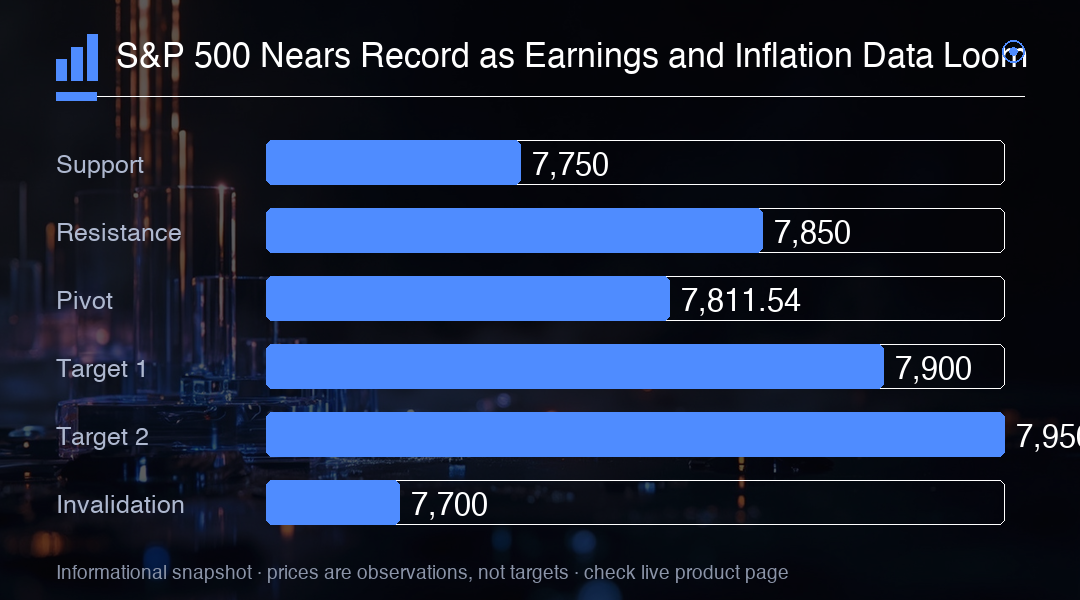
KEY POINTS: The S&P 500 gained 0.6% Friday to close at 7,811.54, near Tuesday's record, finishing the week up 1.2%. The Dow climbed 423 points to 51,654.95, while the Nasdaq rose 0.6% to 27,366.17. S&P 500 futures rose 0.3% early Monday, while Nasdaq-100 futures gained around 0.4%. The week ahead brings bank earnings beginning Tuesday and the CPI report on Wednesday at 8:30 a.m. ET.
Friday's advance capped a week in which the S&P 500 rose 1.2%, bringing the index to within striking distance of the record set on Tuesday. The Dow's 423-point gain to 51,654.95 and the Nasdaq's 0.6% rise to 27,366.17 confirmed the breadth of the move across the major indexes. Smaller companies lagged over the week, with the Russell 2000 losing 0.9%, a divergence that suggests the rally remains concentrated in large-cap growth names rather than broadening across the entire market. The concentration raises questions about the sustainability of the advance if participation does not widen.
Monday's session opened with S&P 500 futures up 0.3% and Nasdaq-100 futures gaining around 0.4%, extending the positive momentum into a new week. European futures also advanced, providing a supportive backdrop for the opening hours. Trading could be thinner than usual: Japan is closed for a holiday and US bond markets observe Columbus Day, although American stocks trade normally. The reduced participation can amplify moves in either direction, as lower liquidity means fewer orders are needed to move prices. Thin markets can produce exaggerated reactions to news that would normally be absorbed more gradually.
SpaceX's spectrum deal triggered a sharp telecom repricing that reverberated through the entire sector. The company agreed to acquire Grain Management's nationwide 800 MHz portfolio, reportedly for $8 billion. T-Mobile closed Friday down 13.3%, AT&T lost 9.8% and Verizon fell 8.8%. Tower operators rallied on the news, as the deal suggested that wireless spectrum assets carry strategic value that incumbent carriers may need to match or exceed. The repricing was swift and severe, with the three major carriers shedding a combined significant portion of their market value in a single session, a magnitude that forced portfolio managers to reassess their telecom holdings.
Amazon and Apple brought separate developments into Monday that added to the week's narrative. Amazon is discussing a $7 billion acquisition of AI startup Decart, with no agreement announced. The potential deal signals that the company is willing to spend aggressively to build out its artificial intelligence capabilities and compete in the rapidly evolving AI landscape. Apple fell 1.1% Friday after component-order cuts for its iPhone 18 Pro models raised demand concerns among investors. The decline added to recent pressure on the stock, as traders questioned whether the next product cycle would deliver the growth needed to justify the valuation that the market has assigned to the company.
International markets showed a mixed picture that diverged from the firmer US futures. South Korea's Kospi fell 2.2% and Taiwanese shares slipped 0.5%, while Chinese blue chips edged up 0.1%. The divergence from firmer US futures shows that Friday's Wall Street recovery has not produced a uniform global rally. Regional factors, including local economic data and policy expectations, continue to drive performance independently of the US market's trajectory. The lack of global follow-through suggests that international investors are waiting for more confirmation before committing to risk assets.
Oil prices retreated as geopolitical tensions eased and supply concerns diminished. Brent fell 1.5% to $103.18 a barrel, while WTI dropped toward $90.31. Trump's proposed Russia-Ukraine energy ceasefire and additional Russian diesel supplies eased immediate concerns about supply disruptions that had supported prices in prior sessions. The decline in energy prices removed one source of inflation pressure, though both benchmarks remain elevated enough to keep input costs for businesses and consumers at levels that complicate the central bank's path toward lower rates.
The dollar retained most of its recent strength, with its index near 102.14, close to an 18-month high. EUR/USD traded around $1.1210 after five weekly declines, GBP/USD hovered near $1.3245 and USD/JPY stood around 158.10 yen. The persistent dollar strength reflects the gap between US economic performance and that of other major economies, as well as the interest rate differential that continues to favor dollar-denominated assets. For US exporters, the strong currency creates a headwind that can erode competitiveness in international markets, potentially weighing on corporate earnings in the quarters ahead.
Gold held above $4,200, trading near $4,206, while silver reached above $61.10. Softer oil and a subdued dollar supported bullion, as the combination of lower energy prices and a stable currency reduced the opportunity cost of holding non-yielding metals. Bitcoin steadied around $83,800 and Ether held near $2,540, showing that the cryptocurrency complex was finding a floor after recent volatility. The precious metals' strength alongside stable crypto suggested that investors were maintaining exposure to alternative assets despite the equity market's advance, a pattern that often persists when uncertainty about the macro outlook remains elevated.
Bank earnings begin Tuesday with JPMorgan, Goldman Sachs, Citigroup and Wells Fargo, followed by Bank of America and Morgan Stanley on Wednesday. The start of the earnings season provides the first real test of whether corporate America can deliver the growth that equity valuations require. S&P 500 third-quarter earnings are expected to rise more than 30%, setting a demanding benchmark for corporate performance. The high bar means that even solid results may not be enough to justify further multiple expansion, and disappointment could trigger a sharp repricing across the market. Investors will scrutinize guidance and forward commentary as much as the headline numbers.
ASML reports Wednesday and TSMC follows Thursday, providing important checks on semiconductor investment and the AI supply chain. TSMC's quarterly profit is forecast to rise 65% to $23.4 billion after revenue increased 50%, a remarkable growth rate that reflects the insatiable demand for advanced chips. The semiconductor sector's performance is critical because it sits at the intersection of the AI buildout and the broader technology cycle. Strong results from these companies would validate the capital expenditure plans that have driven the sector's re-rating, while any shortfall could call into question the sustainability of the spending trajectory that has underpinned the rally.
Wednesday's CPI arrives at 8:30 a.m. ET and is the week's most important economic release. Economists forecast annual headline inflation of 3.7% and core inflation of 2.5%. Markets still strongly favor an October Fed pause, but assign roughly 86% probability to a hike by December, reflecting the persistent nature of price pressures. A hotter reading could revive pressure on bonds and stocks, as it would signal that inflation remains stubborn enough to warrant further tightening. Thursday brings producer prices and retail sales, testing both inflation pressure and household demand. The US 10-year Treasury yield ended Friday around 5.24%, keeping borrowing costs elevated and maintaining the pressure on equity valuations across the market.
交易洞察
The S&P 500 sits near record levels with earnings and inflation data as the next catalysts. A close above the record would confirm the uptrend, while a failure to break through could signal exhaustion. Watch the 7,811.54 level as the pivot, with support at 7,750 and resistance at 7,850. The CPI print on Wednesday is the key macro event, with a hotter reading likely to pressure rate-sensitive sectors.