


KEY POINTS: Meta gained 3.4% to $742.96 Monday, ending four consecutive losing sessions and outperforming a declining Nasdaq. The catalyst was the launch of Muse Wonder and Muse Wonder Full, giving investors fresh evidence of progress from the company's expensive AI overhaul. Zuckerberg told a report that Meta has caught up with rivals at the AI frontier and rejected calls to slow development.
Meta shares climbed 3.4% to $742.96 on Monday, ending a streak of four consecutive losing sessions and outperforming a broader market that was weighed down by semiconductor weakness. The advance came after the company introduced Muse Wonder and Muse Wonder Full, its most advanced model family to date under the internal codename Watermelon. The launch gave investors tangible evidence that the company's substantial capital expenditure on artificial intelligence is producing visible product milestones, which is the kind of catalyst that can shift sentiment even in a difficult macro environment.
The Watermelon project represents the culmination of a expensive overhaul of Meta's AI business that has consumed tens of billions of dollars in capital expenditure. The new models follow Muse Spark, previously known as Avocado, and represent a significant step forward in the company's ambition to compete with OpenAI and Anthropic at the frontier of artificial intelligence capability. Meta said the models can handle complex tasks involving coding, legal documents, finances and insurance claims, which suggests a broadening of use cases beyond the consumer messaging applications where the company has historically generated most of its revenue.
A key feature of the new models is Active Memory, which carries relevant information between conversations, allowing the system to maintain context across multiple interactions. This is a meaningful improvement over previous generations that required users to re-establish context with each new session. The company also introduced Active Focus, which aims to help agents work through obstacles and recover from errors autonomously. Together, these features represent an attempt to move beyond simple question-and-answer interactions toward more sophisticated agentic behavior that can handle multi-step tasks.
Zuckerberg told a report that Meta has caught up with rivals at the AI frontier, arguing that Muse Wonder enables more sophisticated behavior than previous models. The term frontier describes the industry's most capable systems, and the CEO's claim represents a significant assertion given that Meta was widely perceived as lagging behind OpenAI and Anthropic in the race for advanced AI capability. However, the company's claims still need to be tested against real-world user experience, and the competitive landscape is evolving rapidly enough that today's frontier can become tomorrow's baseline.
The report also indicated that the CEO rejected calls to slow development and committed to further big spending to challenge OpenAI and Anthropic. This stance puts Meta at odds with some voices in the AI safety community who have argued for a more cautious approach to capability advancement. The company's position is that the competitive dynamics of the AI industry make it impossible to slow down without ceding ground to rivals, and that the responsible path forward is to invest aggressively in both capability and safety simultaneously.
Meta said it evaluates releases under its Superintelligence Scaling Framework, with safeguards covering private information and misuse. Additional safety evaluations are due in a forthcoming report that will provide more detail on how the company assesses the risks associated with increasingly capable models. As agents gain access to messages, calendars and documents, reliability and permission controls become part of the product's commercial appeal, which means that safety is not just a regulatory requirement but a competitive differentiator.
A report indicated that Muse has attracted nearly nine million downloads, but download growth is slowing and its 14-day retention trails ChatGPT's. Retention measures whether people keep returning after trying an app, which is a more meaningful metric than raw download numbers because it indicates whether the product is delivering sustained value. Better models could help improve retention, but download totals alone do not establish durable demand or subscription revenue, which is ultimately what will determine whether the AI investment generates adequate returns.
The financial stakes remain substantial: Meta's 2026 capital expenditure guidance stands at $130 billion to $145 billion, including finance-lease principal payments. This level of spending is unprecedented for a company of Meta's size and represents a significant bet that AI capabilities will generate sufficient returns to justify the investment. The guidance includes not just the direct costs of training and running models but also the infrastructure required to deploy them at scale across Meta's family of applications.
Meta's 3.4% advance on Monday occurred against a broader market backdrop that was decidedly negative, with the Nasdaq falling 0.4% and semiconductor stocks under pressure from multiple sources. The fact that Meta outperformed the broader market by such a significant degree suggests that investors are willing to reward companies that demonstrate tangible progress on AI, even when the macro environment is challenging. This divergence between Meta and the chip names highlights how stock-specific catalysts can override sector-wide weakness.
The launch of Muse Wonder and Muse Wonder Full represents a significant milestone in Meta's attempt to close the gap with OpenAI and Anthropic, but the competitive landscape remains intense. OpenAI has postponed its own listing plans, with Sam Altman arguing that going public now would be ill advised, while Anthropic is preparing for a potential IPO as soon as mid-November. Meta's decision to continue investing aggressively while its rivals pursue different strategies creates an interesting dynamic in the AI industry, with each company betting on a different path to value creation.
For investors, the key question is whether Meta's AI investments will generate sufficient returns to justify the $130 billion to $145 billion capital expenditure guidance for 2026. The company's ability to monetize its AI capabilities through advertising, enterprise subscriptions and consumer applications will determine whether the investment creates or destroys shareholder value. Monday's 3.4% advance suggests that at least some investors believe the company is making progress, but the real test will be whether the new models can attract and retain users in a competitive market.
Trading Insight
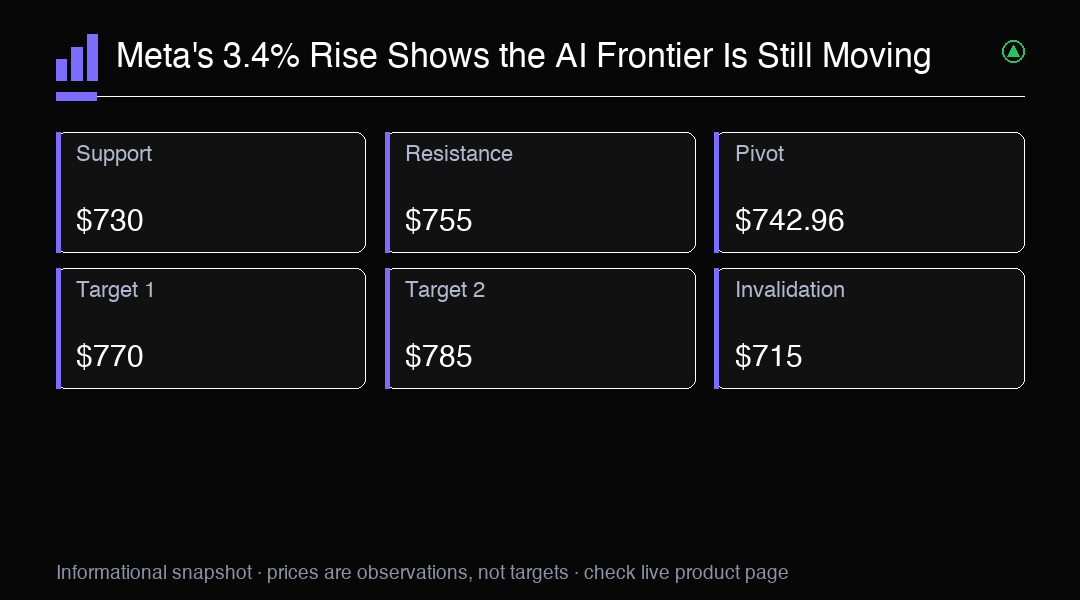
Meta's 3.4% rise to $742.96 shows that investors still reward tangible AI progress even in a difficult macro environment. The $742.96 level is the key pivot, with support at $730 and resistance at $755. A break below $730 could expose $715, while a recovery above $755 would target $770. Watch the forthcoming safety report and any announcements about enterprise adoption of the Muse Wonder models for direction.