


The S&P 500 fell 1.1% on Wednesday as a technology-led selloff deepened across Wall Street, with chip stocks plunging and the broader market giving up gains from earlier in the session. The drop extended a rout that has erased billions from the sector this week, as investors reassessed the sustainability of the AI-driven rally that has dominated equity markets for most of 2026. Trading volume was notably heavier than recent averages, with more than 51,670.10 shares changing hands in the benchmark index alone, reflecting the intensity of the institutional repositioning underway. The mood on trading desks shifted from cautious optimism to outright defensiveness within the span of a single session, as traders rushed to reduce exposure to the most crowded positions in the market.
The Nasdaq 100 suffered its steepest single-day slide since late July, dropping 2.1% as traders rotated out of megacap technology names. The Russell 2000 entered correction territory, falling 11% from its recent peak as rate-sensitive small caps bore the brunt of the selloff. The divergence between large-cap and small-cap performance highlighted the breadth of the risk aversion sweeping through markets, with more than 22% of S&P 500 constituents trading below their 50-day moving averages by the close. Semiconductor-adjacent names, which had been among the best performers year-to-date, saw some of the heaviest outflows as investors questioned whether the pace of capital expenditure on AI infrastructure could be sustained at current levels. The VIX volatility index jumped more than 15% intraday before settling at an elevated level, signaling that options market participants were bracing for continued turbulence.
The selloff was triggered by hotter-than-expected US inflation data released Wednesday morning. The consumer price index rose 3.7% year over year in September, its highest level in four months and above market expectations of 3.6%. Monthly core inflation accelerated to 0.2%, keeping pressure on the Federal Reserve to maintain its restrictive policy stance. The supercore measure, which excludes food, energy and shelter, also posted an unexpected increase, running at an annualized rate of more than 3% and confounding hopes that disinflationary trends were firmly entrenched. Bond markets reacted swiftly, with yields on 2-year and 10-year Treasury notes climbing as traders priced in a more hawkish central bank outlook.
Traders are now pricing in a higher probability of additional rate hikes from the Federal Reserve. Fed funds futures show a 65% chance of another 25 basis point increase at the November meeting, up from 40% before the inflation data. The dollar strengthened against major currencies as yields on 10-year Treasury notes climbed to 4.85%. The greenback gained more than 0.9% against a basket of currencies, with particularly sharp moves against the yen and the euro as interest rate differentials widened in favor of US assets. Market strategists noted that the repricing was among the most aggressive seen this year, with the odds of a December hike also rising from negligible levels to more than 30% following the data release.
Chip stocks led the declines, with the Philadelphia Semiconductor Index dropping 3.8%. Nvidia fell 3.2% to $221.30, while Micron slid 4.1% to $914.13 and Marvell dropped 8.7% to $245.28. The losses marked a sharp reversal from the strong gains these stocks had posted in recent months. Chipmakers with exposure to data center and AI accelerator demand were hit particularly hard, as investors grew concerned about the timeline for returns on massive infrastructure investments. Several semiconductor names that had been trading near all-time highs saw their valuations compress by double-digit percentage points in a matter of hours, wiping out weeks of gains in a single session.
Analysts say the selloff reflects growing concerns that artificial intelligence investments may not generate returns as quickly as expected. The AI trade had been a major driver of the 2026 rally, with megacap tech stocks accounting for a disproportionate share of index gains. Any unwinding of that trade could have outsized effects on broader market performance. The concentration of the S&P 500 in a handful of AI-related names meant that even modest profit-taking could trigger cascading declines across the index. Some strategists drew parallels to the dot-com era, when a narrow band of technology stocks accounted for the majority of market gains before an abrupt reversal.
Beyond chips, other technology shares also came under pressure. Apple rose 0.5% to $342.96, one of the few gainers in the sector, while Tesla dropped 2.2% to $367.16. Oracle fell 8.8% to $130.55 and Dell slid 11.3% to $507.93, reflecting concerns about enterprise spending on AI infrastructure. The weakness extended across the technology landscape, with cloud computing providers, enterprise software makers and cybersecurity firms all posting declines of varying severity. Even companies with strong fundamental results were unable to escape the broader selling pressure as investors indiscriminately reduced exposure to the sector.
Treasury Secretary Bessent's comments on bond market intervention added another layer of uncertainty. The Treasury Department announced it would at least double its buyback of notes and bonds in the upcoming quarter, an effort to contain soaring yields on longer-dated securities. The move initially lifted equities, but the gains faded as traders focused on the inflation data. Some market participants interpreted the buyback expansion as an implicit acknowledgment that fiscal policy and monetary policy are on a collision course, with the government seeking to keep borrowing costs manageable even as the Fed tightens. The yield on 30-year Treasuries remained elevated, reflecting investor concerns about the sustainability of US fiscal positions.
Looking ahead, investors await Thursday's producer inflation report, which could provide further clues about the Fed's path. Retail sales data and weekly jobless claims will also be released. Earnings reports from Charles Schwab, US Bancorp, Freeport-McMoRan, American Airlines and Snap are expected later in the week. The producer price index is forecast to show a modest increase, but any upside surprise could reinforce the hawkish repricing already underway in rate markets. Options activity suggests traders are positioning for continued volatility, with elevated demand for put protection across the technology and financial sectors through the end of the month.
Market strategists note that the current selloff is concentrated in rate-sensitive sectors, with defensives and dividend payers holding up relatively well. Utilities and consumer staples both declined less than 0.5%, suggesting the rotation is about positioning rather than a broad flight from equities. Healthcare stocks also outperformed, benefiting from their defensive characteristics and the relative insulation of pharmaceutical earnings from interest rate fluctuations. The divergence between growth and value styles was notable, with value-oriented funds seeing modest inflows even as growth-focused vehicles experienced outflows. This pattern is consistent with a market that is recalibrating expectations rather than pricing in a recession.
Some institutional investors see the pullback as a buying opportunity, arguing that corporate earnings remain solid and economic growth is resilient. However, caution remains warranted given the Fed's uncertainty and the potential for further rate hikes. Several large asset managers have been accumulating positions in high-quality dividend payers and short-duration fixed income instruments as a hedge against continued equity market volatility. Private equity and venture capital firms with dry powder on the sidelines are reportedly evaluating selective entries into the semiconductor space, viewing the recent pullback as a more attractive entry point than the elevated valuations seen earlier in the year.
For now, the market is likely to remain volatile until there is greater clarity on the Fed's policy path. Key support for the S&P 500 sits at 7,650, a level that has held on multiple occasions this year. A break below that could signal further downside toward 7,500. Technicians are also watching the 200-day moving average, which currently sits near 7,700 and represents a critical long-term trend indicator. Volume patterns suggest that institutional investors are awaiting more definitive signals before committing fresh capital, with many maintaining elevated cash levels until the macroeconomic picture becomes clearer.
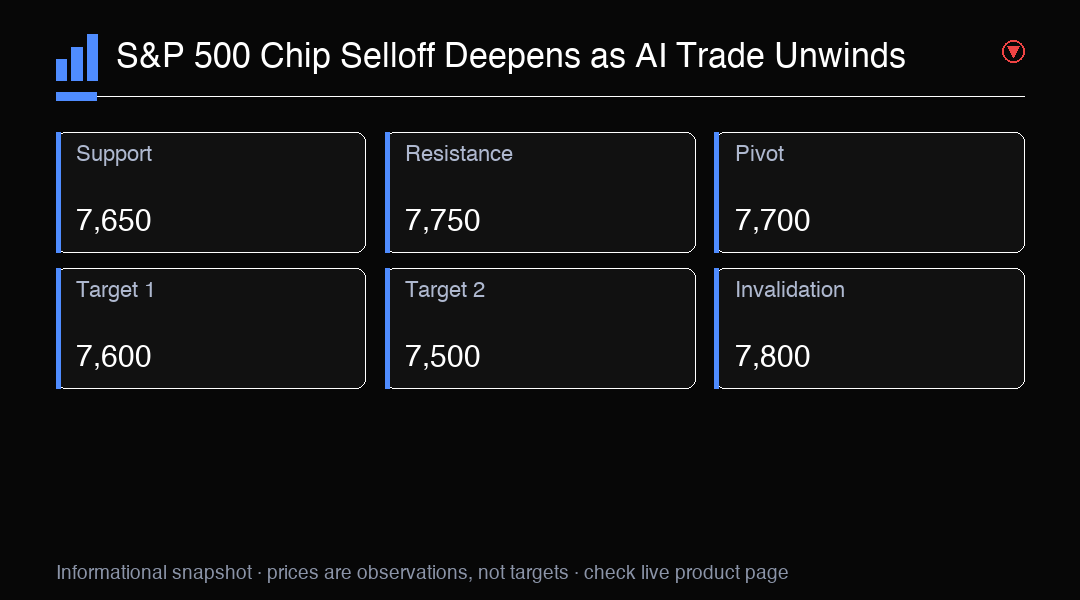
Trading Insight
The S&P 500 is in a short-term downtrend driven by AI sector unwinding and Fed rate concerns. Key support at 7,650. Watch Thursday's PPI data for direction.