


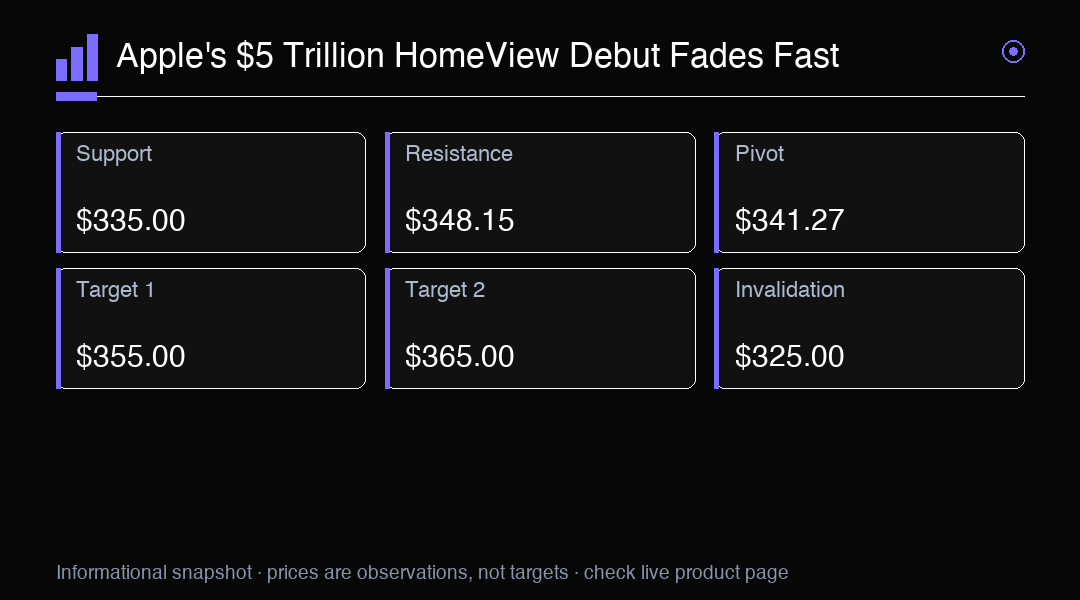
KEY POINTS: Apple shares touched an intraday record of $348.15 on Tuesday before closing up just 0.1% at $341.27, leaving market capitalization at $4.98 trillion. The HomeView home hub starts at $299 and ships November 13, with pre-orders already open in initial markets. A close above $342.61 would put Apple over $5 trillion using the current share count.
Apple on Tuesday unveiled HomeView, a seven-inch home hub that marks the company's most ambitious push into the smart-home category to date. The device comes in tabletop and wall-mounted versions and combines entertainment, FaceTime and smart-home controls in a single screen designed for shared household use. The launch represents Apple's clearest signal yet that it views the connected home as a major growth frontier rather than a peripheral accessory market, and the company is betting that its ecosystem integration can give it an edge over established smart-display competitors. The smart-display market has grown steadily over the past several years, and Apple's entry brings significant brand recognition and a loyal installed base to a category that has so far been dominated by less integrated offerings.
The software proposition centers on Siri AI, which powers conversational requests, information discovery and actions across compatible apps. When paired with an Apple Intelligence-enabled iPhone or iPad, HomeView can draw on personal context from services such as Messages and Calendar, making the existing Apple ecosystem central to its usefulness. Apple says the device can recognise up to six household members and personalise the screen for each, a feature aimed at making the hub feel less like a shared appliance and more like a family product that adapts to whoever is standing in front of it at any given moment.
Alongside HomeView, Apple introduced the HomePod mini 2 at $149, arriving October 30, and a new Apple TV 4K at $299, arriving November 13. The launch schedules differ from feature availability: Siri AI reaches HomePod mini 2 through a future software update, making delivery of the promised experience worth watching for early adopters. The staggered rollout means customers who buy the speaker this month will not access its most advanced capabilities until a later software release, a strategy that has drawn mixed reactions from consumers who expect full functionality on day one.
Apple also expanded its Home Collection with cameras, thermostats and a smart lock, developed in partnership with LG Electronics and Schneider Electric. Some camera features require eligible iCloud+ plans, which could create a modest recurring revenue stream alongside the hardware sales. The partnerships with established home-appliance manufacturers suggest Apple is prioritising broad compatibility over a fully proprietary approach to the connected home, a pragmatic decision that should help the products gain traction in households that already have non-Apple smart devices installed. By working with third-party manufacturers rather than building every component in-house, Apple can expand its home ecosystem faster and at lower risk.
HomeView will initially be unavailable in the European Union because Siri AI is currently unavailable in iOS there, the company said. The restriction limits the product's launch addressable market and underscores how regulatory and software-readiness issues continue to shape Apple's global rollout strategy. European customers who pre-order other Apple products will need to wait for a separate announcement regarding HomeView availability, and the company has not provided a timeline for when the device might reach that market.
Wearables, Home and Accessories generated $7.9 billion in Apple's June quarter, up 6% annually. That category includes several products, so its results will not isolate HomeView's contribution, but the segment's steady growth gives Apple a solid foundation to build on. The 6% increase demonstrates that demand for Apple's home and accessory products remains healthy even before the new product line reaches customers, and investors will be watching whether the category accelerates in the December quarter as HomeView begins shipping.
Tuesday marked Apple's sixth session trading above $5 trillion in market capitalization intraday without holding that level into the close. The repeated failure to secure a close above the threshold suggests some investors are using the milestone as a trigger to take profits rather than add exposure. Market pricing showed the stock struggled to maintain momentum after the initial excitement of the HomeView announcement faded during the trading session, a pattern that has become familiar for Apple shares during major product events.
Shares are up roughly 26% this year, giving Apple a substantial advance heading into the holiday shopping season. The new home range adds another growth opportunity, but investors will ultimately need evidence of customer demand and revenue alongside the product demonstrations to justify further multiple expansion. The 26% gain means expectations are already elevated heading into the most important retail quarter of the year, leaving little room for disappointment if early sales figures fail to impress.
For current Apple device owners, HomeView's deep integration with iPhone, iPad and the broader ecosystem creates a compelling upgrade path that builds on their existing investment in Apple products. For prospective buyers without existing Apple hardware, the value proposition is less clear, since much of the device's intelligence depends on pairing with Apple Intelligence-enabled products. This dynamic means HomeView is more likely to deepen loyalty among current users than to convert new ones at launch, which could limit the product's initial sales velocity but strengthen long-term engagement. The upgrade cycle for Apple device owners tends to be driven by ecosystem lock-in, and HomeView adds another reason to stay within the Apple universe rather than switch to a competitor.
The $299 price point positions HomeView as a premium but accessible entry into Apple's home ecosystem, well below the cost of a new iPhone but high enough to signal quality and durability. Pre-orders are already open in initial markets, and the November 13 release date positions the product squarely within the holiday shopping window. Apple's decision to open pre-orders before reviews and real-world testing are available reflects confidence in the product's appeal to its installed base, though it also means early adopters are committing based on promise rather than proven performance.
Apple's HomeView debut has generated genuine excitement, but the stock's fade from intraday record to a flat close reminds investors that product launches alone do not sustain valuations indefinitely. The coming weeks of pre-order data and early reviews will provide the first real test of whether HomeView can convert enthusiasm into a meaningful new revenue stream. For now, Apple sits just below the $5 trillion mark, a threshold that has proven stubbornly difficult to hold despite six attempts, and the burden of proof now shifts from product announcement to commercial execution.
Trading Insight
Apple's failure to hold above $5 trillion for a sixth consecutive session suggests profit-taking at the milestone. A close above $342.61 would confirm a breakout, while a drop below $335.00 would signal deeper pullback. Investors should watch pre-order data and early reviews for evidence of customer demand.