


The S&P 500 erased losses and closed 0.3% higher on Thursday after Federal Reserve Chair Kevin Warsh said artificial intelligence technology is a huge benefit to the US economy. The comments helped ease concerns that AI investments may not generate returns as quickly as expected, powering a recovery in technology stocks. Warsh's remarks landed at a critical juncture for market sentiment. After weeks of anxiety about whether artificial intelligence capital expenditure could deliver meaningful returns, the Fed chair's endorsement provided institutional investors with fundamental cover to rebuild exposure. The timing proved especially significant given the recent bout of profit-taking in megacap technology names. For traders navigating the current landscape, the message from Washington is clear: policymakers view AI not as a speculative bubble but as a genuine productivity catalyst capable of reshaping output potential across multiple sectors.
Speaking in Bangkok, Warsh said he is seeing structural economic growth in the US driven by AI adoption. Traders pared bets on an interest-rate hike and the dollar fell. Futures on the Nasdaq 100 Index climbed as much as 0.2% after the comments, having earlier dropped as much as 0.5%. The shift in rate expectations was immediate and pronounced. Interest-rate futures quickly adjusted to reflect a lower probability of additional tightening, with the implied probability of a hike at the next meeting falling sharply. The dollar softened across major pairs, providing additional support for risk assets denominated in US currency. Bond yields also edged lower, easing the valuation pressure that had weighed on growth-oriented sectors. Market participants interpreted the Bangkok comments as a signal that the Fed is increasingly comfortable with the current policy stance, reducing the tail risk of premature tightening that had haunted equities since late September.
The recovery came after a chip-fueled selloff earlier in the week that had sent the Russell 2000 into correction territory. Micron Technology's blowout forecasts and a benign inflation report helped the benchmark S&P 500 and tech-heavy Nasdaq reverse weekly losses. The S&P 500 is now up more than 15% year to date. The chip sector had come under intense pressure as investors rotated away from AI-adjacent names amid fears of an inventory correction. However, Micron's results demonstrated that demand for high-bandwidth memory and advanced semiconductor packaging remains robust. The Russell 2000's fall into correction territory had raised concerns about broadening weakness in the US economy. Yet the S&P 500's ability to recover suggests that large-cap technology continues to drive index performance, even as smaller companies struggle with higher borrowing costs. The divergence underscores the concentration risk inherent in cap-weighted benchmarks.
Asian equities were primed to rebound Friday after dip buyers powered a recovery on Wall Street. Equity-index futures for Japan, South Korea and Australia pointed to gains at the open. The MSCI Asia Pacific equities index advanced 1.5%, while South Korea's Kospi gained 3.6%. The synchronized strength across Asian markets reflected growing confidence that the worst of the AI-related selloff may be behind us. Japanese exporters benefited from a weaker yen, while South Korean semiconductor names rallied on the back of Micron's strong outlook. Australian mining stocks also contributed to the advance as commodity prices firmed. The breadth of the rebound suggested that institutional investors were not merely trading headlines but actually repositioning portfolios for a renewed AI-driven earnings cycle. For regional investors, the key question is whether the recovery can sustain momentum once the initial enthusiasm fades.
Treasury Secretary Bessent's earlier comments on bond market intervention had initially lifted equities, but gains faded as traders focused on inflation data. However, Warsh's latest comments provided a more durable catalyst, suggesting the Fed sees AI as a productivity boost rather than an inflation risk. The distinction between these two drivers is critical for understanding the market's trajectory. Bessent's intervention remarks addressed financial stability concerns but did little to alter the fundamental earnings outlook. Warsh's AI commentary, by contrast, directly addressed the valuation debate that has dominated equity markets for months. By framing AI as a deflationary force through enhanced productivity, he effectively neutralized one of the most persistent bear arguments. This reframing could have lasting implications for sector rotation, as investors may now be more willing to pay up for companies demonstrating clear AI-related revenue growth. The market's positive response suggests that this narrative shift is already underway.
Trading volumes are expected to remain light this week, with the US stock market closing at 1:00 p.m. ET on Wednesday and shut on Thursday for the holiday. Optimism around AI, a resilient US economy and monetary policy easing put the three main indexes on course for their third consecutive year of gains. Thin volumes can amplify price movements, meaning that even modest flows can have an outsized impact on index levels. The combination of reduced liquidity and positive sentiment creates conditions for potentially volatile swings. Historically, holiday-shortened weeks tend to favor bulls, as institutional investors prefer not to hold large positions over extended breaks. The current setup, with the S&P 500 approaching resistance and sentiment improving, suggests that the path of least resistance may be higher. However, traders should remain cognizant that low-volume rallies often lack conviction. The true test will come when volumes return to normal levels.
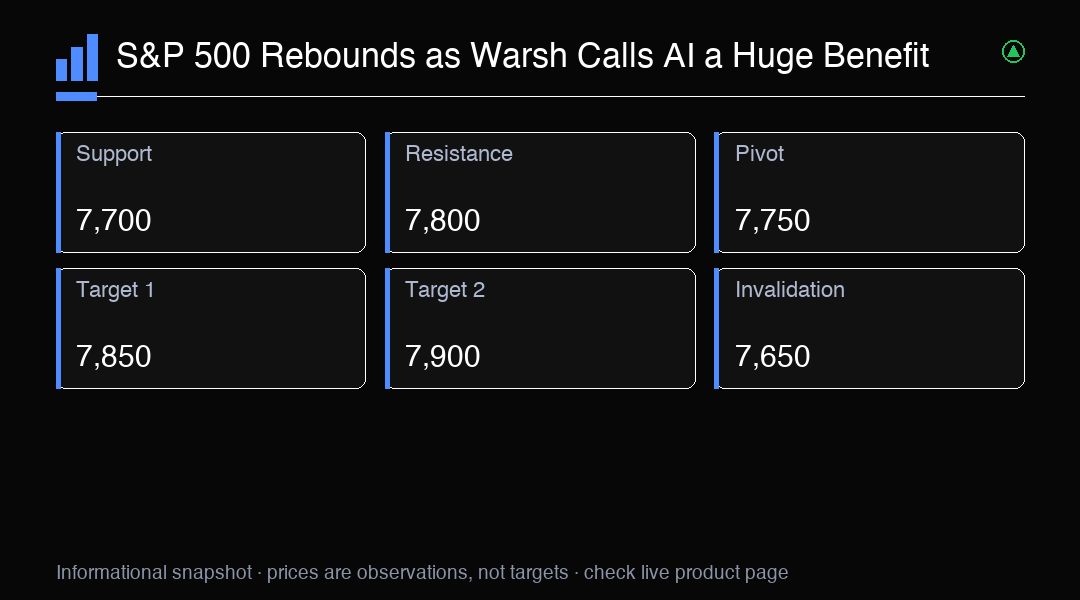
Analysts note that the S&P 500 is now testing key resistance at 7,800. A break above that level could open the door to a retest of the all-time high near 7,850. Support sits at 7,700, which has held on multiple occasions this week. The technical picture suggests that the index is consolidating in a narrowing range, with each successive dip being bought more aggressively. Volume patterns indicate strong institutional interest at current levels, with block trading activity picking up during pullbacks. The relative strength of technology and communication services sectors has been instrumental in holding the index above key moving averages. From a positioning perspective, there is evidence that systematic strategies have been adding exposure during dips, which could accelerate any move above resistance. The 7,800 level represents not just a psychological barrier but also a significant gamma threshold above which option-related hedging flows could turn supportive.
Chip stocks led the recovery, with the Philadelphia Semiconductor Index rising 2.1%. Micron surged 8.7% after its blowout forecasts, while Nvidia added 1.2% and Marvell gained 3.4%. The gains marked a sharp reversal from the earlier selloff. Semiconductor investors have been particularly sensitive to any signs of demand weakness, given the sector's elevated valuations and the massive capital expenditure commitments from hyperscale cloud providers. Micron's outlook provided reassurance that the AI infrastructure buildout remains on track and that memory pricing power persists into next year. The breadth of the chip rally extended beyond just the largest names, with smaller semiconductor equipment and design software companies also posting solid gains. This suggests that the market is pricing in a broadening of the AI beneficiary universe rather than concentrating gains in a handful of megacap names. For traders, semiconductor leadership remains critical for any sustainable equity rally.
Beyond chips, other technology shares also rallied. Apple rose 1.1% and Tesla gained 0.8%, while Oracle recovered 4.2% and Dell added 3.8%. The broad-based rally suggests investors are regaining confidence in the AI trade after the recent bout of profit-taking. Oracle's recovery is particularly noteworthy given the company's aggressive AI infrastructure commitments and the market's earlier skepticism about its ability to monetize those investments. Dell's gains reflect growing demand for AI-optimized servers and enterprise hardware refresh cycles. The participation of megacap platform companies alongside chipmakers indicates that the AI investment thesis is expanding beyond semiconductor hardware to include cloud infrastructure, software applications and consumer-facing AI features. This broadening participation is essential for a durable rally, as narrow leadership tends to be more vulnerable to sudden sentiment shifts. Analysts are watching whether this breadth can sustain itself once the initial post-comment euphoria subsides.
Looking ahead, investors await key economic data later this week, including the producer price index and retail sales. Any signs of cooling inflation could further ease rate pressure and support equities. Conversely, a hot reading could reignite concerns about Fed hawkishness. The producer price index is particularly relevant given the Fed's recent emphasis on pipeline inflation pressures and their potential transmission to consumer prices. A softer reading would validate the market's expectation that the current policy stance is sufficiently restrictive to bring inflation back to target without additional tightening. Retail sales data will provide insight into the health of the US consumer, which has remained surprisingly resilient despite elevated borrowing costs. The labor market has shown early signs of cooling, but consumer spending has held up. Together, these data points will help determine whether the market's optimistic AI-driven narrative can coexist with the macroeconomic reality.
Options market positioning suggests that institutional investors have been actively hedging against downside risk while maintaining upside exposure. The put-call ratio for the S&P 500 has declined notably this week, indicating reduced demand for protective puts relative to bullish calls. Implied volatility has compressed across major indices, with the VIX falling to its lowest level since early September. This decline in volatility expectations is consistent with the view that the immediate risk of a sharp pullback has diminished. However, some strategists caution that falling volatility can create complacency and leave portfolios vulnerable to sudden shocks. The skew in S&P 500 options remains tilted toward puts, suggesting that tail-risk hedging demand persists despite the more benign near-term outlook. For directional traders, the current options landscape favors strategies that benefit from time decay and further volatility compression, provided no adverse macroeconomic surprises emerge.
Overall, the market appears to be stabilizing after the recent volatility. Warsh's comments have provided a near-term catalyst, but sustained gains will likely require confirmation that AI investments are translating into corporate earnings growth. The coming quarters will be decisive in determining whether the AI investment cycle can deliver on its promise of enhanced productivity and revenue growth. Companies that have committed billions to AI infrastructure will need to demonstrate measurable returns on those investments, or risk a renewed wave of skepticism from investors. The Fed's evolving stance on AI as a productivity driver rather than an inflation risk represents a significant narrative shift that could support higher valuations over the medium term. However, markets are forward-looking, and much of this optimism may already be priced in. Traders should focus on upcoming earnings as the next major catalyst, with attention to capital expenditure guidance and AI monetization progress.
Trading Insight
The S&P 500 is rebounding after Warsh's AI comments eased Fed rate concerns. Key resistance at 7,800. Watch PPI data for direction.