


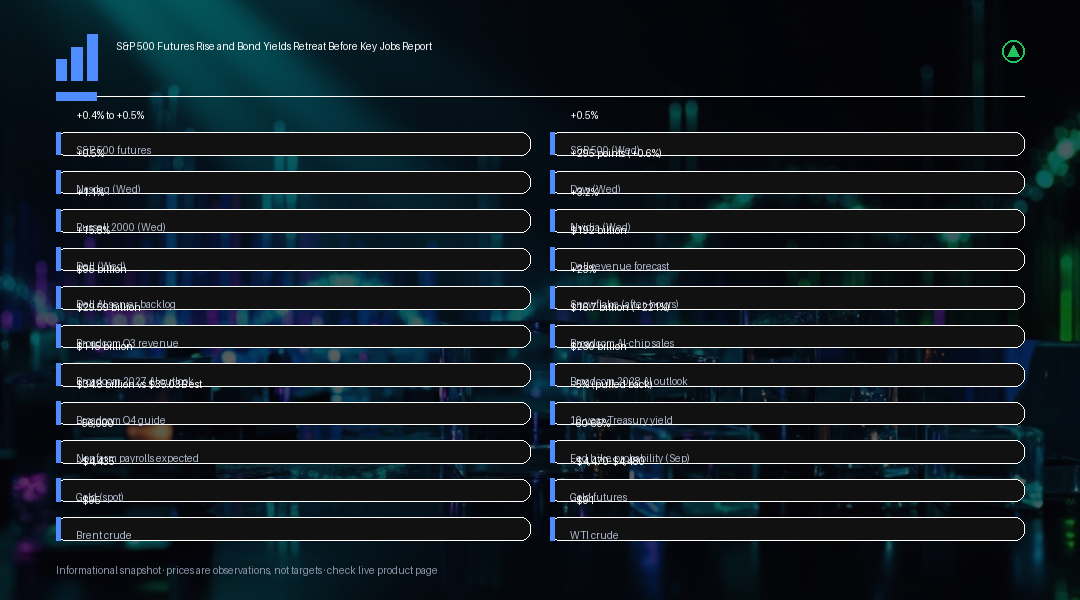
S&P 500 futures were up about 0.4% to 0.5% in early U.S. premarket trading on Thursday, while Nasdaq 100 futures were roughly flat to slightly higher, ahead of Friday's nonfarm payrolls report. Wednesday's cash session snapped a three-day losing streak: the S&P 500 rose 0.5%, the Nasdaq Composite gained 0.5%, and the Dow Jones advanced 295 points, or 0.6%. The recovery was notable not just for the headline numbers but for the breadth of participation, which had been lacking in the prior rally attempts this quarter.
The Russell 2000 outperformed with a 1.1% gain, while regional banks, airlines, and precious-metal miners joined the recovery. That healthier breadth was a positive signal, showing investors buying beyond mega-cap technology. Nvidia still provided substantial assistance, rising 3.2%, but the fact that the rally broadened out of tech is what matters most for sustainability. When the equal-weight S&P 500 outperforms the cap-weighted version, it signals that the rally is not just a narrow mega-cap phenomenon driven by a handful of names. The participation breadth is a key indicator that professional investors are rotating into laggards rather than chasing the same winners.
Dell surged 15.8% after lifting its fiscal 2027 revenue forecast to $192 billion, underscored by a record $95 billion AI-server backlog. Snowflake jumped more than 23% in after-hours trading following a quarterly beat and raised full-year product-revenue guidance. Artificial intelligence remains disruptive : particularly to analysts' spreadsheets : as the magnitude of these post-earnings moves reflects how much AI-driven demand is surpassing expectations. The Dell print in particular is a strong read on enterprise AI infrastructure spending, and the backlog figure suggests that the demand pipeline extends well beyond the next quarter.
Broadcom reported third-quarter revenue of $29.59 billion as AI-chip sales rocketed 221% to $16.7 billion. Adjusted earnings reached $3.32 per share, while management raised its AI-chip revenue outlook to approximately $115 billion in 2027 and $230 billion in 2028. Broadcom guided Q4 revenue to $34.8 billion, just below the $35.03 billion Wall Street estimate. The slight miss on Q4 was overshadowed by the sheer scale of the AI revision, which implies a multi-year runway of accelerating demand for custom AI silicon. The custom ASIC market is becoming a meaningful complement to GPUs, and Broadcom is a primary beneficiary of that trend.
Retreating Treasury yields are giving growth stocks additional support after the 10-year yield recently pushed close to 5% in intraday trading before pulling back. The move in rates has been a tailwind for duration-sensitive tech names, and the bond market's behavior suggests the recent sell-off in yields may have run its course. For equities, that removes one headwind while the earnings picture improves. The relationship between equity performance and yield direction remains one of the most important correlations in the current market environment. The yield pullback is particularly important for the high-multiple growth names that had been under pressure from rising rates.
Weak private-sector hiring has raised the stakes around Friday's nonfarm payrolls report, which is expected to show roughly 56,000 new jobs. Markets are pricing a roughly two-in-three chance of a September Fed rate hike, though the exact probability shifts with each data print. Asian equities mostly tracked Wall Street higher, with the yen firming on growing Bank of Japan rate-hike expectations. The global rate backdrop is shifting, and the divergence between Fed and BOJ policy paths is creating cross-currents in currency markets. The yen strength is a risk factor for Japanese equities and for carry trades more broadly.
Gold rebounded more than 1%, with spot gold climbing back toward $4,435 an ounce and futures trading near $4,470 to $4,480. Brent crude eased toward $95 and WTI slipped below $91 after the latest U.S.-Iran exchange produced no immediate follow-up attack. Oil remains elevated enough to complicate inflation, however, and Friday's jobs report will set the near-term tone. The commodity price action reflects a market that is balancing geopolitical risk against demand concerns. The gold rally is a clear signal that some investors are hedging against worst-case scenarios in the Gulf.
For traders, the combination of retreating yields, recovering breadth, and AI-driven earnings beats is supporting risk sentiment heading into the jobs report. The breadth of the rally is the key differentiator this time : when regional banks, airlines, and miners all join the move, it signals broad-based conviction rather than a narrow tech bid. Friday's payrolls print is the key near-term catalyst, and the outcome will determine whether the recovery has legs or stalls. A weak print could paradoxically help equities if it reduces rate-hike expectations, while a strong print could reignite inflation fears.
Looking ahead, the key variables are the jobs report, the trajectory of Treasury yields, and the sustainability of AI-driven earnings momentum. The market has shifted from a rate-driven narrative to an earnings-driven one, and the breadth of the rally suggests that the rotation is genuine. The risk is that a hot payrolls print rekindles rate fears and reverses the recent yield decline, which would weigh on the duration-sensitive names that have led the recovery. The AI trade is powerful but not invincible, and any signs of demand fatigue in the Broadcom or Dell numbers would be a warning sign.
From a positioning standpoint, the market is caught between two narratives: the AI-driven earnings momentum and the rate-hike risk from a hot payrolls print. The VIX has compressed, which suggests complacency, but the put/call ratio remains elevated, which suggests hedging. The resolution of this tension will likely come from Friday's jobs data, and traders should be prepared for a volatile reaction in either direction.
The bottom line for traders: the combination of retreating yields, recovering breadth, and AI-driven earnings beats is supporting risk sentiment heading into Friday's jobs report. The breadth of the rally is the key differentiator this time, and the market has shifted from a rate-driven narrative to an earnings-driven one. The risk is that a hot payrolls print rekindles rate fears and reverses the recent yield decline. For now, the recovery has legs, but Friday's print will determine whether it extends or stalls.
Trading Insight
The combination of retreating yields, recovering market breadth, and AI-driven earnings beats is supporting risk sentiment heading into the jobs report. Friday's payrolls print is the key near-term catalyst.