


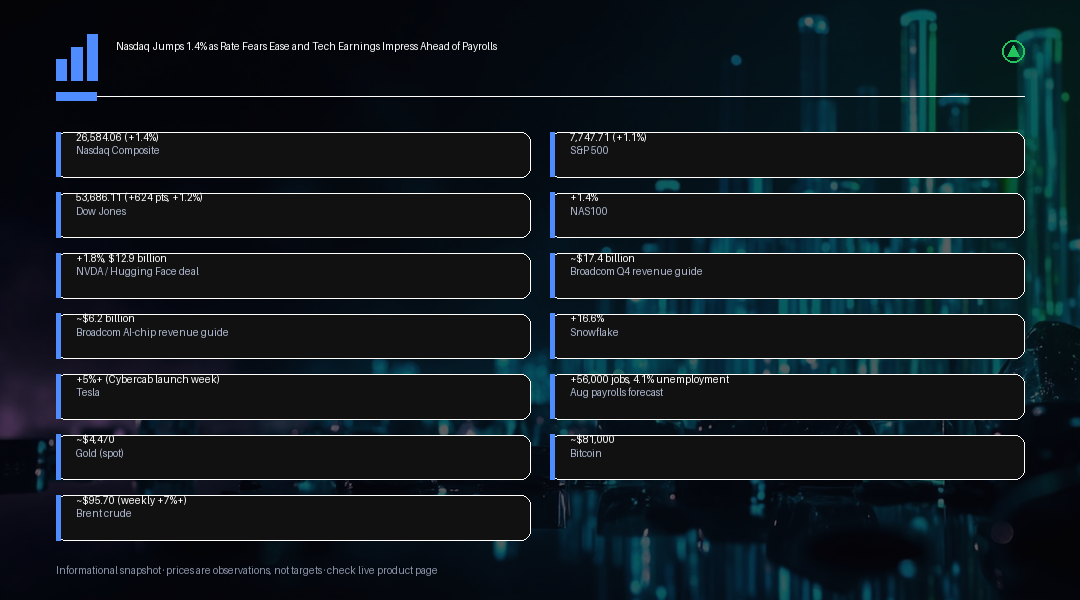
Wall Street had one of its stronger sessions of the quarter on Thursday, with the Nasdaq Composite surging 1.4% to 26,584.06, the S&P 500 adding 1.1% to close at 7,747.71 and the Dow Jones Industrial Average climbing 624 points, or 1.2%, to 53,686.11. The rally was broad enough to touch nearly every corner of the market, from mega-cap technology names to cyclical sectors, and it came just one session before a payrolls report that traders widely view as the next major test for the rate-cut narrative driving the move.
The spark came from the Federal Reserve. Governor Christopher Waller signaled he could support holding interest rates unchanged in September if incoming inflation data continues to show easing price pressure. That comment nudged market pricing away from a near-certain rate hike, with traders now viewing the odds of a September increase as close to a coin flip after starting the week in the low-60s. Treasury yields retreated from multi-year highs on the shift, which eased pressure on equity valuations and gave growth stocks in particular more room to run, since a lower discount rate makes their future earnings worth more in today's dollars.
Nvidia added to the day's momentum after agreeing to acquire open-source AI platform Hugging Face for $12.9 billion, one of the chipmaker's largest deals to date. The stock posted only a modest gain on the news, edging up about 1.8%, which suggests investors are still working out the strategic implications of Nvidia extending its reach from chips into AI developer infrastructure rather than treating the deal as an immediate profit driver.
Broadcom was one of the session's more closely watched names after reporting quarterly results. The company delivered a beat-and-raise quarter, guiding fourth-quarter revenue to roughly $17.4 billion and lifting its AI-semiconductor revenue outlook to approximately $6.2 billion for the coming quarter, alongside disclosure of a large new AI-chip order. Despite the strong guidance, the stock's reaction was muted rather than sharply higher, a reminder that in this earnings season the size of the beat matters less than whether it clears an already elevated bar of expectations.
Tesla was another standout, with shares rising more than 5% the same week the company opened its Cybercab robotaxi service to public riders in limited parts of Austin. US safety regulators are now evaluating the rollout, adding a regulatory subplot to a stock move that also reflects broader enthusiasm for autonomous-vehicle progress across the market.
Elsewhere in technology, Snowflake extended its post-earnings strength, with shares up roughly 16.6% after an AI-fueled beat and a raised full-year outlook lifted sentiment across software peers including Salesforce, ServiceNow and Adobe. The read-through is consistent with the broader theme of the week: companies demonstrating real AI-driven revenue acceleration are being rewarded, while those merely promising future AI upside are facing a higher bar.
All of this sets up Friday's August nonfarm payrolls report as the swing factor for where markets go next. Economists widely expect a rebound to roughly 56,000 new jobs after July's surprise decline of 23,000, with unemployment forecast to hold near 4.1%. A stronger-than-expected print could revive September rate-hike bets and pressure the growth stocks that led Thursday's rally, while a weaker print could reinforce the case for a pause but also stoke concern about the pace of economic growth. Asian shares tracked Wall Street higher overnight, global bonds stabilized, and the dollar index held near 99 while the yen firmed toward 155.50 yen per dollar on growing Bank of Japan tightening expectations.
Commodity markets reflected a similar tug-of-war between growth optimism and geopolitical caution. Gold held near $4,470 an ounce after rebounding roughly 2% in the prior session, Bitcoin traded around $81,000, and Brent crude hovered near $95.70, on pace for a weekly gain above 7% as tensions between the United States and Iran kept a risk premium in energy markets. Those levels should be read as a snapshot rather than a settled range, since all three assets remain sensitive to fast-moving headlines heading into the weekend.
For traders, Thursday's session was less about any single headline and more about the market successfully juggling three narratives at once: a Fed that sounds closer to done hiking, an AI-earnings cycle that continues to reward genuine execution, and a jobs report that could validate or unwind both stories within 24 hours. The breadth of Thursday's advance is the more encouraging signal for anyone tracking whether this rally has durability, since broad participation historically holds up better than gains concentrated in a handful of mega-cap names.
Positioning into Friday reflects that tension. Options markets are pricing a wider-than-usual move around the payrolls release, and traders who want exposure to the outcome without picking a single-stock winner are increasingly looking at the index level, where Thursday's broad-based gain across technology, industrials and small caps suggests the market is set up for a swing in either direction rather than a one-sided outcome.
Cross-asset signals broadly confirmed the equity move. The retreat in Treasury yields lowered the relative appeal of cash and short-duration bonds versus equities, while a steadier dollar and a firmer yen pointed to reduced immediate concern about a disorderly currency move heading into the jobs data. Energy markets were the outlier, with Brent's climb toward a weekly gain above 7% a reminder that geopolitical risk premium can offset some of the disinflationary comfort coming from the labor market and Fed commentary, keeping headline inflation risk from being fully dismissed even as the rate-path narrative turned more dovish.
Sector rotation within Thursday's rally is also worth tracking into the payrolls print. Software and AI-infrastructure names led on the earnings-driven catalysts from Nvidia, Broadcom and Snowflake, while the presence of gains in more cyclical, rate-sensitive areas suggests the advance was not purely a mega-cap technology story. That broader participation is generally viewed as a healthier signal for a rally's durability than narrow leadership, though a hot payrolls print strong enough to revive aggressive rate-hike bets could quickly narrow that leadership back toward the same handful of AI beneficiaries that dominated earlier in the year.
Trading Insight
Thursday's broad rally leaves markets pricing a close call on the Fed's September decision, and Friday's payrolls report is the catalyst that could confirm or unwind it. A stronger jobs print would revive rate-hike bets and pressure the growth names that led the advance, while a weaker print supports the case for a pause.