


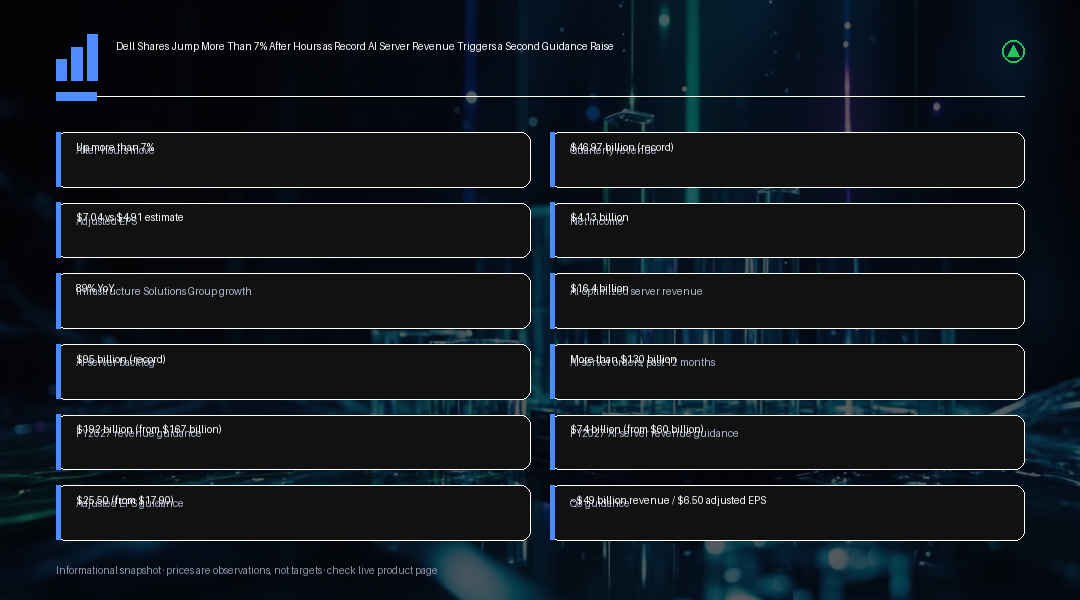
Dell shares jumped more than 7% in extended trading after the company reported quarterly results that comfortably beat Wall Street's expectations on nearly every measure that matters to investors. Adjusted earnings came in at $7.04 per share, well ahead of the $4.91 analysts had been modeling, while quarterly revenue surged 58% year over year to a record $46.97 billion against consensus estimates near $44.9 billion. Net income climbed to $4.13 billion, or $6.34 per diluted share, up sharply from $1.16 billion a year earlier. For a company that spent years being viewed primarily as a legacy PC maker, the scale of this beat underlines just how far Dell's business mix has shifted toward data-center infrastructure.
The clearest driver of that shift is the Infrastructure Solutions Group, which houses Dell's servers, storage and networking business and grew 89% year over year. Traditional server and networking revenue alone more than doubled to $10.53 billion, a reminder that even the non-AI portions of the data-center buildout are benefiting, since AI workloads still rely on conventional servers to coordinate tasks, manage data and support specialized accelerators. Layered on top of that, AI-optimized server revenue doubled to $16.4 billion for the quarter, with the company booking a record $60.9 billion of new AI-server orders during the period alone and more than $130 billion over the trailing twelve months, supplied in part by cloud providers such as CoreWeave and Nscale.
What makes this quarter particularly notable for investors is the backlog. Dell's AI-server backlog reached a record $95 billion, representing orders that are contracted but not yet delivered. A backlog of that size gives management an unusually clear window into future revenue, since customers have already committed to the spending rather than simply expressing interest. The obvious question is whether that demand holds up once each order's delivery date actually arrives, but for now the sheer size of the backlog is one of the strongest visibility signals Dell has ever offered the market.
Management responded to the strength by raising guidance for the second time this fiscal year. Full-year revenue guidance moved to $192 billion from $167 billion, comfortably above the roughly $174 billion Wall Street had penciled in, while adjusted earnings guidance rose from $17.90 to $25.50 per share. The AI-server revenue forecast specifically was lifted to $74 billion from $60 billion, itself an increase from an original estimate of only $50 billion set at the start of the fiscal year. Third-quarter guidance also landed well above expectations, with management pointing to approximately $49 billion in revenue and $6.50 in adjusted earnings per share, versus consensus estimates of roughly $41.36 billion and $4.46.
The PC side of the business, often treated as an afterthought next to the AI story, also showed genuine improvement. Client Solutions Group revenue rose about 20%, with the commercial segment up around 22%, helped by corporate upgrade cycles and Dell's ability to pass higher memory component costs through to customers via price increases. That pricing power is a useful signal of demand strength, though it also means buyers of Dell's commercial and consumer machines are likely to keep facing higher price tags as component shortages persist across the industry.
Investors should keep the valuation context in view. Dell shares were already up sharply for the year heading into this report and trading above their historical average valuation multiples, meaning expectations were high before the results even landed. A stock priced for exceptional growth tends to receive limited forgiveness if future quarters merely meet rather than exceed elevated expectations, which is part of why the size of tonight's beat and the scale of the guidance raise mattered so much to the after-hours reaction. The key variables to watch going forward are whether AI-server gross margins hold up as component costs rise, whether supply constraints ease enough to let Dell convert more of that $95 billion backlog into delivered, billed revenue on schedule, and whether the broader AI infrastructure spending cycle that has driven results across the hardware sector this year continues at its current pace into next year.
Broadcom is scheduled to report its own results shortly after Dell, with the market watching for confirmation that AI-related demand remains broad-based across the semiconductor and infrastructure supply chain rather than concentrated in a handful of names. Because Dell's results land at the intersection of the AI infrastructure buildout and the broader technology earnings cycle, its guidance raise is likely to be read as a data point for the sector as a whole, not just for Dell's own share price.
The composition of the beat also matters for how durable investors judge it to be. Rather than a single blowout product line, the strength this quarter spanned AI-optimized servers, traditional server and networking hardware, storage, and even the previously sluggish PC business, suggesting the demand backdrop is broader than a narrow AI accelerator story. That kind of multi-segment strength tends to be viewed more favorably by long-term holders than a single hot product cycle, because it reduces the risk that a slowdown in any one category derails the overall growth trajectory. At the same time, hardware suppliers across the industry have shown in past cycles that order backlogs can compress quickly if end customers slow their own capital spending, so the durability of that $95 billion figure will remain a live debate until several more quarters of conversion data are available.
For traders positioning around the print, the combination of a large earnings beat, a rare second guidance raise in the same fiscal year, and a backlog that already extends well into next year gives Dell one of the stronger fundamental setups among hardware names heading into the final months of the year. The main swing factors from here are execution rather than demand: whether component supply, largely tied to memory and advanced packaging capacity, can keep pace with the order book, and whether gross margins on AI servers hold steady as competition among hardware suppliers for the same cloud customers intensifies.
Trading Insight
The post-earnings reaction puts Dell in a stronger technical position heading into the next session, but the size of the after-hours jump also raises the bar for follow-through. Traders should watch whether the stock can hold its extended-hours gains once regular trading resumes, since sharp earnings-driven moves sometimes fade as the market digests valuation alongside the headline beat. The record $95 billion AI-server backlog and the second guidance raise this fiscal year both support a constructive medium-term view, but near-term volatility is likely given how far expectations had already run. Because Dell's results are closely tied to broader AI infrastructure spending, its reaction is also worth watching as a read-through for the Nasdaq-listed technology and semiconductor names that report in the coming days, including Broadcom.