


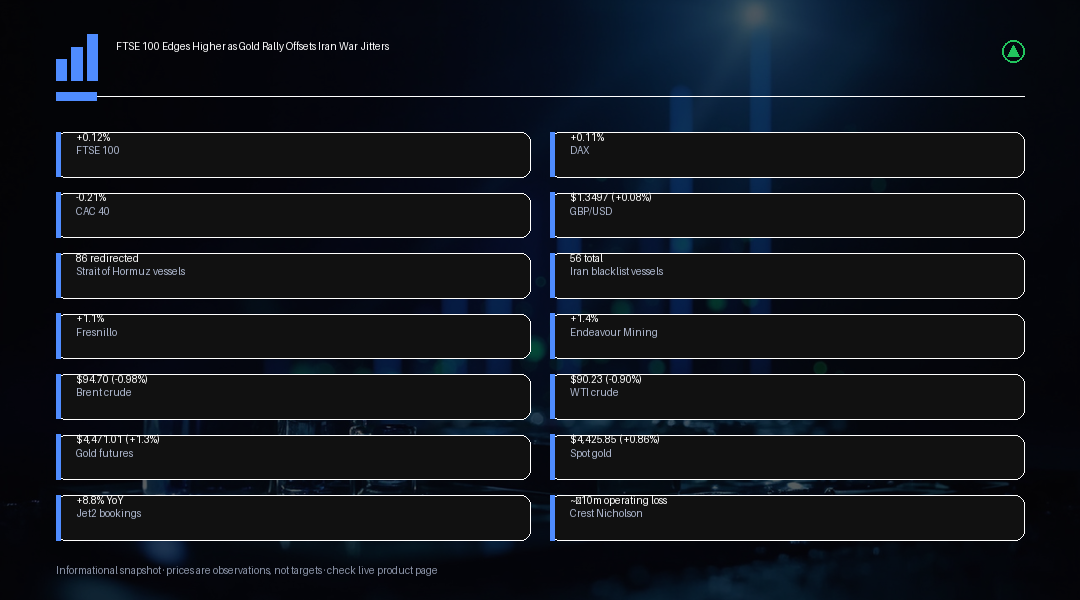
British stocks edged higher on Thursday as a rally in gold and silver miners offset broader unease over the escalating Iran war and its threat to Gulf shipping. The FTSE 100 rose 0.12% as of 03:20 ET. Germany's DAX added 0.11%, while France's CAC 40 slipped 0.21%. Sterling firmed 0.08% against the dollar to $1.3497. The modest gains belie the complexity of the forces at work, with safe-haven demand and geopolitical risk pulling in opposite directions. The FTSE 100's heavy weighting in miners and energy gives it a defensive tilt that is being tested by the current environment.
The U.S. Central Command said it had redirected 86 commercial vessels through the Strait of Hormuz as part of its naval blockade of Iran, up from 84 a day earlier, and said it had disabled three vessels and boarded two others. Iran's Persian Gulf Strait Authority added 11 more vessels to its blacklist, including the tanker Kiku and the LNG carrier Mubaraz, taking the total to 56. The Strait of Hormuz is a critical chokepoint for global energy supplies, and any disruption there would have immediate and severe consequences for oil markets and global flow. The escalation in vessel redirections and blacklisting suggests that both sides are preparing for a prolonged standoff.
President Trump indicated the conflict would not last long, and US forces were helping move oil shipments through the strait and intercepting Iranian drones. The administration is seeking to manage escalation while maintaining economic pressure on Tehran. Secretary of State Marco Rubio said Iran would continue to feel the squeeze until it abandons nuclear weapons ambitions and ends support for terrorism. The rhetoric suggests a calibrated approach designed to apply maximum pressure without triggering a full-scale regional war. The administration is walking a fine line between deterrence and provocation, and the margin for error is thin.
Chinese President Xi Jinping, on a visit to Cairo, urged Middle Eastern countries to reject foreign interference and called for diplomacy. Iranian military officials said the force was fully prepared to respond to any hostile moves using missile and drone capabilities. The UAE condemned Iran's Monday strike on the Saudi-owned tanker Sidr near Oman's Musandam Peninsula, which killed two Filipino crew members, as well as Iranian missile and drone strikes on Bahrain, Kuwait, Jordan, and Iraq's Kurdistan region. The diplomatic landscape is fracturing along predictable lines, with the U.S. and its allies on one side and Iran and its proxies on the other. China's diplomatic engagement in the region adds another layer of complexity.
Fresnillo rose 1.1% and Endeavour Mining gained 1.4% on the gold and silver rally. Brent crude fell 0.98% to $94.70 a barrel, and WTI dropped 0.90% to $90.23. Gold futures rose 1.3% to $4,471.01 an ounce, with spot gold up 0.86% at $4,425.85. The gold price action underscores the safe-haven demand in play while the Strait situation remains unresolved. The oil price decline is notable given the geopolitical backdrop, and suggests that demand concerns are currently outweighing supply fears. The commodity price action reflects a market that is balancing geopolitical risk against demand concerns, and the resolution of that tension will drive the next major move in both markets.
Among UK companies, Jet2 reported summer bookings up 8.8% year over year, a strong read on consumer travel demand despite geopolitical tensions. M&G beat half-year profit expectations on inflows from Japanese partner Daiichi Life. EnQuest narrowed its annual output forecast toward the lower end after a five-week Magnus field outage. Crest Nicholson forecast an annual operating loss of around £10 million. The UK company updates paint a mixed picture, with consumer-facing businesses holding up better than those exposed to energy or housing. The Jet2 number is particularly encouraging given the geopolitical headwinds facing the travel sector.
For traders watching the FTSE 100, the gold rally and energy-sector moves are providing a floor, while geopolitical risk premiums remain elevated. The Strait of Hormuz situation is the key variable to watch, as any escalation could quickly reverse the modest gains. The FTSE's heavy weighting toward miners and energy gives it a partial hedge that purer-tech indices lack, but a major disruption to Gulf shipping would overwhelm that cushion quickly. The index's defensive characteristics are being tested by the current environment, and the outcome will depend on whether the geopolitical situation stabilizes or deteriorates.
Looking ahead, the key variables are the trajectory of the Iran conflict, the price of oil and gold, and the resilience of UK consumer demand. The FTSE 100's composition : heavy in miners, energy, and financials : makes it a different animal than the S&P 500 or Nasdaq, and the current environment is playing to some of those differences. The risk is that a significant escalation in the Gulf would trigger a risk-off move that hits all equities, regardless of index composition. The defensive trade is not a perfect hedge, but it is better than no hedge at all.
The broader question is whether the current geopolitical risk premium is adequately priced. Gold's rally suggests that some investors are hedging against worst-case scenarios, while the modest equity gains suggest that others see the situation as containable. The divergence between these two signals is itself a source of uncertainty, and the resolution will likely come down to whether the Strait of Hormuz remains open and whether the conflict remains limited in scope. The FTSE 100 is likely to remain range-bound until that uncertainty resolves.
From a positioning standpoint, the FTSE 100 is benefiting from a rotation into defensives, but the index's composition is not uniformly defensive. The miners and energy names are providing a floor, but the financials are vulnerable to any deterioration in the geopolitical situation. The put/call ratio for FTSE options has risen, which suggests that some investors are hedging against a worst-case scenario in the Gulf.
The bottom line for traders: the FTSE 100 is being pulled in opposite directions by the gold rally and the Iran war jitters, with the gold rally currently winning. The Strait of Hormuz situation is the key variable to watch, and any escalation could quickly reverse the modest gains. The FTSE's heavy weighting in miners and energy gives it a partial hedge, but a major disruption to Gulf shipping would overwhelm that cushion. For now, the index is likely to remain range-bound until the geopolitical uncertainty resolves.
Trading Insight
For traders watching the FTSE 100, the gold rally and energy-sector moves are providing a floor, while geopolitical risk premiums remain elevated. The Strait of Hormuz situation is the key variable to watch.