

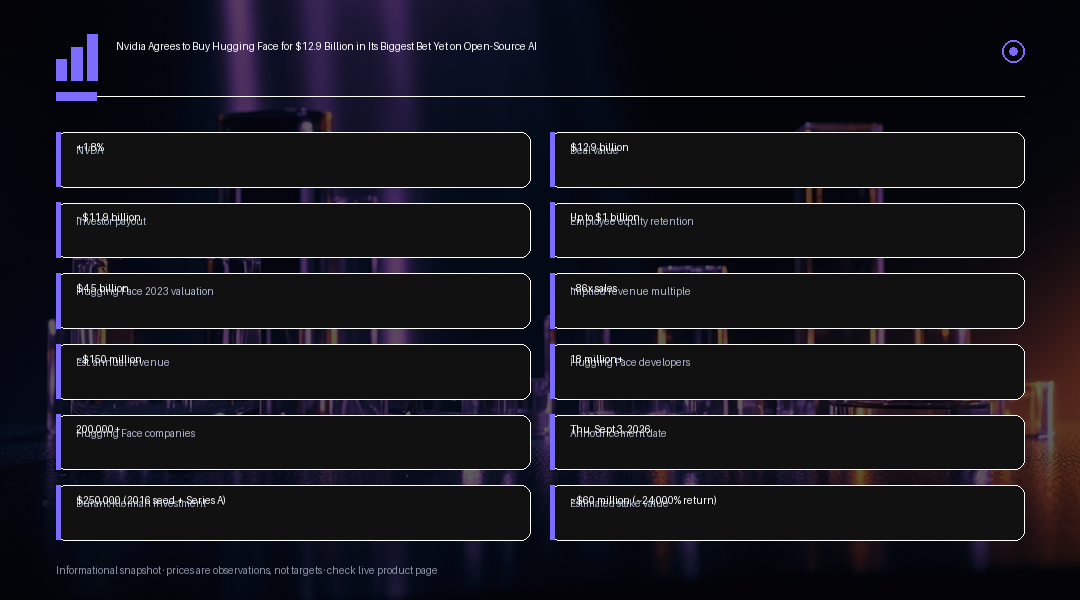
Nvidia has agreed to acquire Hugging Face for approximately $12.9 billion, in one of the chipmaker's largest deals to date. Under the terms, roughly $11.9 billion will go to Hugging Face's investors while up to $1 billion in equity is being reserved to retain employees who join Nvidia. Shares of Nvidia edged higher by about 1.8% on the announcement, a comparatively modest move given the size of the deal, which suggests the market is still working through what the acquisition means strategically rather than treating it as an immediate profit driver.
Hugging Face has become the closest thing the AI industry has to a shared workshop. More than 18 million developers and 200,000 companies use the platform to access, share and deploy open-source models, datasets and applications, earning it the informal nickname the GitHub of AI. That scale is precisely what makes the price tag defensible in strategic terms even if it looks aggressive on a pure revenue basis.
And the multiple is aggressive. Hugging Face was valued at $4.5 billion during its 2023 funding round, meaning Nvidia is paying about three times that figure. The company reportedly generates only around $150 million in annual revenue, which implies Nvidia is paying close to 86 times sales, both figures that should be treated as approximate rather than precisely audited numbers disclosed in the deal announcement. Traditional valuation models were not built for a transaction like this one.
The logic becomes clearer once the deal is viewed as a distribution play rather than a revenue play. Controlling the platform where AI developers already gather gives Nvidia early visibility into which models and applications are gaining traction, long before that demand shows up in chip orders. It also builds a pipeline that feeds directly into Nvidia's chips, software and cloud-computing services, effectively letting the company monetize activity that happens upstream of a hardware purchase.
Open-source models are increasingly competing with proprietary systems from closed-model developers because they are cheaper to customize and deploy. By owning Hugging Face, Nvidia gains exposure to both sides of that fight. Closed-model companies still need its hardware, while open-source developers now build on a platform Nvidia owns outright. That dual exposure also serves as a hedge against major cloud providers that are increasingly designing their own in-house chips: the more of the surrounding tools and developer infrastructure Nvidia controls, the harder it becomes for customers to route around its hardware entirely.
There is a notable trust question sitting underneath the deal. Nvidia chief executive Jensen Huang has stated that Hugging Face will remain open and that developers will not be required to use Nvidia hardware or cloud services to keep using the platform. Preserving that neutrality is not optional from a business standpoint. Hugging Face's core value comes from being seen as a neutral hub; if developers start to believe the platform quietly favors Nvidia over AMD, Google or other cloud providers, the community that makes it valuable in the first place could begin migrating elsewhere.
One of the more unusual footnotes to the deal involves basketball star Kevin Durant. Durant and business partner Rich Kleiman reportedly invested a combined $250,000 in Hugging Face through their venture vehicle, including $100,000 in the 2016 seed round and $150,000 during the Series A. Estimates suggest that stake could now be worth more than $60 million, an implied return above 24,000%, although the exact ownership structure and payout remain private. It stands as one of the more striking athlete-led technology investments on record, made years before generative AI became a mainstream investment theme.
For traders, the deal reframes how to think about Nvidia's growth story. The company is no longer purely a chip supplier riding AI infrastructure demand; it is now also positioning itself as the owner of a major piece of AI developer distribution. The muted near-term share reaction leaves room for the market to reprice the strategic value of the deal as more details emerge, including how Hugging Face's roadmap, revenue model and neutrality commitments evolve under Nvidia's ownership. The key risks to monitor are any sign that the platform's independence is compromised, integration costs that weigh on margins, or regulatory scrutiny given Nvidia's already dominant position in AI hardware.
It is also worth weighing this deal against Nvidia's other recent large transactions, since some coverage has debated whether Hugging Face is the company's single biggest purchase ever or merely among its largest. That ranking question does not change the strategic read: Nvidia is spending aggressively to own more of the layer between its chips and the applications built on top of them, a pattern likely to continue as competition for AI developer mindshare intensifies among Nvidia, AMD and the hyperscale cloud providers building their own custom silicon.
The deal also arrives against a backdrop where every major AI infrastructure player is racing to lock in developer mindshare, not just compute capacity. Cloud providers building custom silicon still need somewhere for developers to discover, fine-tune and deploy models, and Hugging Face has effectively become that neutral meeting point for the industry. By owning it, Nvidia is betting that owning the meeting point is worth more over a multi-year horizon than the near-term revenue the platform generates on its own, a bet that will only be validated if usage and developer trust keep growing under the new ownership structure.
For traders sizing exposure around this news, the key is separating the deal's strategic logic from its near-term price impact. The modest 1.8% share reaction suggests the market has not yet meaningfully repriced Nvidia's long-term platform ambitions into the stock, which leaves room for the story to develop over subsequent quarters as Nvidia reports how Hugging Face is integrated and whether usage metrics continue climbing. Volatility around Nvidia's next earnings update is likely to be higher than usual as analysts press management for specifics on monetization plans and neutrality safeguards.
Trading Insight
Nvidia's Hugging Face deal is a distribution and ecosystem play more than an immediate earnings driver, and the muted 1.8% stock reaction reflects that. Watch for developer sentiment around platform neutrality and any regulatory response, since either could shift how the market values the acquisition.