


Kevin Warsh did not kill quantitative easing. In his first Jackson Hole speech as Federal Reserve chair, he said unconventional stimulus may suit genuine crises but should otherwise be used sparingly, if at all. That puts QE behind a higher policy threshold; it does not remove the tool.
For gold traders, the distinction matters. The immediate market question is not whether QE has vanished forever, but whether persistent inflation keeps short-term rates, Treasury yields and the US dollar high enough to pressure XAUUSD. The slower question is whether central-bank and physical demand can absorb that pressure.
Key takeaways
- Warsh restricted the normal case for QE; he did not rule it out during a genuine crisis.
- Gold's post-speech decline tracked higher rate expectations, yields and a firmer dollar.
- Horwitz's 40–60% crash call is a forecast, not a probability implied by current market data.
Did Kevin Warsh actually kill QE?
No—Warsh argued that short-term interest rates should do the routine work, while unconventional policies should be exceptional. In the Federal Reserve's 28 August speech, he described short-term rates as the predominant tool for the dual mandate. He left unconventional stimulus available for genuine crises, while saying it should otherwise be used sparingly.
That is narrower than the headline claim that QE is dead. It means markets should not assume every growth scare, equity correction or funding wobble will trigger new large-scale bond buying. A real crisis could still change the policy response, and any chair would also need enough support across the Federal Open Market Committee to act.
Warsh's broader message was hawkish because inflation remained above target. He cited 12-month PCE inflation of 3.7% and a six-month rate of 4.1%, against the Fed's fixed 2% objective. The July FOMC had held its target range at 3.50%–3.75% in a 9–3 vote, with three policymakers preferring a 25-basis-point increase. That backdrop made a rate hike—not QE—the near-term policy question.
Why did gold fall after Warsh's speech?
Gold fell because traders raised the probability of tighter policy, which lifted yields and supported the dollar. A non-yielding asset becomes less attractive at the margin when cash and government bonds offer higher returns, especially when real yields rise. A stronger dollar adds a second headwind because gold is priced in dollars.
Reuters recorded spot gold at $4,594.61 per ounce at 12:03 GMT on 28 August, shortly before the speech, after a $4,696.18 three-month high on 25 August. By 06:39 GMT on 2 September, Reuters put spot gold at $4,321.31 and December futures at $4,368.50. The same report said CME FedWatch pricing implied a 70% probability of a September rate hike.
These are dated market observations, not a continuous price series. They show the size and direction of the repricing, but they do not prove that one speech alone caused every move. Renewed Middle East tension also pushed oil and Treasury yields higher, reinforcing the inflation channel even though geopolitical risk is often described as supportive for gold.
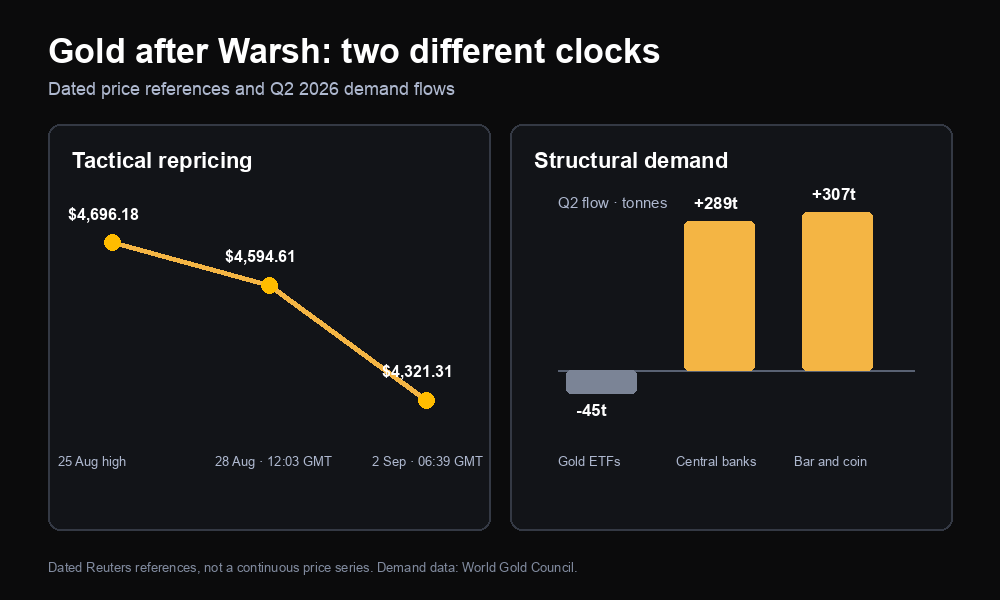
Reuters spot-price references are dated snapshots, not a continuous series. Q2 demand flows are from the World Gold Council.
Can gold rise without fresh QE?
Yes, but “gold without QE” needs more than a hard-asset slogan. Gold can draw demand from reserve diversification, geopolitical uncertainty, inflation hedging and distrust of sovereign credit. It can also fall when real yields and the dollar rise. The dominant force changes with the trading horizon.
World Gold Council data illustrate that split. In Q2 2026, gold ETFs recorded 45 tonnes of outflows, a sign that financially sensitive investors were reducing exposure as rate expectations and the dollar moved against the metal. Over the same quarter, central banks bought 289 tonnes and bar-and-coin investment reached 307 tonnes. Total demand including over-the-counter activity was 1,269 tonnes.
The figures do not guarantee a floor. They show that the gold market contains buyers with very different clocks. ETF positioning can react quickly to yields and currency moves; reserve managers usually operate on strategic mandates. That is why gold can suffer a sharp tactical drawdown without erasing its longer-run diversification case.
The earlier MC Markets guide to the $4,650 gold decision zone explains the same principle from a price-action angle: a level matters only if the market can hold it, while the dollar and yields reveal whether the move has macro support.
Which signals matter most for XAUUSD now?
Rate expectations, real yields and the dollar should lead the short-term read; flows and reserve demand belong to the slower one. Keeping those horizons separate prevents a strong structural thesis from becoming an excuse to ignore a hostile daily tape.
| Signal | Why it matters for gold | What would change the read |
|---|---|---|
| September policy pricing | A higher hike probability raises the opportunity cost of holding gold | Clear inflation cooling or weaker labour data reduces tightening pressure |
| Real Treasury yields | Rising real yields increase the return available on inflation-adjusted bonds | A sustained yield reversal removes a key tactical headwind |
| US dollar | A firmer dollar makes dollar-priced gold more expensive for other currencies | Broad dollar weakness can support gold even before policy changes |
| Oil and inflation | Higher energy prices can keep inflation and rate expectations elevated | Oil cooling without a risk shock weakens that transmission channel |
| ETF flows | Fast-moving allocation can amplify rate and momentum moves | Persistent inflows would show financial demand returning |
| Central-bank demand | Strategic reserve buying can absorb supply over longer horizons | A broad, sustained slowdown would weaken the structural bid |
Is the 40–60% crash warning a market signal?
No—the 40–60% figure is Todd “Bubba” Horwitz's forecast, not an observed market probability. In the approved 2 September interview, Horwitz compared the current backdrop with elements of the dot-com and housing bubbles and argued that AI spending, leverage and household stress could eventually combine into a large equity decline.
The useful part of that claim is the stress test, not the percentage. Traders can monitor credit spreads, funding conditions, earnings revisions, unemployment, delinquency data and equity breadth. If those measures do not deteriorate together, attaching a precise 40–60% drawdown to the current market creates false certainty.
The relationship with gold is also not automatic. An orderly equity correction accompanied by higher real yields and a stronger dollar can pressure gold. A disorderly funding event may initially force investors to sell liquid assets, including gold, before demand for defensive assets appears. A recessionary slowdown that lowers yields can be more supportive. The path matters more than the crash label.
What should gold and crypto traders watch next?
Watch whether the same macro message appears in three places: policy pricing, real yields and the dollar. If hike odds stay elevated, real yields rise and the dollar strengthens, the post-Warsh pressure on gold remains internally consistent. If those signals reverse while XAUUSD stabilises, the market is rejecting part of the hawkish repricing.
Crypto traders should not assume Bitcoin and gold express the same theme at the same time. Both can benefit from a weaker dollar or concern about monetary credibility, but Bitcoin usually carries more liquidity and risk-appetite sensitivity. Gold strengthening while Bitcoin and equities weaken points to defensive demand; all three rising with lower yields looks more like broad liquidity relief.
A related MC Markets analysis on gold above $4,400 offers a wider confirmation checklist for separating a durable range shift from a temporary spike.
Final thoughts
Warsh did not erase QE; he challenged the assumption that emergency policy should become routine. Gold's first response was a rate-and-dollar repricing, while quarterly demand data still show a meaningful structural bid beneath the daily tape. The cleanest read is therefore neither “QE is dead, so gold must fall” nor “hard assets always win.” Let policy expectations, real yields, the dollar and actual demand flows decide which horizon is in control.