

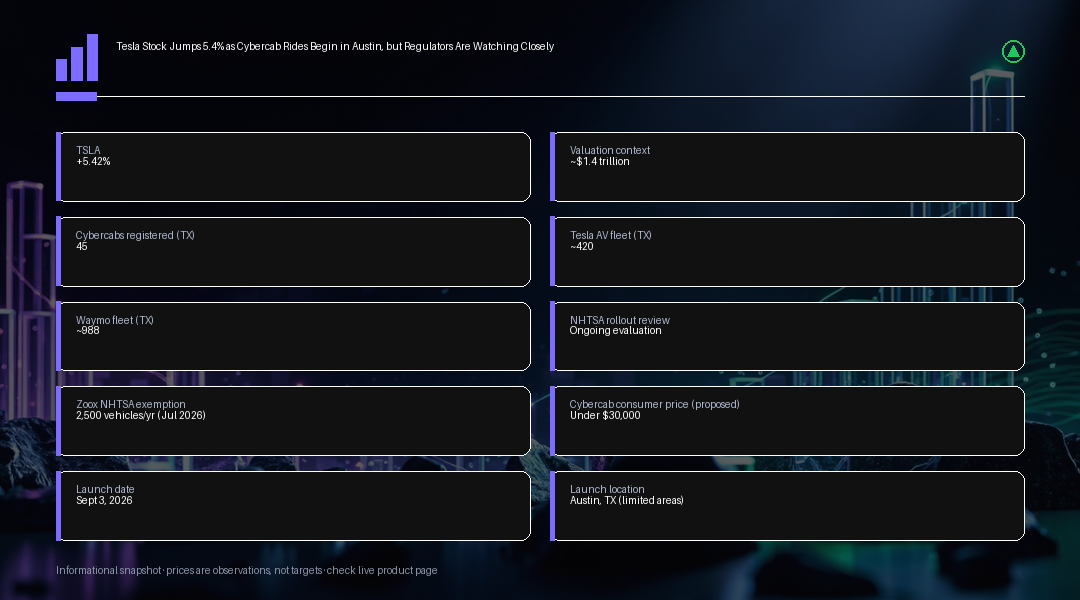
Tesla shares climbed 5.42% on Thursday after the company quietly opened its Cybercab robotaxi service to public riders in limited parts of Austin, Texas. The move marks the commercial debut of Tesla's purpose-built, steering-wheel-free robotaxi and gives investors their first real evidence that the Cybercab program has moved beyond staged demonstrations. With Tesla's market value sitting near $1.4 trillion, the rally reflects how much weight traders are now placing on the company's autonomous-ride ambitions alongside its traditional vehicle business.
The launch itself was notably low-key. There was no public livestream, no broad media rollout and no appearance from chief executive Elon Musk. Access was invite-only and limited to select riders in specific parts of the city. The two-seat, gold-colored Cybercab has butterfly doors but no steering wheel, pedals or mirrors, meaning the entire driving experience is reduced to entering a destination and letting Tesla's camera-based system handle the rest.
Scale remains modest for now. Texas registration records show Tesla has 45 Cybercabs in service as part of a roughly 420-vehicle autonomous fleet in the state. Rival Waymo, by comparison, has approximately 988 vehicles registered in Texas alone, giving Alphabet's robotaxi unit a meaningful head start in the state Tesla is now targeting. That gap illustrates the scale Tesla still needs to build if it wants ride-hailing revenue to become a material part of its business.
Regulators are already paying attention. The National Highway Traffic Safety Administration said it is evaluating the rollout and is in direct contact with Tesla. Federal vehicle-safety rules generally require manual driving controls such as a steering wheel, pedals and mirrors, which the Cybercab does not have. Competitors have navigated this hurdle before: Amazon-owned Zoox secured a formal NHTSA exemption in July 2026 that caps its exempted fleet at 2,500 vehicles per year. Tesla has not publicly filed for a comparable exemption and instead appears to be proceeding on a self-certification basis, arguing its design already meets the safety intent of the rules.
That distinction matters for how the regulatory story develops. NHTSA has not ordered a halt to Cybercab operations, and its evaluation should not be read as an active enforcement action. Still, the agency's broader investigation into Tesla's Full Self-Driving software, which covers a large share of the company's fleet and includes reports of crashes and at least one fatality tied to visibility and detection issues, remains a separate and unresolved overhang. Tesla's own incident reports to regulators describe its robotaxi vehicles as not at fault in any collisions so far, but that characterization is self-reported and has not been independently verified by NHTSA.
The technology choice adds another layer to the debate. Cybercab relies entirely on cameras, while Waymo and Zoox combine radar and lidar with their camera systems. Tesla argues its camera-only approach is cheaper to build and easier to scale across a large fleet, a claim that will be tested as ride volumes grow and edge cases multiply in real-world conditions such as poor visibility, glare and unusual road markings.
On the commercial side, Tesla plans to introduce dynamic pricing so fares move with demand, though it has not published a full fare schedule. Musk has previously suggested that consumers could eventually buy a Cybercab for under $30,000 and add it to Tesla's ride-hailing network, generating income for owners when the vehicle is not in personal use. That remains a past statement rather than a confirmed 2026 pricing plan, but it captures the scale of the ambition: turning Tesla from a car manufacturer into a recurring-revenue transportation platform built on fares, software and fleet services.
For traders, the Cybercab story is now a two-track catalyst. One track is operational: how quickly Tesla can grow its Texas fleet beyond 45 vehicles and expand into new cities without a safety incident that draws a harder regulatory response. The other track is regulatory: whether NHTSA's evaluation stays informal or escalates toward a request for a formal exemption similar to Zoox's capped approval. A materially adverse NHTSA finding, a headline safety incident, or a stalled expansion timeline would each weigh on sentiment built around the robotaxi narrative, while faster-than-expected city expansion or a smooth exemption process would reinforce the bullish case behind Tesla's premium valuation.
Valuation debates around Tesla have always hinged on whether the market should price the company like a carmaker or like a technology platform. The Cybercab rollout, however limited, gives bulls fresh evidence for the platform argument, since a working robotaxi fleet, however small today, is a prerequisite for the recurring-revenue vision Musk has described for years. Bears will point out that 45 vehicles is a rounding error against Waymo's presence in the same state, and that regulatory uncertainty could slow expansion just as competitors widen their lead. Both views can be true at once, which is why the stock's reaction to Cybercab-specific news is likely to stay volatile until the fleet size and the regulatory posture become clearer.
The wider autonomous-vehicle sector gives useful context for how to read Tesla's move. Waymo has spent years building out its Texas presence with a sensor stack that regulators and safety researchers generally view as more conservative, since redundant radar and lidar can catch obstacles cameras alone might miss in poor light or heavy rain. Tesla's bet is that cost and scale advantages from a camera-only system will eventually outweigh that redundancy gap, but until Cybercab accumulates meaningfully more miles and cities, that thesis remains unproven in the way that matters most to regulators and to the market.
From a risk-management standpoint, traders holding or considering TSLA around this news should treat the current setup as binary in the near term rather than a smooth glide path. A clean expansion into a second or third city over the coming months, paired with no adverse safety headlines, would likely be read as confirmation that the self-certification approach is working and could support a further re-rating of the stock's autonomy premium. Conversely, any pause in the rollout, a request from NHTSA for a formal exemption filing, or a widely reported incident involving a Cybercab would quickly reintroduce the regulatory-overhang discount that has periodically weighed on Tesla shares in the past.
Trading Insight
Tesla's Cybercab launch gives the stock a fresh growth narrative beyond EV sales, but the regulatory setup is still unresolved. Watch for any formal NHTSA exemption filing or fleet-expansion updates out of Texas, since either could move the stock sharply in the sessions ahead.