


Bitcoin closed Friday with a 22% weekly gain, its strongest week since March 2023, according to CNBC and Bloomberg reporting. The move carried BTC from about $62,800 at the start of the week to $76,943.90 at Friday's close. The size of the candle mattered, but the more useful signal was how macro relief, forced short covering and spot demand arrived in sequence.
That sequence helps traders avoid two weak conclusions: that every fast rally is “only a squeeze,” or that one exceptional week automatically starts a lasting trend. The better test is trigger, acceleration, validation and then acceptance.
Key takeaways
- Lower long-term yields triggered the move; short liquidations accelerated it.
- More than $1 billion of weekly spot-ETF inflows added evidence of demand beyond forced covering.
- Follow-through depends on price acceptance after leverage resets—not another headline-sized candle.
What does a 22% Bitcoin week actually tell traders?
It shows an unusually forceful repricing, not a guaranteed trend change. CNBC reported Bitcoin ending Friday at $76,943.90, up from about $62,800 at the week's start. Bloomberg described the move as the largest weekly gain since March 2023 and noted that BTC remained well below its October 2025 record above $126,000.
The location of the close is useful. Bitcoin finished near the upper part of the week's range rather than surrendering the entire impulse. But a weekly candle compresses several different forces into one bar. Traders need to ask who was forced to buy, who chose to buy and whether either group remains active after the first burst.
Why did Bitcoin accelerate so quickly?
The rally began with a broad macro catalyst and then intensified as bearish leverage was closed out. On 19 August, the US Treasury said it would raise longer-dated nominal liquidity-support buybacks from a maximum of $2 billion to at least $4 billion per operation, effective 9 September through 4 November. Long yields fell after the announcement, easing pressure on risk assets.
Crypto entered that shift with heavy short positioning. CNBC cited about $2.7 billion of crypto shorts liquidated during the rally. Bloomberg used a different three-day window and reported nearly $2.5 billion of leveraged bearish Bitcoin positions and $4.5 billion across crypto liquidated. The estimates should not be added together; they describe different scopes and windows.
This is the acceleration layer. A short liquidation is forced buying: as price rises, bearish positions are closed, which can push price higher and trigger more closures. It explains the speed of the move, but it does not tell traders whether fresh buyers will keep accepting the new range.
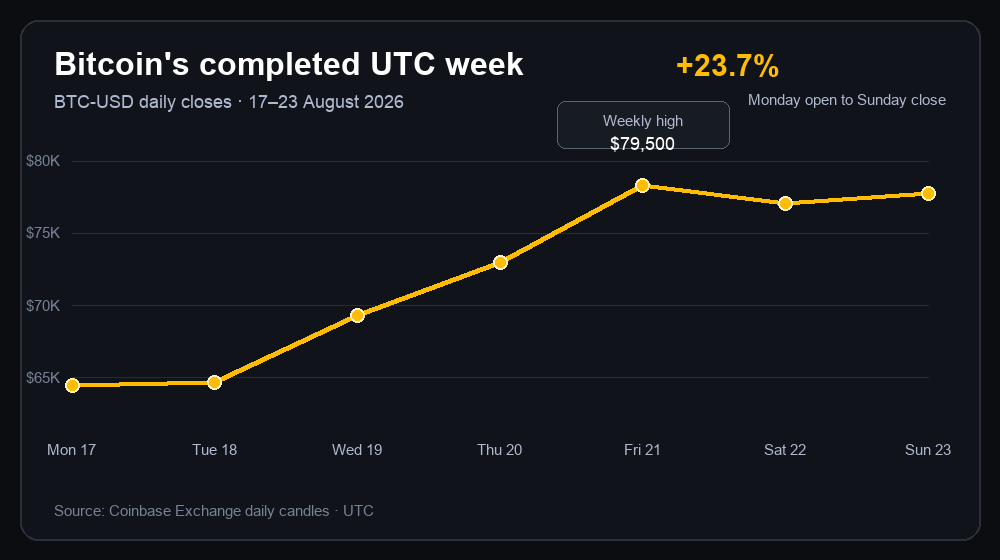
Why do reports show 22%, 23% and 23.7%?
Crypto trades continuously, so the answer changes with the venue and the chosen weekly cutoff. CNBC's 22% figure compared roughly $62,800 with its Friday close of $76,943.90. Bloomberg reported roughly 22% during Friday's market window, while later syndicated versions described about 23% as BTC approached $80,000.
For a completed Monday–Sunday UTC window, Coinbase daily candles opened at $62,836.67 on 17 August and closed at $77,729.36 on 23 August. That produces a 23.7% return and a $79,500 weekly high. The figures are not contradictions; they are different clocks. Matching the timestamp is especially important when comparing continuous crypto prices with US-session ETF flows.
Was the rally real demand or only a short squeeze?
The evidence points to both forced buying and voluntary participation. Bloomberg reported that the 13 US spot-Bitcoin ETFs added more than $1 billion through Friday's reporting window, their strongest weekly inflow pace since January. That matters because ETF creations can continue after a short squeeze has cleared the most crowded bearish positions.
It still does not prove that every dollar came from a new long-term institution. ETF data records net creations and redemptions at the fund level, not each end buyer's identity or holding period. The cleaner conclusion is that spot-linked participation reinforced the move while liquidations amplified it.
Rally anatomy: Treasury news improved the macro backdrop; short covering supplied speed; ETF inflows broadened participation; price acceptance must now do the remaining work.
What would confirm follow-through after the breakout?
Confirmation would be a calmer market that holds most of the repricing while spot participation remains constructive. A rally does not need another 20% week to remain healthy. In fact, smaller ranges after a leverage flush can provide better evidence that buyers are willing to transact at higher prices.
| Layer | What the week showed | What strengthens the read | What weakens it |
|---|---|---|---|
| Trigger | Long yields fell after the Treasury buyback announcement | Risk appetite stays broad without another policy surprise | Yields reverse sharply and risk assets lose the macro tailwind |
| Acceleration | Billions of dollars in bearish leverage were liquidated | Open leverage rebuilds slowly while price holds | A fresh leverage surge becomes the main support for price |
| Validation | US spot-Bitcoin ETFs added more than $1B through Friday | Positive flows persist across several sessions | Weekly inflows reverse quickly into large redemptions |
| Acceptance | BTC closed near the upper end of the weekly range | Pullbacks become shallower and reclaimed prices hold | The move falls back through its impulse zone on heavy volume |
The framework is evidence, not a trade instruction. Bitcoin can hold the new range, consolidate below the $79,500 weekly high or retrace part of the move without any one outcome being preordained. For the prior ETF-flow setup, see what the $517 million ETF day showed. For another flow-led comparison, see Bitcoin at a five-week high.
Final thoughts
Bitcoin's best week in more than three years deserves attention because several clocks aligned at once: macro conditions improved, shorts were forced out and spot-linked demand strengthened. The next signal is quieter. If Bitcoin can absorb profit-taking and hold much of the repricing without another liquidation cascade, the week will look less like a one-off shock and more like genuine price acceptance.