


US spot-Bitcoin ETFs recorded $517.19 million of net inflows on Wednesday, 19 August 2026, their strongest daily intake since 4 May. Bitcoin then moved above $69,000 during Thursday’s reported window. The important signal was not only the size of the flow—it was the breadth across eight funds and whether that participation could survive beyond one session.
That distinction matters in crypto breaking news. A large daily print can strengthen a rally, but it cannot by itself prove who bought, how long they will hold, or whether demand will persist. Traders get a cleaner read by separating flow size, breadth, price confirmation and follow-through.
Key takeaways
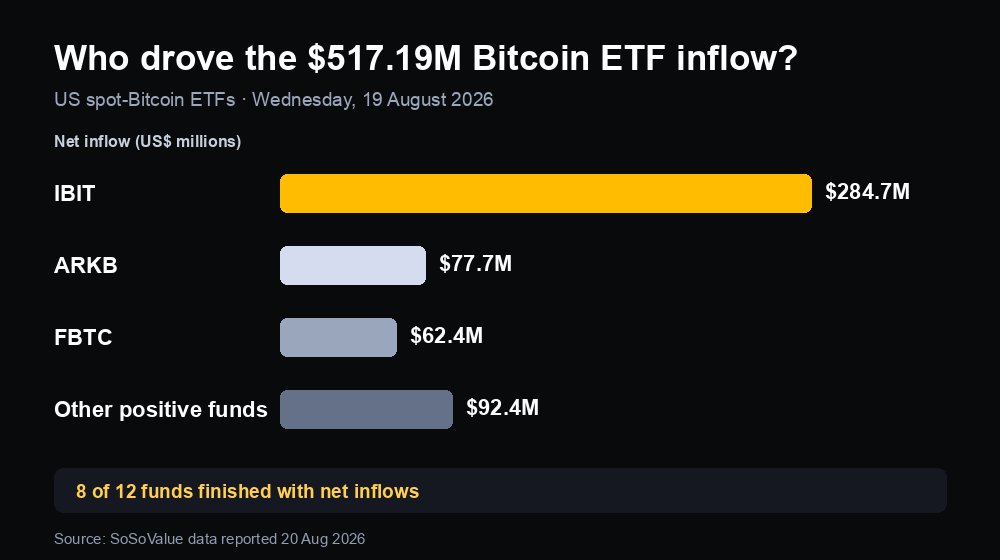
- IBIT supplied about 55% of the $517.19 million net inflow.
- Eight of 12 funds were positive, making the session broader than a one-fund surge.
- The next test is repeated positive breadth alongside BTC price acceptance—not a single headline.
What made the $517 million ETF day different?
It combined an unusually large total with participation across most of the US spot-Bitcoin ETF group. SoSoValue data reported by The Crypto Times showed BlackRock’s IBIT leading with $284.7 million, followed by ARK 21Shares’ ARKB at $77.7 million and Fidelity’s FBTC at $62.4 million. Eight of 12 funds finished positive.
The total was the largest in roughly three and a half months and marked a third consecutive positive session. That is stronger evidence than a single issuer absorbing all the demand, but concentration still matters: IBIT accounted for about 55% of the day’s combined net inflow.
Did ETF inflows cause Bitcoin to rally?
The flows supported the demand picture, but the timing does not prove a single-cause move. In the reported Thursday window, Bitcoin traded above $69,000 for the first time in two months and reached an intraday high near $69,892. The same market window also included a weaker dollar, lower long-dated yields and a broad crypto rebound.
The US Treasury had announced that nominal long-end liquidity-support buybacks would increase from a maximum of $2 billion to at least $4 billion per operation, effective 9 September through 4 November 2026. That announcement affected the wider liquidity and rates backdrop. ETF creations were one part of the confirmation, not the whole explanation.
This is why “ETF inflows caused the rally” is too neat. The more useful conclusion is that the funds showed fresh participation while macro conditions also turned friendlier to risk assets.
Does this prove institutional demand is back?
It shows strong demand through regulated ETF vehicles; it does not identify every end buyer or establish a lasting allocation trend. ETF flow data records net creations and redemptions at the fund level. It cannot tell readers that every dollar came from a new long-term institution.
That boundary is important because “institutional demand returns” is often used as shorthand. The $517.19 million result is significant evidence of fund-level demand, especially with eight products positive. A durable claim needs more: several sessions of positive breadth, rising cumulative flows and BTC holding gains after the initial news impulse.
Read the number in sequence: first the total, then issuer concentration, then the count of positive funds, and finally Bitcoin’s reaction after US ETF trading closes.
What would confirm the ETF-flow signal next?
Confirmation would come from repeated positive breadth while Bitcoin accepts higher prices rather than quickly reversing them. The framework below avoids turning one print into a forecast.
| Check | What the latest print showed | What strengthens the signal | What weakens it |
|---|---|---|---|
| Flow size | $517.19M net inflow | More positive days lift the multi-session total | A full reversal through large outflows |
| Issuer breadth | 8 of 12 funds positive | Participation stays distributed across several issuers | One fund carries the total while the group fades |
| Concentration | IBIT supplied about 55% | ARKB, FBTC and other funds keep contributing | Positive breadth collapses behind one issuer |
| BTC confirmation | Above $69K in the reported Thursday window | Price holds after the ETF session and volatility settles | The move is quickly rejected despite continued inflows |
| Macro backdrop | Lower yields and a weaker dollar supported risk appetite | Liquidity conditions remain constructive | Yields and the dollar reverse sharply higher |
Daily flow tables update after the US session, while Bitcoin trades continuously. Compare matched timestamps instead of treating a fund print and a later crypto quote as simultaneous. For current platform pricing, use the BTC product page. For background on a previous inflow-led setup, see Bitcoin at a five-week high as ETF inflows returned.
Final thoughts
The $517.19 million session deserves attention because it paired scale with broad participation. Its limit is equally clear: one strong day is evidence, not a trend. The better habit is to watch whether fund breadth, cumulative flows and Bitcoin’s price acceptance continue to tell the same story after the breaking-news headline moves on.