


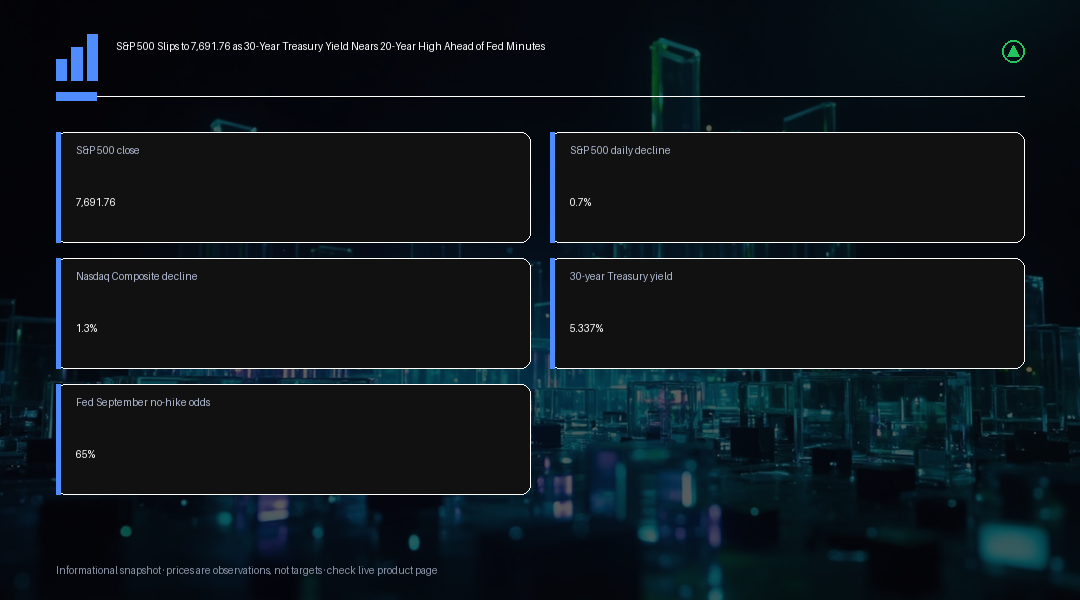
US stocks closed broadly lower on Tuesday as a sharp rise in long dated Treasury yields prompted investors to rotate out of expensive growth and technology names. The S&P 500 fell 0.7% to close at 7,691.76, ending well below last week's record high, while the Nasdaq Composite dropped 1.3% in its worst single session in three weeks. The Dow Jones Industrial Average was comparatively resilient, slipping 0.2%, as money rotated into more defensive sectors including healthcare, consumer staples, and energy.
Semiconductor and memory names bore the brunt of the selling. The Philadelphia Semiconductor Index fell about 5% on the day, with Micron down roughly 7% and Sandisk losing about 9% after both stocks had rallied sharply in recent sessions on artificial intelligence related demand. Nvidia also declined, though the exact size of its move was less consistently reported elsewhere, and investors should treat any single day percentage figure for the stock as approximate given the volatility across the sector. The pullback highlighted how crowded some AI infrastructure trades had become heading into the latest bond market move.
The selloff extended into Wednesday's Asian session. South Korea's Kospi index fell sharply, with declines reported in a range of roughly 5% to as much as 6% intraday as SK Hynix and Samsung Electronics, both major memory chip suppliers, dropped between 7% and 9%. Japan's Nikkei fell around 3%, Taiwan's benchmark declined roughly 1.5%, and mainland Chinese shares slipped between 1.5% and 2%. US index futures pointed to a cautious open, with Dow futures down about 0.1% and Nasdaq futures off roughly 0.2%, as a modest overnight pullback in Treasury yields offered only limited relief.
The catalyst for the broader rotation was a jump in long dated US Treasury yields, with the 30 year bond briefly touching about 5.337%, its highest level in roughly two decades, before easing back toward approximately 5.28%. Higher long term yields raise the discount rate applied to future corporate earnings and increase the opportunity cost of holding assets that pay no income, a dynamic that weighs disproportionately on high multiple growth and technology stocks whose valuations depend heavily on distant future cash flows.
Commodity and currency markets reflected similar cross currents. Brent crude climbed above $90 a barrel as renewed uncertainty around Iran and tanker traffic through the Strait of Hormuz revived supply concerns, a move that risks adding a fresh inflation impulse just as the market debates the path of interest rates. Gold edged higher by roughly 0.5% to around $4,350 to $4,360 an ounce, recovering a small part of the previous session's near 2% decline. Bitcoin traded near $64,500 and Ether hovered around $1,910, with both digital assets remaining sensitive to moves in real yields, which compete directly with non income producing assets. In currency markets, the US dollar index held near 99.65, the British pound traded around $1.353, and the yen stayed close to the intervention sensitive area near 160 per dollar.
Attention now turns to the release of the Federal Reserve's latest meeting minutes, which traders expect to shed light on the central bank's thinking around inflation risk given resilient growth data and now firming energy prices. Futures markets are currently pricing roughly a 65% probability that the Fed leaves rates unchanged at its September meeting, against a 35% probability of a rate increase. Any language in the minutes that signals greater concern about inflation, particularly given the recent jump in oil prices, could reinforce the recent rise in long term yields and extend pressure on richly valued equity sectors.
The move also stands out for how quickly sentiment shifted after the S&P 500 set a fresh record just last week. A 30 year yield within striking distance of a two decade high is a level rarely tested outside of periods of significant inflation concern, and its reappearance now, alongside a fresh leg higher in oil prices, has revived debate over whether the disinflation trend that supported this year's equity rally is at genuine risk of stalling. Sector leadership has shifted accordingly: healthcare, consumer staples, and energy names, which typically hold up better when rates rise and growth expectations soften, outperformed the broader market on Tuesday even as index level benchmarks finished lower.
Tuesday's session also underscored how tightly linked equity, bond, currency, and commodity markets have become around the current rate debate. A further leg higher in oil prices, driven by the ongoing Iran related tension, would complicate the Fed's task by adding a fresh cost push inflation risk just as officials weigh the balance between resilient growth and elevated borrowing costs. Conversely, a swift de-escalation of Middle East tensions or a surprise cooling in upcoming inflation data could allow yields to retreat further, providing relief to the rate sensitive technology and semiconductor names that led Tuesday's declines. Options markets have also picked up on the shift, with implied volatility gauges edging higher into Wednesday as traders positioned for a wider potential range of outcomes around the Fed minutes release, a dynamic that tends to amplify moves in either direction once the release crosses the wires.
Trading Insight
For traders, the interplay between long dated Treasury yields and equity valuations is likely to remain the dominant theme in the near term. As long as the 30 year yield holds within reach of its two decade high, rallies in high multiple technology and semiconductor names may continue to face selling pressure from investors rotating toward yield bearing assets. A benign set of Fed minutes, or a further pullback in yields, could trigger a sharp relief rally in growth and AI linked names, but such a move may prove more technical and positioning driven than a genuine shift in the medium term rate outlook. Conversely, any hawkish surprise, particularly if paired with continued strength in oil prices, would likely extend the current rotation out of expensive growth stocks and into defensive and value oriented sectors. Traders should also keep an eye on upcoming US inflation prints later this month, since a firmer than expected reading combined with rising energy costs would strengthen the case for the Fed to stay cautious well beyond the September meeting.