


KEY POINTS: Bitcoin fell to $83,400 during the previous Monday session after trading as high as $85,060, giving back part of a rally that took the coin above $86,000. The 30-year Treasury yield stood at 5.61% on 1 October after reaching 5.64% on 30 September. Market pricing for an October rate increase has been cut to roughly 25% ahead of September payrolls at 8:30 a.m. ET on Friday 2 October.
The reversal started as a routine give back and developed into a full round trip toward the breakout base. Bitcoin dropped 1.2% to $83,400 on the previous Monday, having been as high as $85,060 earlier in that same session. That swing of more than $1,600 inside one day matters because it shows how quickly the market can move from enthusiasm to defence once the macro picture changes. Nothing in the price action pointed to a broken market. It pointed to buyers who were waiting for a better entry.
The advance being surrendered was substantial. Bitcoin climbed more than 30% from its 19 August level and briefly approached positive territory for 2026, the strongest run since the start of the year. Strong spot exchange traded fund inflows, improving regulatory sentiment and the closing of bearish positions all contributed. Reaching above $86,000 produced the highest price since January, and that recovery is the reason $82,000 now carries so much weight. A market that has travelled this far in six weeks does not usually give the whole move back over a single session.
Shares with direct exposure to the asset moved with it. Coinbase and Robinhood gained more than 4% during the breakout session, and Strategy continued adding to its Bitcoin holdings. That equity complex now serves as a second read on institutional appetite, and it is the first place to look if Bitcoin starts losing $82,000. When the listed proxies and the underlying coin fall together, the selling is coming from larger balance sheets rather than from retail reaction. A split between the two, where the shares lag but the coin holds, would be a different and less dangerous signal.
The important level is $82,000, and its history explains why. Bitcoin was rejected around that area in mid May and again in early September, which makes the eventual break above it structurally significant rather than decorative. Every subsequent rally has been defended from this shelf. Holding it keeps the breakout intact. Losing it does not end the recovery on its own, but it removes the last broad base beneath the move and hands the chart back to a market that has repeatedly failed to push through here.
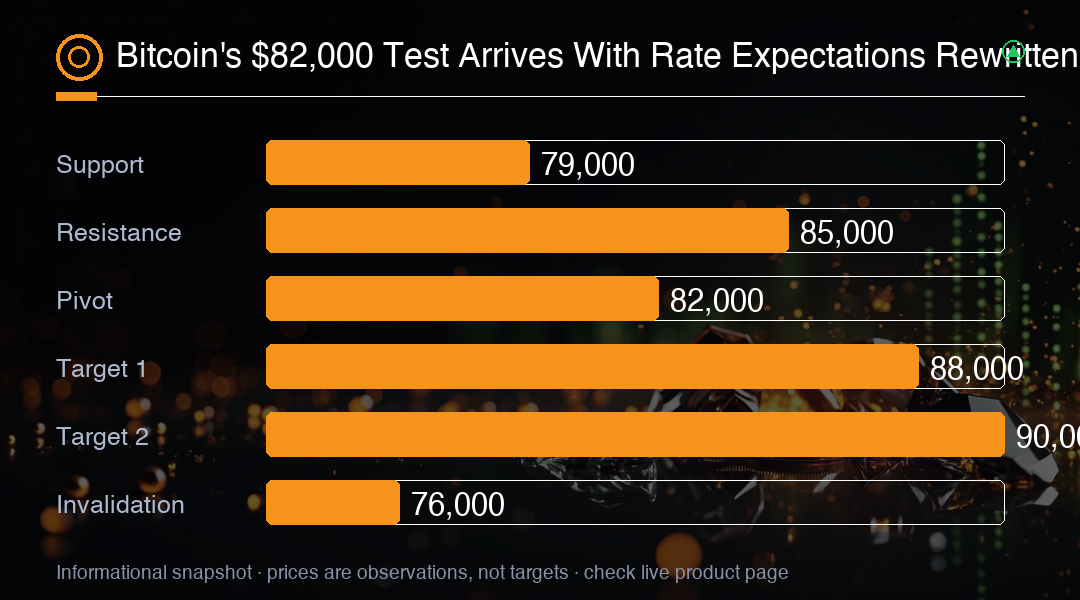
A sustained hold above $82,000 leaves the recent move open to a measured continuation. The first step is a return to $85,000, the level rejected in the previous Monday session, followed by $86,200, which is the recent high and the point that actually confirms the breakout. From there, a convincing close above $86,200 brings the $90,000 round number into view. The structure is straightforward: $82,000 is the floor, $86,200 is the confirmation, $90,000 is the target. Bitcoin does not need all three in one session. It needs the first two to hold and the third to remain in play.
The failure case is equally defined. A close below $82,000 weakens the breakout and exposes $80,000, the round number where resting interest tends to gather. Below that sits the broader $78,000 area, which is where the structure of the rally would be in genuine doubt. The distinction between $80,000 and $78,000 matters for risk management because the first is a retest of an obvious number and the second is a break of the range low. A slide straight through both on a single session would indicate that the macro pressure, not the price levels, is doing the work.
The weakness is arriving alongside a genuine tightening in financial conditions. The 30-year Treasury yield rose to 5.64% on 30 September before easing to 5.61% on 1 October, a level that remains high enough to matter for long duration assets. The dollar index climbed back above 102 on 1 October and traded roughly between 101.7 and 102.0 on 2 October, extending a two month high. Higher yields make cash and government debt more competitive with an asset that produces no income, and a firmer dollar tightens conditions for buyers outside the United States. Both moves were reinforced by rising oil prices.
Rate expectations have been rewritten faster than the price. Earlier in the week, market pricing pointed to roughly a 70% chance of another increase at the 27 to 28 October FOMC meeting. By 1 and 2 October that number had been cut to about 25%, in some readings 26%. This is the single most important change in the backdrop, because Bitcoin was rallying on the assumption that policy would keep getting tighter. Removing that assumption removes a headwind, which is why the asset has held a $82,000 pivot while equities and precious metals have not.
The calendar for the week ending Friday 2 October runs in a specific order. August personal consumption expenditures inflation was released on Wednesday 30 September. The September ISM Manufacturing report followed on Thursday 1 October. September nonfarm payrolls are due on Friday 2 October at 8:30 a.m. ET, which is the release that matters most. Inflation first, activity second, employment last. Each one can move the October pricing, and the payrolls figure lands with enough time before the FOMC meeting for markets to rebuild a full rate path.
The two outcomes are cleanly separated. Softer employment data, or a figure that comes in below expectation, would pull yields lower, weaken the dollar and hand Bitcoin the $85,000 to $86,200 range without requiring a fresh buying wave. Hot inflation or strong employment figures would push the October probability back toward the levels seen earlier in the week and raise the risk of a deeper retracement toward $80,000 and below. The asymmetry favours patience. Bitcoin is trading above a level it has defended twice, with its main macro headwind already reduced.
For positioning, the framework is straightforward. Treat $82,000 as the line that decides whether this is a pullback inside an uptrend or the start of a range. Add exposure on strength through $85,000 and $86,200 rather than on the first touch. Use $90,000 as the far objective once the recent high is cleared, and treat a decisive close under $80,000 as the signal to reduce. Bitcoin has already shown it can travel 30% in six weeks and then stall. The market does not need new enthusiasm to work from here. It needs the rate path to stay where it was repriced this week.
Trading Insight
Bitcoin is pinned between a defended $82,000 base and a $86,200 breakout confirmation, with rate pricing now the swing factor. Buy strength through $85,000 toward $86,200 rather than chasing the first touch, and hold the $90,000 round number as the far objective once $86,200 clears. A decisive close below $80,000 invalidates the long case and points to $78,000, while September payrolls at 8:30 a.m. ET on Friday 2 October is the event most likely to move yields and the dollar before the 27 to 28 October FOMC meeting.