


KEY POINTS: The dollar index traded near 102.00 on Friday, holding around a 17-month high on course for a third consecutive weekly gain. Traders put the odds of an October rate increase at about 25% to 26%, down from roughly 70% a week earlier. September payrolls arrive at 8:30 a.m. ET on Friday, with consensus expecting 90,000 new jobs and unemployment steady at 4.1%.
A market snapshot showed the dollar index trading near 102.00 on Friday, sitting around what would be a 17-month high and heading for a third straight weekly gain. Levels quoted in the session described an advance of roughly 1% on the week for the index, with the euro close to its weakest since May 2025 in the same snapshot. The combination matters more than either figure alone: a third consecutive weekly advance of that size is the kind of move that tends to force a reassessment of dollar positioning rather than be treated as drift. It also puts the index back in territory it has not occupied since mid 2024, which reframes the question for traders from whether the dollar can hold gains to how much further the move has room to run.
The most striking feature of the week is what the dollar did not need. Odds of an immediate rate increase at the October meeting collapsed, yet the currency barely paused. That tells you something about how the rate path is currently being priced: the market has largely removed the tail of an immediate move, and the dollar absorbed that news without giving back its weekly advance. Two readings are possible. One is positioning, where a crowded long that had been built on hike expectations is being defended rather than liquidated. The other is that the dollar is now being bought for reasons that have little to do with the next meeting, which is a more durable kind of bid. Which reading is correct should become clearer once the employment data lands.
Traders assign roughly 25% to 26% odds to an October rate increase, down from about 70% a week earlier. Those are fed funds futures market odds for the October move itself, and the meeting that carries the pricing decision is the 27 to 28 October FOMC gathering. That distinction matters more than it sounds, because a quarter of implied odds for October is a statement about one meeting, not about the whole path. Roughly one chance in four of a move at a single meeting can coexist comfortably with a market that expects policy to stay restrictive through the year. It also means the next repricing can go either way with real force, in either direction, since the odds are starting from such a low base relative to where they stood seven days earlier.
The long end has not followed the odds lower, and that is the second half of the puzzle. The 10-year Treasury yield remains near 5.25%, having briefly reached 5.34%, which was its highest level since 2002. A market that genuinely expected easier policy would normally see the long end respond. Instead the yield curve is holding yields elevated while front-end hike pricing drains away, which is consistent with an economy that is not obviously slowing and with inflation risk that is being taken seriously. The 2002 comparison should be read as a scale reference rather than a forecast: yields at those levels have historically reflected genuine tightening conditions, not just anticipation of them. For the dollar, it means the carry story still works, because real income at the short end has not been dislodged.
Europe is supplying a second and largely separate source of support. French government bonds have come under pressure as investors question the country's fiscal position, and the euro lost about 2.5% across September. Political and fiscal stress of that kind does not require any coordination with US policy to show up in the dollar index. It shows up because the index is a relative instrument, and relative weakness in a large component is dollar strength by arithmetic. The persistence of the move is the part worth watching. One bad month for the euro can be a positioning event. A trend that has already absorbed a September decline and a fresh session of pressure is starting to look structural, and structural currency moves tend to be less responsive to a single US data point.
The composition of the dollar index explains why that matters so much. The euro carries 57.6% of the index weight, which makes European developments unusually influential on the headline number. This is worth keeping in mind whenever the index moves sharply, because a given point of DXY strength can be produced by broad dollar buying or by euro weakness alone, and the two have different persistence. If the index reaches a new high while the euro simply continues to grind lower, the move is inheriting the European story rather than generating a fresh US one. That has practical consequences for how you would trade a payrolls surprise. A number strong enough to pull the dollar up across the board would be a much cleaner signal than a number that merely interrupts an existing euro decline.
In early Friday trading, levels quoted in the session included EUR/USD hovering near $1.1240 after breaking a long-term support level, GBP/USD around $1.32, USD/JPY close to 158 and USD/CAD at 1.4220. Taken together, those levels describe a session in which sterling and the Canadian dollar were also softer while the yen held comparatively firm, which is closer to a broad dollar move than a euro specific one. The broken support under EUR/USD is the detail to remember. Levels that have been defended for long periods tend to become reference points, and a sustained break below one invites a different set of positioning than a test that fails. It also gives traders a clean line to watch into the data.
The yen carries a domestic catalyst of its own, which complicates the read on USD/JPY near 158. Tokyo core inflation accelerated to 2.7% in September, up from 1.8% in August and above the 2.4% that had been expected. A move of that size, in that direction, strengthens the case for further Bank of Japan tightening and puts the yen in an unusual position for this cycle: supported by its own central bank story rather than only by dollar weakness. That does not make the yen the strong leg of the index, because USD/JPY still depends heavily on US yields and on the gap between expected interest rates in the two economies. A stronger US payrolls print that lifts Treasury yields can offset a hawkish Bank of Japan path quite easily.
September's US jobs report arrives Friday at 8:30 a.m. ET, and consensus expects 90,000 new payrolls with unemployment steady at 4.1%. For context on how to read that, a 90,000 print is a soft number in absolute terms and a solid one relative to recent trend, and it lands against an unemployment rate that has been sitting in a narrow band. The headline that matters most is the payroll figure, but the unemployment rate is the release's internal consistency check. A payroll number that beats consensus alongside a rising unemployment rate is telling you something different from the same number alongside a falling one, and the difference usually shows up first in the interest rate reaction rather than in the currency.
The component most worth watching is wage growth, and it needs to be treated as a consensus expectation rather than a settled figure. Economists surveyed put annual wage growth at 3.2%, against 3.1% in August. That expected uptick is the number to watch in the release, because wages help distinguish resilient hiring from a renewed source of inflation pressure. If wage growth lands at or above the expected 3.2%, the combination of a firm payroll print and firm wages is the cleanest possible signal that the labour market is not cooling, and the dollar would have a straightforward reason to extend. If wages come in softer while payrolls hold up, the more constructive story is that firms are adding headcount without adding pay pressure.
Revisions are the second thing to watch, and they carry the analytical weight in this release. August's job gain was an unexpectedly strong print that economists now anticipate being revised down. The magnitude of that prior gain is best left to the official release and revision tables rather than stated as settled here, because preliminary figures move and because the direction of the revision matters far more than the level. The key scenario is a respectable September headline accompanied by substantial negative revisions to prior months, which would leave the labour market looking materially softer than the headline implies and would probably cap any initial dollar rally. Positioning built on a strong August number is the vulnerable side of that trade, and it is also why a beat on the face of the report does not automatically confirm the third weekly gain. Framing the session around two risks is more useful than framing it around a single forecast: the first is a hot payrolls number, especially with wages at or above the expected 3.2%, pushing October move odds back up from about 25% to 26% and pulling the 10-year yield back toward the 5.34% area unseen since 2002; the second is a weak headline with heavy negative revisions unwinding the dollar's weekly advance rather than just part of it. Between those sits the 90,000 payrolls consensus with unemployment at 4.1%, where expectations sit and where the market is least likely to find a reason to travel far. The 27 to 28 October meeting remains the event the futures market is pricing, and Friday's release is the first real test of that pricing rather than a preview of it.
Trading Insight
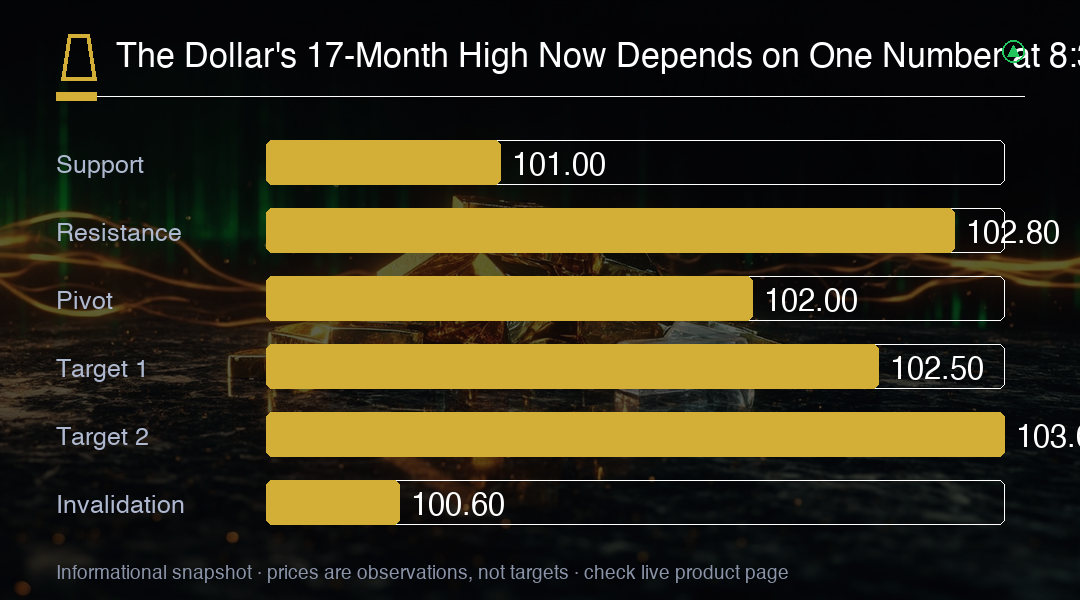
With the dollar index near 102.00 and October move odds at about 25% to 26%, the asymmetry favours waiting on the payrolls print rather than chasing the weekly advance. A hot headline with wages at or above 3.2% puts the 103.00 area back in play, while a soft print with heavy negative revisions exposes the index to the 101.00 region. Watch wage growth first and revisions second, since revisions decide whether the initial dollar reaction holds.