


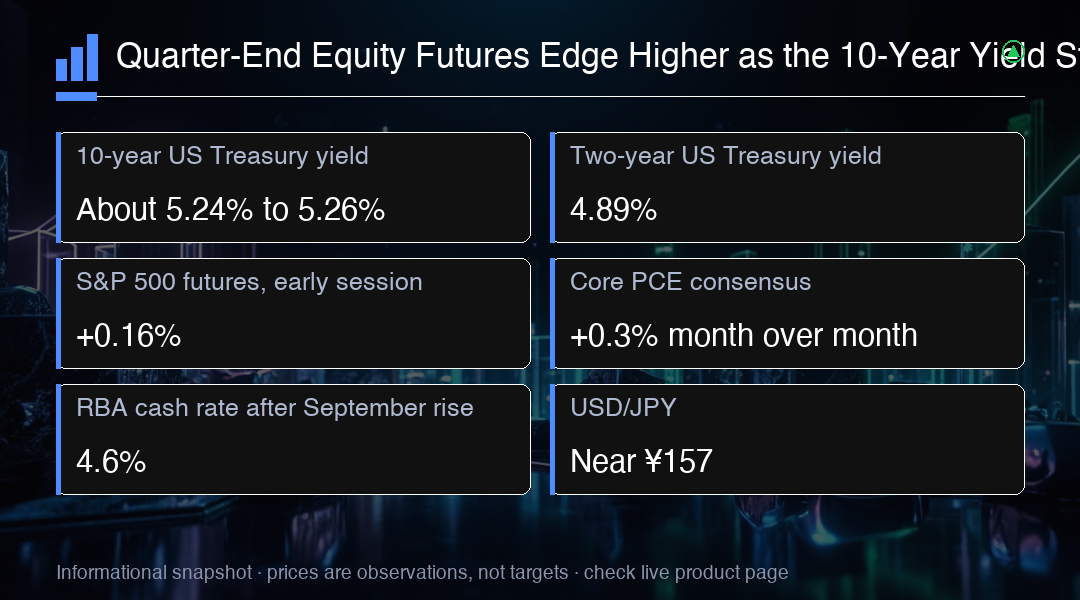
US equity futures finished the quarter on a firmer note while the government bond market supplied the pressure. S&P 500 futures rose 0.16% in an early-session snapshot on the final trading day of the quarter, with the 10-year US Treasury yield holding near 5.24% to 5.26%, close to its highest level since 2007. That gap between a calm equity tape and an expensive bond market is the defining feature of the session, and it is why the day's scheduled events carry more weight than a routine quarter-end close would suggest.
The advance was not a large one. In the same early-trading snapshot, Nasdaq futures were up 0.13% and Dow futures were also modestly higher. Moves of that size are routine for index futures and should be read as positioning into the cash open rather than as a decisive risk-on shift. Index contracts often sit close to flat through early trading until real cash orders arrive or macro data lands, which is precisely what the 8:30 a.m. ET inflation release is expected to do.
Rates are where the actual repricing is happening. The September 29 US Treasury curve showed the two-year note at 4.89% and the 10-year note at 5.26%, and a later same-day market snapshot put the 10-year at 5.2383%. Naming each maturity matters, because the front end and the long end are not sending the same message. A two-year yield anchored near 4.89% keeps policy expectations tight, while the long end absorbs term premium, government supply and energy-driven inflation risk at the same time.
The 10-year yield was on course for a rise of nearly 50 basis points during September, a large move for a benchmark over a single month. Investors cited inflation readings, heavy government borrowing and elevated energy costs as the drivers. Mechanically, higher yields raise corporate borrowing costs and reduce the present value of distant profits, which is the standard argument for caution on richly valued equities. It is an argument about valuation pressure, not a prediction that the index must fall.
The immediate test arrives on schedule at 8:30 a.m. ET, when the August personal income and outlays release is due, including the personal consumption expenditures price index. Consensus looked for core PCE to rise 0.3% month over month. No outcome was known at the time of writing, and the reaction function is directional rather than dramatic: a hotter reading tends to lift yields and pressure index futures, while a softer reading tends to relieve immediate pressure on the front end. Investors were also watching upcoming labor-market releases further out.
Underneath the quiet futures tape, equities are still being carried by earnings growth and enthusiasm around artificial-intelligence investment. Investors appeared to be pricing the idea that corporate profits can outrun the rising cost of money, and equity futures were being described as resilient rather than defensive. That is a working assumption rather than a settled one. Elevated yields can pressure multiples even when the immediate index reaction looks muted, and a quarter-end advance does not settle what valuations can carry while the discount rate stays near multi-year highs.
Japan supplied the strongest equity session in Asia. The Nikkei gained 2.1% in an early September 30 snapshot, and a later market-data reading put the index up 1.28% at its own timestamp, which is a useful reminder of how quickly intraday figures change. Even so, the Nikkei was on course to end the month up about 0.8% while finishing the quarter down 4.7%. Japanese government bond yields hovered near multi-decade highs, so equities there are again advancing alongside expensive money rather than because of it.
China remains the conspicuous laggard. The CSI 300 edged up 0.2% in morning trade but stayed on course for a quarterly fall of about 13%, which would be the weakest quarter since the height of the country's pandemic lockdowns. Single-session percentages in the region move quickly, so the direction carries more information than any one print. In Europe, equity index futures indicated a firmer open while government bond yields remained elevated, a combination that has described the entire quarter across developed markets.
Australia delivered its own inflation warning. Headline consumer prices rose 4.0% year over year in August, up from 3.5%, with fuel a notable contributor, and the Reserve Bank of Australia had lifted its cash rate to 4.6% the previous day, a 25 basis point increase to a 15-year high. The nuance matters just as much: the underlying trimmed-mean measure came in softer than expected, which cuts against a simple reading that inflation pressure is accelerating without limit across every major economy.
The dollar was tracking a monthly gain of about 2% in September, with the euro and sterling each down roughly 2.4% over the month. EUR/USD traded near $1.1336 in an early snapshot. USD/JPY was near ¥157, below its September highs, with intervention concerns supporting the yen from its late-month lows, although the yen was still on course to lose about 1.7% against the dollar across the month. Rate differentials, rather than sentiment, are doing the work in both pairs.
Commodities are the third leg of the cross-asset picture, and they are not reinforcing the disinflation story. Brent crude was quoted at $103.16 and US crude at $89.49 in an early snapshot, with Middle East supply-disruption concerns cited as support. Spot gold sat near $4,171.93 in that snapshot, where higher yields and a stronger dollar are headwinds for an asset that pays no interest. Bitcoin traded around $82,925 in one same-day indication, and any technical support claim there needs a stated methodology before it is treated as fact.
The session's largest scheduled company event is Micron, which was set to report fiscal fourth-quarter results after the US close, with a conference call at 2:30 p.m. Mountain Time. Investors were focused on what the print would say about memory pricing, high-bandwidth memory demand, profitability and capital spending, none of which was public before the release. Tuesday's single-stock tape offered little tolerance for disappointment: Fair Isaac fell about 26.5%, described as its largest-ever daily decline, and Carnival rose as much as 14% after raising full-year earnings guidance.
Trading Insight
Watch the 10-year US Treasury yield rather than the index level. Treat 5.24% to 5.26% as the decision band: a sustained move above the upper end, especially into the 8:30 a.m. ET PCE release, tends to pressure index futures, while a retreat from it gives the equity tape room. Size for gap risk around both the inflation print and Micron's after-close report, and treat quarter-end futures strength as provisional until the cash close confirms it.