


KEY POINTS: Anthropic could begin trading as soon as mid-November 2026, with formal marketing expected to start during the week of November 9 and a debut possible before Thanksgiving on November 26. Prospective investors see a fair valuation of $1.8 trillion to $2 trillion for the company. Revenue reached roughly $4.6 billion in 2025 while the operating loss was $8.06 billion, so the offering would price a fast growing business that is still deeply loss making.
The timetable is the most tradeable part of the story. Reporting this week indicated that the company could go public as soon as mid-November, roughly seven weeks from now, after a marketing phase that is expected to begin during the week of November 9. Thanksgiving falls on Thursday, November 26 this year, so a first day of trading before that date would sit comfortably inside the calendar rather than at its edge. Treat the schedule as possible rather than confirmed, because nothing in the reporting is a commitment and a company can always move, delay or cancel.
The marketing phase is commonly called a roadshow. It is the period in which management presents the business to prospective investors while the banks running the offering assess how much genuine demand exists at the asking price. That matters more for a company of this size than for a conventional listing, because a trillion dollar valuation is not something that clears on institutional allocation alone. The roadshow is where the order book is tested, and where a price range gets shaped or broken before the shares are ever allocated.
On valuation, prospective investors see a fair range of $1.8 trillion to $2 trillion. Anthropic also expects to match or exceed the size of the offering being prepared by SpaceX. Two qualifications are important. First, no SpaceX listing has taken place, so that reference is a benchmark against a prospective deal rather than a completed one. Second, the word size is ambiguous here. Company valuation and money raised are two very different figures, because an offering sells only a portion of the business, and reporting on the target has not always distinguished clearly between the two.
The revenue line is the strongest argument for the offering. Revenue reached roughly $4.6 billion in 2025, up from $386 million in 2024. That is close to a twelvefold increase in a single year, and it is the kind of growth curve that justifies an extraordinary valuation multiple. It also tells you what the business actually is at this stage: a developer and enterprise seller of model access rather than a hardware business, with revenue concentrated in a small number of large customers and usage contracts.
The cost line is the strongest argument against paying the top of that range. The operating loss was $8.06 billion, which is a larger figure than revenue itself. Running frontier models means paying for compute, data centres and talent before the associated revenue arrives, and the expense is front loaded while the revenue is back end loaded. Investors are therefore being asked to fund a gap, not simply to capitalise a profit stream, and any listing will hand the market a quarterly number that will move on that gap rather than on the growth rate.
The headline net loss of nearly $42 billion needs careful handling. Roughly $34 billion of that figure was an accounting charge connected to financing instruments that could convert into shares. Such a charge is a recognition of expected dilution, not cash leaving the business, and it has no direct effect on what the company must spend each quarter to stay in operation. Any analysis that treats the full $42 billion as a cash cost will be badly wrong. Operating loss and cash generation are the two figures worth separating, and they tell very different stories about this company.
Put the figures side by side and the structure of the deal becomes clear. A roughly $4.6 billion revenue base, growing close to twelvefold, sits against an $8.06 billion operating loss, which implies a company that has never been close to break even at the operating line. The expense of building advanced AI systems is currently larger than the revenue those systems generate. That does not make the equity story wrong, since the case rests on future scale rather than present profitability, but it does mean the valuation range is a bet on profit arriving years later in the model, not on the current income statement.
There is also a governance argument running alongside the financial one. Chief executive Dario Amodei is calling for slower advancement at the AI frontier. His proposed framework includes embedded independent evaluators, common industry safety standards for the sector and international coordination between governments. For investors this cuts two ways. A slower pace of capability growth may reduce the risk of a disruptive event that reprices the whole sector, and it may support the case for the company leading on safety. It also caps the near term growth rate that the revenue multiple depends on.
The competitive picture reinforces the caution. Rival OpenAI has postponed its own listing plans, with Sam Altman arguing that going public now would be ill advised. Two leading developers reaching opposite conclusions about the same market is a useful signal about how unsettled pricing for AI equities has become. Anthropic moving first would put it ahead of its closest peer on price discovery, which is an advantage in a promotional offering. It would also mean that the first serious public valuation of an independent frontier lab sets the reference point for everything that follows.
The things to watch are concrete and they arrive on a known calendar. The eventual price range will show where demand actually sits against the $1.8 trillion to $2 trillion discussion. The number of shares offered will show how much of the company is being sold and therefore how much money is genuinely being raised. Final pricing will show whether early enthusiasm converted into orders. Between now and the week of November 9 there is little to trade on other than the timetable, and between then and November 26 the flow of filings will do most of the work.
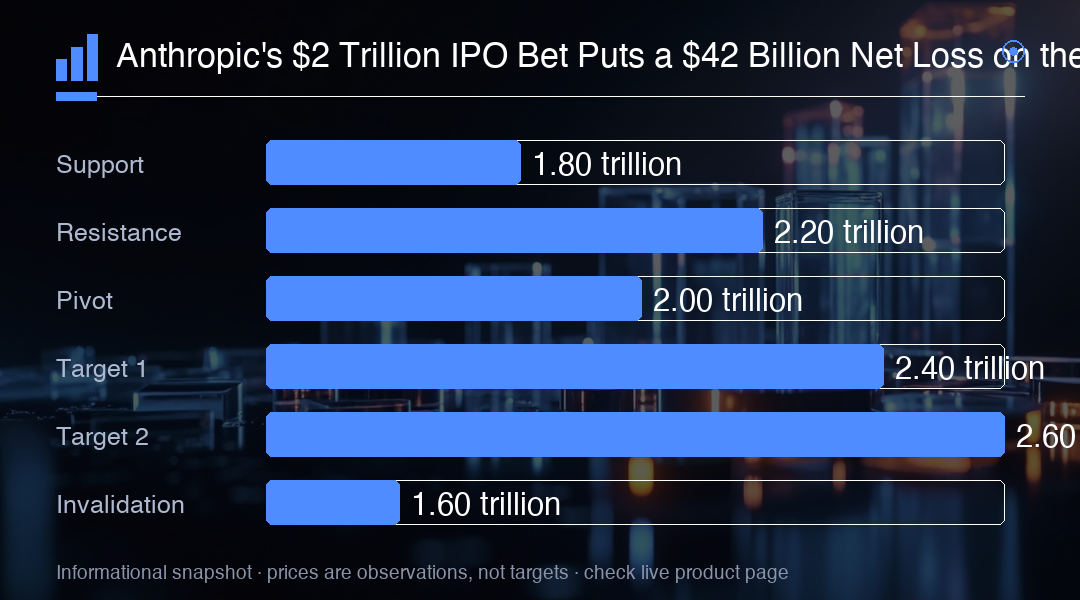
For the broader market, the practical consequence is that a trillion dollar AI valuation will soon be set in public rather than in private rounds, and the sector will be marked to whatever that price implies. If the offering lands near the top of the range, the read through is supportive for AI infrastructure, compute suppliers and listed peers. If it prices at or below the lower end, or slips past the pre Thanksgiving window, the same read through works in reverse. For now the valuation ladder below frames the discussion, with the revenue and loss figures setting the fundamental boundaries that any first day price will have to justify.
Trading Insight
Treat mid-November as a possible date rather than a scheduled one, and watch the week of November 9 for the price range and share count, which reveal whether the $1.8 trillion to $2 trillion talk survives real order books. A deal near the top of that range would mark the whole listed AI complex higher, while pricing at or below the lower end, or a slip past 26 November, would do the opposite. Anchor expectations to the operating loss of $8.06 billion rather than the $42 billion net figure, which is dominated by a non cash accounting charge.