


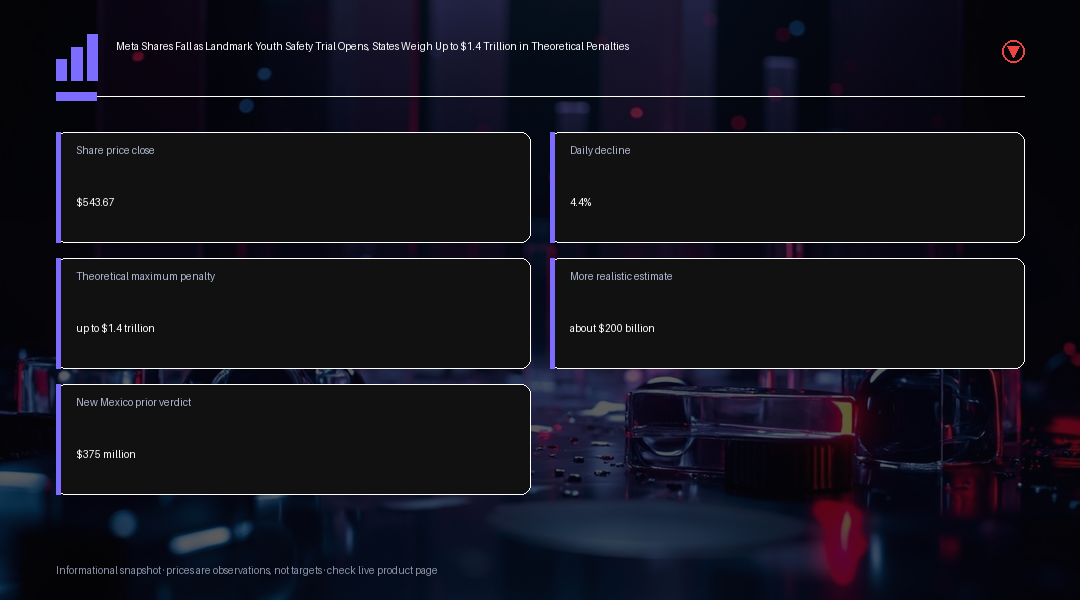
Meta Platforms shares fell approximately 4.4% on Tuesday, closing near $543.67, as a closely watched federal trial opened in Oakland, California, over allegations that the company designed Facebook and Instagram to compulsively engage children and teenagers. The decline came alongside broader weakness across technology shares, so the move should not be attributed to the trial alone, but the case adds a new and potentially long running source of legal and regulatory risk for the world's largest social media company.
The lawsuit was originally brought by a coalition of 29 states, though the Oakland trial's lead consumer protection claims are being pursued specifically by California, Colorado, Kentucky, and New Jersey. State attorneys allege that Meta engineered features such as infinite scroll, autoplay, like counts, and push notifications specifically to maximize the time young users spend on its platforms, and that the company misled parents and regulators about the risks. Separate claims allege that Meta collected data from children under 13 without proper parental consent, potentially in violation of the Children's Online Privacy Protection Act, known as COPPA.
Much of the market's attention has focused on a headline figure of up to $1.4 trillion in potential penalties and disgorgement, an amount that sits near Meta's entire market capitalization. That number, however, represents a theoretical maximum exposure calculated by multiplying statutory fines by an estimated number of violations across millions of young users, not a confirmed damages demand or an awarded judgment. California Attorney General Rob Bonta has publicly clarified that the states are not actually seeking $1.4 trillion, and other reporting has suggested a figure closer to $200 billion could be a more realistic order of magnitude if the states prevail. Meta has called the states' calculation methodology unsupported and disproportionate, and denies deliberately designing addictive products or that social media addiction is an established psychiatric condition.
The trial does not exist in isolation. A New Mexico jury separately ordered Meta to pay $375 million in a related youth safety case, a verdict that remains subject to potential post trial and appellate developments. In a separate Los Angeles case involving both Meta and YouTube, a jury awarded $6 million in damages, with Meta reportedly held responsible for 70% of that amount. Neither outcome determines how the Oakland trial will be decided, but both illustrate that juries have been willing to find social media companies at least partially liable in related youth safety litigation. The Oakland trial is expected to last roughly six to seven weeks, and Meta chief executive Mark Zuckerberg and Instagram head Adam Mosseri are both expected to be called to testify, though neither had done so as of this writing.
Youth mental health has become one of the most consequential regulatory battlegrounds for social media companies over the past several years, following extensive reporting and internal research suggesting some platforms were aware of potential harms to younger users. Former Meta engineer Arturo Bejar has been a prominent voice in related proceedings, previously testifying that internal warnings about child safety were disregarded during product development at the company; the extent of his testimony specifically within the Oakland trial should be confirmed as proceedings unfold. The case is widely viewed as a bellwether for how courts will treat a wave of similar state and federal actions targeting algorithmic design choices across the social media industry, with implications that could extend well beyond Meta to other major platforms.
The Oakland case also lands amid a broader wave of state and federal scrutiny of how technology platforms design products for younger users, spanning proposed age verification mandates, algorithmic transparency rules, and separate litigation against other major social media and video platforms. Legal analysts have described the trial as one of the most significant tests yet of whether product design choices themselves, rather than the content users post, can support large scale liability under state consumer protection statutes. A verdict against Meta could embolden other state attorneys general pursuing similar claims, while a narrower or more favorable outcome for the company could slow the pace of comparable litigation elsewhere.
For investors, market participants increasingly view potential product related remedies as a bigger long run risk than any specific dollar penalty. If the court eventually orders changes to recommendation systems, limits on autoplay or infinite scroll, stricter age verification, or new restrictions on how youth data can be collected and used, the impact on user engagement and advertising delivery could be more durable than a one time fine, however large. Any such outcome remains conditional on a finding of liability, the specific remedies ordered, and the results of any appeal, so it should be treated as a risk scenario rather than an expected outcome at this stage.
Meta shares have still generated substantial returns for long term holders even after Tuesday's decline, and the stock's reaction reflects a market that is treating the trial as a serious but manageable risk rather than an existential threat, at least for now. That could change quickly if testimony from senior executives produces unfavorable disclosures, or if the presiding judge signals openness to sweeping product remedies during the roughly six to seven week proceeding. Traders should expect headline driven volatility around key trial dates, including any scheduled testimony from Zuckerberg or Mosseri, and should watch for signals on both the ultimate size of any penalty and, more importantly, whether the court moves toward mandating specific product changes.
Trading Insight
For traders, the more actionable signal from Tuesday's move is that markets are currently pricing legal headline risk rather than an existential threat to Meta's business model. Short term volatility around META is likely to track trial headlines, particularly any testimony from Zuckerberg or Mosseri and any signal from the presiding judge about the scope of potential remedies. A ruling or settlement that limits financial exposure to a fraction of the $1.4 trillion theoretical maximum, closer to the roughly $200 billion figure some reporting has floated, would likely be read as a relief outcome even though it remains a large absolute number. The more durable risk to monitor is any court ordered change to core engagement features such as recommendation systems, autoplay, or infinite scroll, since those changes could weigh on user time spent and advertising revenue well after the trial itself concludes.