


Micron Technology closed at $1,011.75 on 17 August 2026, its first close above $1,000 since early July, then fell 7.02% to $940.76 the next session. The four-digit print restarted attention on the AI memory trade, but the reversal means the rally still needs confirmation from earnings durability, memory supply and semiconductor breadth.
This distinction matters beyond one stock. Micron sits where AI infrastructure spending meets the traditionally cyclical DRAM and NAND markets. Its price can therefore act as an early stress test for chip leadership and, when the move broadens, for the technology-heavy Nasdaq 100.
Key takeaways
- MU reclaimed $1,000, then gave back the breakout in one session.
- Record margins support the AI-memory thesis, but pricing power is doing more work than shipment growth.
- A durable restart needs MU, semiconductor breadth and NAS100 to confirm one another.
What did Micron's $1,000 move actually prove?
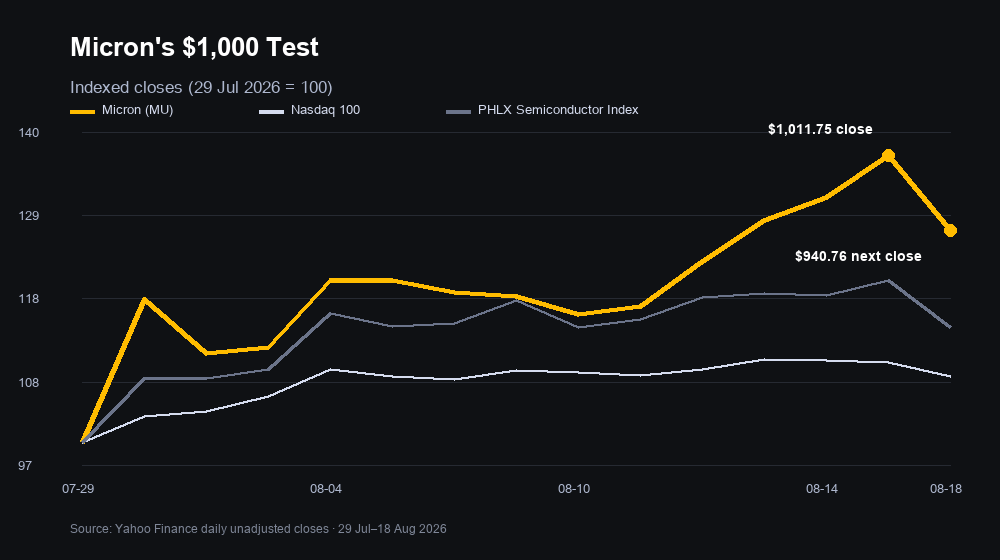
It proved that buyers were willing to revisit the four-digit valuation after a violent correction; it did not prove that the correction was over. Yahoo Finance daily closes show MU rising from $739.00 on 29 July to $1,011.75 on 17 August, a 36.9% rebound. The next day's close at $940.76 cut that rebound and turned $1,000 from a victory line into a live test of demand.
The broader tape was more restrained. Over the same 29 July–17 August window, the Nasdaq 100 gained about 10.3% and the PHLX Semiconductor Index about 20.8%. On 18 August, those benchmarks fell about 1.7% and 5.0%, respectively, while MU dropped 7.0%. That hierarchy says Micron was leading both the upside and the downside rather than simply tracking the market.
Why does AI change the memory cycle?
AI systems need more high-performance memory per server, while advanced memory capacity takes time and capital to add. That combination can keep demand ahead of supply for longer than in a conventional PC or smartphone replacement cycle.
Micron reported $41.46 billion of fiscal Q3 2026 revenue, up from $9.30 billion a year earlier, with an 84.6% GAAP gross margin and $25.39 billion of operating cash flow. The company guided fiscal Q4 revenue to $50.0 billion, plus or minus $1.0 billion, and gross margin to approximately 86%. These are company-reported results and guidance from 24 June, not market estimates.
The product evidence is equally important. Micron said HBM4 was already in high-volume shipments for a lead customer's platform, while HBM4E volume production was expected in calendar 2027. Management also said multi-year strategic customer agreements should improve the durability and predictability of financial performance. That is the strongest argument for a structural change: more advanced memory, deeper customer commitments and less dependence on a single spot-price swing.
What could still break the memory rally?
The main threat is the old cycle returning through weaker demand, faster supply growth or both. Extraordinary margins attract capacity. If new output arrives as AI infrastructure spending slows, memory prices can fall faster than shipment growth can compensate.
Pricing sensitivity is already visible in the operating mix. INDmoney's 17 August analysis of Micron's fiscal Q3 Form 10-Q noted that DRAM and NAND revenue growth was driven much more by higher average selling prices than by bit-shipment growth. That is powerful while supply stays tight, but it also makes memory pricing the most important variable to watch.
The market is testing that tension in real time. A stock can have record reported numbers and still fall if investors think those numbers mark peak scarcity. The 18 August reversal is useful precisely because it challenges the easy version of the story. For another example of strong chip fundamentals meeting a weaker market reaction, see why chip stocks can fall after strong results.
How can traders confirm a real restart?
Use three layers rather than one price threshold: Micron's business engine, the memory cycle and market breadth.
| Confirmation layer | Evidence now | What would strengthen it | What would weaken it |
|---|---|---|---|
| Business engine | Record Q3 revenue, margin and cash flow; strong Q4 guidance | Guidance holds and customer agreements improve visibility | Guidance cuts or slower AI-memory shipments |
| Memory cycle | Tight supply and high pricing power | Demand absorbs added capacity without sharp price erosion | DRAM/NAND pricing rolls over before volume accelerates |
| Market breadth | MU outpaced both NDX and SOX into 17 August | MU reclaims $1,000 while SOX and NAS100 participate | Repeated MU failures with chip breadth deteriorating |
The table separates reported facts from forward confirmation. Market prices move continuously; the dated closes above are the comparison window.
What does Micron mean for NAS100 traders?
Micron is a useful signal for AI-infrastructure appetite, but it is not the Nasdaq 100. NAS100 contains a broader mix of mega-cap software, platforms, consumer technology and semiconductor exposure. A Micron breakout matters more when semiconductor breadth and the index confirm it; an isolated MU spike can remain a company-specific move.
The practical read is relative, not predictive. If MU and the semiconductor index recover together while NAS100 holds its own trend, the memory rally is becoming a broader technology signal. If MU keeps failing near $1,000 while chips lag the index, traders are looking at a narrower and more fragile story. The same separation helps in mixed sessions such as the Sandisk and NAS100 market open.
Final thoughts
Micron's move through $1,000 was important because it reopened the question, not because it settled it. Record financials make the AI-memory thesis credible; the next-session reversal keeps the cycle risk visible. The cleaner conclusion is to let three pieces agree: durable company execution, sustained memory pricing and broad participation from chips and NAS100. Until then, $1,000 is a test rather than a verdict.