


KEY POINTS: A market snapshot showed Brent crude for December delivery at $101.62 a barrel and West Texas Intermediate for November at $90.19 at 03:00 ET on Monday, with Brent down 0.6% and WTI down 1% as Asian trade opened. The G7 agreed on Friday to release 100 million barrels of crude and fuel products from emergency reserves, with a substantial share of diesel within 20 days. Middle Eastern export flows have also recovered above pre-war levels, with a seven-day average of 18.5 million barrels a day on 1 October against an 18 million barrel pre-war average.
The combination that pushed crude lower on Monday morning was two sided. Emergency supply was being organised at the same time as physical barrels were already moving again through the Middle East, and together they removed some of the immediate shortage premium that had built since the war involving Iran began. Prices still gave up only modestly rather than collapsing, which tells you how quickly the geopolitical discount returned once the flow news was digested. A market snapshot taken at 03:00 ET showed Brent crude futures expiring in December down 0.6% at $101.62 a barrel, while West Texas Intermediate futures for November slipped 1% to $90.19. Elevated geopolitical tensions, described in the same reporting as heightened, limited how far losses could travel.
Two price points sitting about eleven dollars apart is the shape of the market right now. Brent at $101.62 and WTI at $90.19 reflect a spread that has held wide through the conflict because seaborne risk, freight insurance and the availability of non Middle Eastern barrels all feed into it. For traders, the practical read is that the Atlantic Basin benchmark is the one carrying the war premium, while the inland US benchmark is more exposed to domestic storage levels and refinery margins. A Monday move of less than one percent in both contracts is a pause, not a turn. The war premium has been in place long enough to become the baseline against which every supply headline is now measured.
The G7 agreement reached on Friday is the single largest policy variable on the board. The group agreed to release 100 million barrels of crude and fuel products from emergency reserves, and a substantial portion of the diesel component is to be released within 20 days. The stated purpose was to cushion energy markets against supply disruption caused by the war involving Iran. The size of the release matters less than its composition and its speed. One hundred million barrels spread across all consuming nations is meaningful but not overwhelming, whereas diesel arriving inside a three week window lands directly into the tightest product market of the coming months.
Analysts said the decision reflects growing tightness in the diesel market as the Northern Hemisphere winter approaches, and it also removes a specific policy risk that had been hanging over the market, the possibility of a United States ban on diesel exports. An analyst note framed the release as a substitute for a supply decision that would have hurt refiners and consumers more directly. A US diesel export ban would have tightened the Atlantic Basin balance and pulled product toward the United States at the moment when global distillate inventories were already drawing down. The G7 move has ruled out that possibility for now, which is why the reaction in products was more contained than the reaction in crude.
The physical data is the part that complicates the shortage narrative. Export-tracking data showed Middle Eastern crude exports running above pre-war levels on four separate days during the final week of September. The same data put flows at between 19.5 million and 22.5 million barrels a day on 24 September and again across 27, 28 and 29 September, with a seven-day moving average of 18.5 million barrels a day on 1 October, above the pre-war average of 18 million barrels a day. On the face of it, supply is not short at the aggregate level. Export tracking is a tanker and terminal based estimate rather than a government figure, but the direction is consistent across the individual days.
Recovery in those numbers has two components, more barrels moving through the Strait of Hormuz and a wider use of alternative export routes. Both carry costs that do not show up in a barrels a day tally. Shipping in the region remains risky, insurance premia stay elevated, and routing around chokepoints lengthens voyages and ties up tonnage. That is the practical explanation for why headline export strength has not fully translated into calm prices. A barrel that arrives late, or that a shipowner will not accept at all, is not equivalent to a barrel that clears a normal loading programme. Physical availability and commercial availability are separate problems, and the gap between them is where the remaining risk premium sits.
The supply picture stays complicated by continued attacks in the region, and that is the part of the story that cannot be verified from market data. Yemen's Iran-aligned Houthis said they launched missiles and drones at Saudi Aramco facilities in Riyadh and the Khurais area, in response to Saudi-led strikes in Yemen. Saudi Arabia has not confirmed the attacks. That claim should be treated strictly as an unconfirmed assertion. If any part of it were verified, the effect on crude would be immediate and large, because the facilities sit inside the largest spare capacity system in the Middle East. Until it is confirmed, it functions as a volatility input rather than a supply fact.
Saudi Aramco separately moved on price rather than on volume, and the move cuts against the grain of a tight market. The company unexpectedly cut its November official selling price for Arab Light to Asia by $3 a barrel, taking the grade to a discount of $5 to the Oman-Dubai average. That is the widest discount since June 2020. The stated reason is to defend market share in Asia as freight costs rise, and a record discount is a competitive tool rather than a shortage signal. Producers cutting headline prices while exports run above pre-war levels is a pattern traders have seen before in soft demand conditions, and it is one of the quieter arguments against the idea that physical barrels are actually scarce.
The producer group added the final layer. OPEC+ agreed to keep November production targets unchanged, and the group said its next meeting would be held on 1 November. Holding targets rather than raising them is a notable choice given how much political capital has been spent on managing this market, and it leaves the group with no pre-committed increase available if prices keep sliding. The meeting date sets a clear calendar marker. Between now and then, the group has an incentive to defend the current price range publicly while doing nothing operationally, which means the policy signal over the next four weeks is likely to be rhetorical rather than physical.
Prices above $100 for Brent are unusual and they are now being set by a contest between two forces that both have dates attached. The G7 barrels arrive inside 20 days, the producer group meets on 1 November, and Middle Eastern exports are already averaging above their pre-war level. Against that, the regional attack risk is unresolved and any confirmed damage to Saudi export infrastructure would reprice the entire curve overnight. That is an unusually well defined set of markers for a market trading at a war premium, and it is why traders are holding positions rather than building them. The level that matters most is where Brent holds if the emergency barrels are absorbed without incident, because that becomes the new reference point for everything that follows.
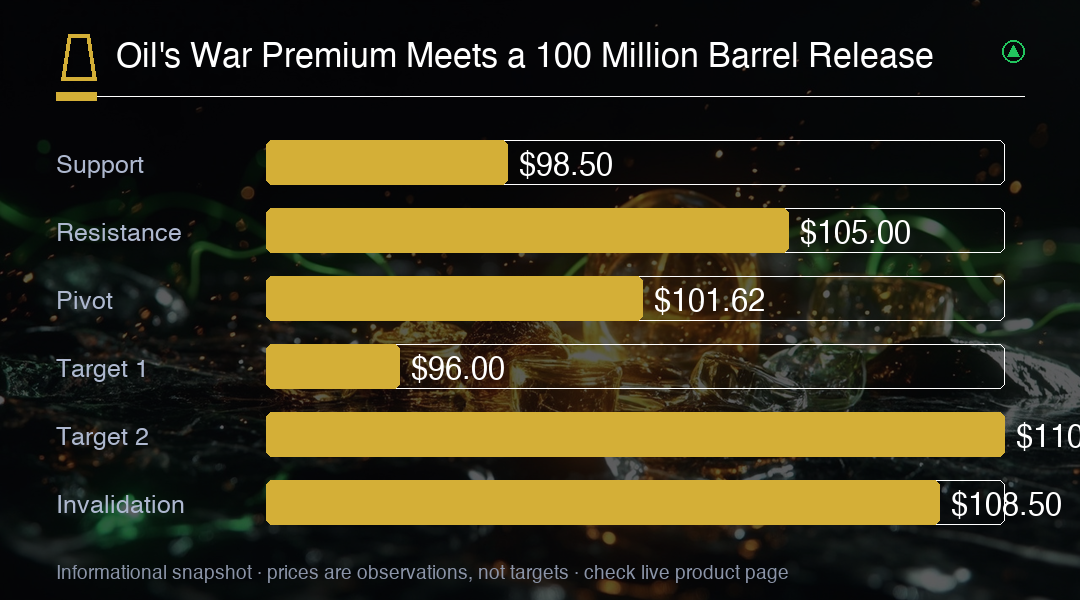
The practical setup favours patience on a market sitting between two policy dates with an unverified military claim sitting on the tape. Brent at $101.62 keeps the structural bull case intact while the release and the export recovery cap the upside, and WTI at $90.19 shows how much of the war premium is priced into the seaborne benchmark rather than the US one. A close back below $99 would say the emergency barrels are being treated as genuine supply, while a move above $105 on any confirmed regional infrastructure damage would say the opposite. Until one of those conditions resolves, the range between roughly $98 and $105 is where most of the value sits, and diesel is the contract where the G7 composition actually bites.
Trading Insight
Brent is pinned near $101.62 by a race between dated supply relief and unresolved attack risk, so treat $98 to $105 as the working range until either the G7 barrels are absorbed cleanly or regional infrastructure damage is confirmed. A close under $99 confirms the supply side is winning and favours selling strength toward the high 90s; a verified hit on Saudi export or loading capacity above $105 opens the low 110s. Diesel is where the release composition actually bites, so product cracks deserve at least as much weight as crude direction into the Northern Hemisphere winter.