


KEY POINTS: US employers added 29,000 jobs in September, well short of expectations, and the two prior months were revised down by a combined 60,000, with July revised to -10,000 and August to 133,000. Futures pricing put the chance of an October rate hike below 20%, sharply lower than the prior week, ahead of the policy meeting on 27 to 28 October 2026. Bitcoin was quoted at $85,929.4 at 02:27 ET on Monday 5 October after reaching a session high of $86,995.4, so $87,000 is still the level traders have to clear.
Monday 5 October was the first full trading session after a US employment report that landed on Friday 2 October at 8:30 a.m. ET, and Bitcoin spent the whole of it testing the same round number. The price picture that day has to be read as snapshots rather than a single authoritative quote, because different feeds printed different levels at different seconds. One feed showed $85,929.4 at 02:27 ET, roughly 1.1% higher on the session, after Bitcoin had touched $86,995.4 earlier. Another feed printed about $86,525 at 00:00 UTC. Anyone anchoring to a single number is describing one exchange at one moment, not the market.
The headline September figure is the part most people will remember, and on its own it looks like a soft patch rather than a break. US employers added 29,000 jobs in September, well below what forecasters had been looking for. A number that small, on a US workforce of this size, is close to stagnation once you account for population growth. It is the kind of print that makes economists argue about whether the labour market is cooling on purpose or slipping, and it lands directly on top of inflation concerns that have not gone away.
The revisions are the more important half of the report, and they are where the labour market story actually gets decided. July was revised down by 31,000 to -10,000, meaning the US economy shed jobs in July once the full data set was compiled. August was revised down by 29,000 to 133,000. Taken together that is 60,000 fewer jobs than previously believed across two months. A single weak month can be noise. Two consecutive revisions that large in the same direction are a pattern, and pattern recognition is what moves rate pricing rather than a single data point.
This is why the labour data did more work than its headline suggested. The market received confirmation that job growth was not just underperforming in September but was weaker in July and August than anyone had modelled. Slower hiring, a negative month, and downward revisions together point to a labour market losing momentum at a specific moment. They also raise the question of what the Federal Reserve does with that information in a period when energy costs are pushing the other way on prices, which is a genuine policy conflict rather than a simple dovish signal.
Rate futures have already taken the softer read. Pricing for an October rate hike fell to less than a 20% probability, sharply lower than the level seen during the prior week. That figure is intraday pricing and moved through the session, so it should be treated as a snapshot of market pricing rather than a settled number with a single timestamp. The next scheduled policy decision falls on 27 to 28 October 2026, and the distance between now and then is where the repricing opportunity sits. Weak hiring argues for patience, while elevated energy costs argue against abandoning the tightening bias altogether.
Bond markets told the same story with more noise. The 10-year US Treasury yield briefly fell below 5.17% after the jobs data, a move that would normally be supportive of risk assets including Bitcoin, but it later rebounded to about 5.28%. That round trip matters. Bitcoin often trades as a liquidity-sensitive asset, and it popped above $87,000 on Friday 2 October straight after the report before giving back gains as yields recovered. The dollar also stayed relatively firm, which limits how much upside dollar-denominated assets can hold for overseas buyers, since a stronger currency makes them more expensive in their own terms.
Underneath the rate noise, the flow data has been the steadiest support. Spot Bitcoin exchange-traded funds recorded net inflows of $102.7 million on 1 October and $189.8 million on 2 October, according to the data provider's figures. Those two sessions sit either side of the employment release, which means the buying was not a one-minute reaction to a headline. Sustained creations in the ETF channel while spot price chops sideways are usually read as accumulation rather than momentum trading, and they change the character of a pullback from a sign of weakness into a question about entry price.
The inflation channel is the part that could still break the rally. Oil prices remain above $100 a barrel amid the Middle East conflict, and higher energy costs feed straight into headline inflation. That constrains how far the Federal Reserve can move toward easier policy even with a labour market losing 60,000 jobs of apparent momentum. Bitcoin's relationship with real rates runs through this chain: energy prices push inflation expectations up, higher inflation expectations push yields up, and rising yields raise the opportunity cost of holding a non-yielding asset. The jobs report addressed one end of that chain while oil pressure works on the other.
The wider crypto picture in the same session showed a market with energy beyond the largest asset, though unevenly distributed. Ethereum rose 0.7% to $2,715.88, XRP gained 1.3% to $1.52, Solana traded flat, and BNB edged up 0.6%. Cardano surged 10.6% to 0.2707, its highest level since May 2026, and Dogecoin jumped 3.1%. Read as one snapshot, that is a market where capital is returning to large caps while some higher-beta names move much further than the headline Bitcoin quote suggests.
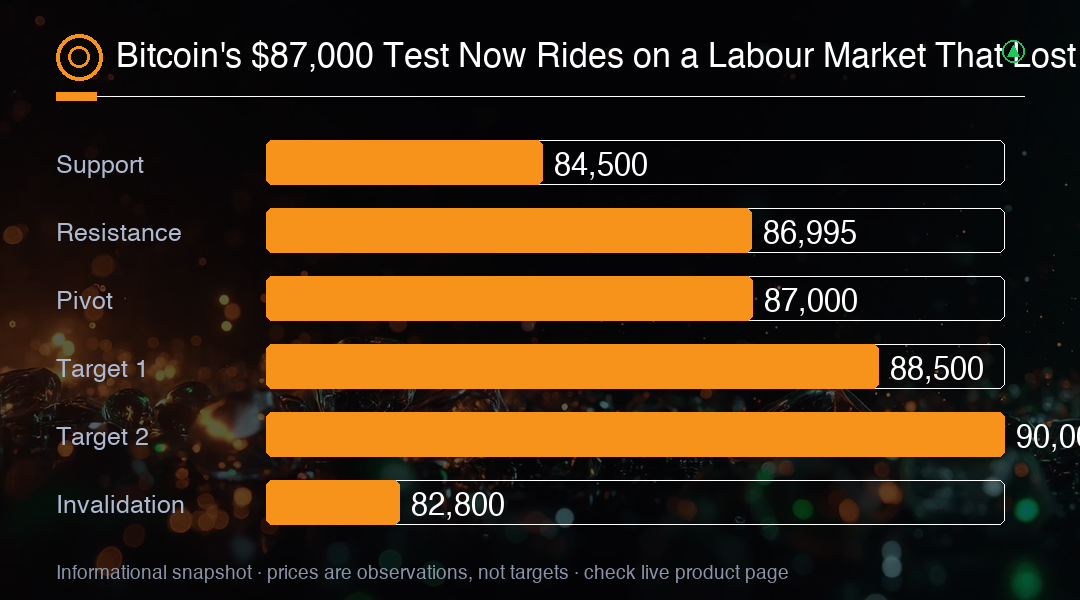
So the question for the week is narrow and testable: can Bitcoin establish a foothold above $87,000? The asset has twice approached or briefly cleared that level in recent sessions, including on Friday 2 October after the employment report, and twice failed to hold it once bond yields recovered. That pattern says the level is being sold into, which usually means there is supply waiting above it rather than a vacuum below. A sustained move above $87,000 on expanding volume would revive expectations of a move toward $90,000, and the first real evidence would be a daily close above the level with the 10-year yield staying under 5.28%.
The invalidation case is straightforward. If Bitcoin loses the $85,000 area while the 10-year yield holds above 5.28% and oil stays above $100, the two forces that pushed price up on Friday are both absent, and the breakout thesis has no support. Watch the same three inputs rather than the price alone: the yield, the ETF flow prints, and the rate pricing into 27 to 28 October. Weak labour data removed the immediate tightening risk, and the flows show patient money accumulating, but the 60,000 job revision only matters if it changes what the Federal Reserve does in three weeks. Until then $87,000 is a question, not a confirmed direction.
Trading Insight
Bitcoin needs a daily close above $87,000 with the 10-year yield holding under 5.28% to confirm the breakout that targets $90,000, and a failure to hold it hands the range back to the $84,000 to $85,000 area. Spot ETF inflows of $102.7 million and $189.8 million on 1 and 2 October suggest the dips are being bought, so pullbacks into the $85,000 area are higher quality than chasing resistance. Watch the rate pricing into the 27 to 28 October policy meeting, because that is what decides whether weak labour data becomes an actual easing cycle or stays a talking point against oil above $100 a barrel.