


KEY POINTS: Tesla delivered 486,532 vehicles in the third quarter of 2026, roughly 5.3% ahead of a compiled consensus of 461,974 units. Production for the quarter was 464,391 vehicles, so shipments outpaced the factory by 22,141, and energy storage deployments reached 13.7 GWh. Shares closed Friday 2 October at $370.59, up about 4.7% on the day, with third-quarter earnings scheduled for Wednesday 21 October after the close.
A quarterly delivery figure is the most frequent hard number Tesla publishes, arriving a few weeks before the financial report and carrying no revenue, profit or cash information of its own. Its value to the share price sits in how much it narrows the range of possible outcomes for the quarter that follows. Tesla reported 486,532 deliveries for the three months to September, and a compiled consensus had been looking for 461,974 vehicles. That is a gap of 24,558 units, or about 5.3%, large enough to reset expectations across the automotive business before any accounting is done. The reaction came fast. Trading on Friday 2 October, the stock advanced about 4.7% to a close of $370.59 and contributed to a broadly stronger session for the major US indexes.
The production number is the more revealing half of the report. Tesla built 464,391 vehicles during the quarter while delivering 486,532, a difference of 22,141 units drawn down from vehicles already in inventory. A gap of that size in a single quarter is not a rounding item. It means completed cars accumulated faster than they could be shipped or registered, and it flatters the delivery line relative to the health of the production system behind it. Investors who read only the headline will miss that distinction, and the 21 October financial report will show whether the inventory drawdown carried a cash cost or a price adjustment. Production efficiency, not shipment volume alone, is what separates a durable recovery from a quarter of favourable timing.
The comparison that carries more weight than the beat is the year-ago quarter. In the third quarter of 2025 Tesla delivered 497,099 vehicles, a period inflated by buyers rushing to secure US tax incentives before they expired. Against that base, the 486,532 vehicles delivered in the third quarter of 2026 represent a decline of about 2.1%. So the quarter that the market treated as the strongest of the year was in fact the second-best, and the segment headline beat coincided with a year-on-year contraction. Commentary has framed the shortfall as the high base rather than as lost share, and that distinction will decide how long the Friday 2 October rally lasts.
The sequence within 2026 supports that reading. Second-quarter deliveries were 480,126 vehicles, and third-quarter deliveries of 486,532 came in 6,406 units above that level. On the company's own numbers the third quarter was therefore the strongest quarter of 2026, ahead of the second and well clear of the weaker first and fourth quarters of the prior year. That progression is what has improved the odds of Tesla avoiding a third consecutive annual fall in deliveries, a outcome that would otherwise have left the automotive business in visible structural decline. The open question is whether a modest sequential gain of about 1.3% carries enough pricing strength to improve profitability, and the 21 October report is where that gets answered.
Beyond vehicles, the storage line is where Tesla has been growing most consistently. Energy storage deployed in the quarter reached 13.7 GWh, a figure that continues to run ahead of the pace of the car business and comes with revenue recognition spread over project timelines rather than recognised at a single handover. Large grid installations move the number in steps, so a strong quarter here says more about project conversion than about run-rate demand, and the year-to-date total will matter more than one quarter. For the equity, storage and cars are two different arguments: one supports near-term revenue and cash, the other carries the valuation. Keeping them separate is useful when the 21 October figures arrive, because the two rarely disappoint or surprise in the same period.
The starting point for all of this is how far the shares have travelled. The 4.7% gain on Friday 2 October came with the stock still about 18% lower year to date, a return of roughly minus 17.6%. In other words, a single strong delivery print recovered only part of a decline that has run through most of the year, and the market is treating each catalyst as a step rather than a trend change. That framing has practical consequences for positioning. When a stock is down heavily on the year and rallies on a data point, the buyers are often covering and re-rating at the same time, which produces a move that can outrun the underlying change. Friday's close of $370.59 is best read as the market repricing delivery risk, not profitability risk, which remains open until the financial report.
Autonomy is the part of the equity story that the delivery figure cannot speak to, and it carries a valuation weight far beyond its current contribution to revenue. Tesla's purpose-built Cybercab reportedly began carrying paying passengers in the Austin robotaxi service around 3 September, a step that moves the programme from demonstration to commercial service if the reporting holds. Claims that safety supervision has been removed entirely from operations in Texas and Florida remain unverified and should be treated as such until the company or a regulator confirms them. What can be said is that the fleet remains smaller than that of the leading competitor in the same markets. Fleet size is not the return, and only paid rides, vehicle utilisation, operating cost and the share of trips needing remote assistance will tell investors whether autonomy is becoming an earnings line.
The reason delivery beats have limited predictive value is that volume and profit can move in opposite directions. Tesla does not break out pricing, incentives or discounting in a delivery release, so a quarter can beat on units while automotive gross profit falls, and the way to tell is the 21 October report. Four items deserve attention there: automotive gross profit excluding regulatory credits, the direction of average selling prices and the incentives attached to them, capital spending, and free cash flow. Regulatory credits in particular have flattered automotive profitability for several quarters, and a reader who tracks the headline only will overstate the improvement. The 486,532 figure is the input that makes those four lines interpretable, not a substitute for reading them.
Funding capacity has become a live part of the discussion, and here the record needs care. A widely circulated figure attributes a $25 billion expansion in borrowing capacity to Tesla through arranged credit facilities, sized to fund rising investment in artificial intelligence. That figure could not be confirmed against primary reporting and is repeated here as unconfirmed rather than as fact. Whether or not the exact number is right, the underlying point holds and can be stated without it: a company pursuing autonomy, robotics and energy infrastructure at the pace Tesla describes will need external funding, and access to committed credit determines how much of that programme it can carry without returning to equity markets. Borrowing capacity is optionality, not cash spent, and investors should separate the two when the cash flow statement is read.
There is a nearer-term event that could shift sentiment before earnings. The Roadster unveiling, originally scheduled for 1 October, was postponed to 15 October because of severe weather and because the presentation required an outdoor setting. That moves the event inside the reporting window and ahead of the 21 October numbers, which matters for two reasons. Any production timeline, pricing or volume commitment given at the event becomes information the market will carry into the quarterly expectations. And a second delay on a programme already described as long delayed would tell investors something about execution that no delivery figure can offset. The 13.7 GWh of storage deployed and the 486,532 vehicles delivered describe the business as it is, while the 15 October event describes the business as management intends to build it.
Wednesday 21 October after the close is the date that decides what Friday 2 October was worth. The market has a delivery beat of 5.3% against consensus, a year-on-year decline of 2.1%, a production shortfall against shipments, and a storage figure of 13.7 GWh. What it does not have is any evidence on profitability. A constructive report would show automotive gross profit excluding credits holding while volumes rise, capital spending that does not outrun operating cash generation, and free cash flow that funds the autonomy and robotics programme without new equity. A weak report would show the delivery beat bought with pricing and incentives. Between now and then, the Roadster event on 15 October is the last scheduled catalyst. The rally off a $370.59 close has repriced delivery risk. It has not repriced the returns question.
Trading Insight
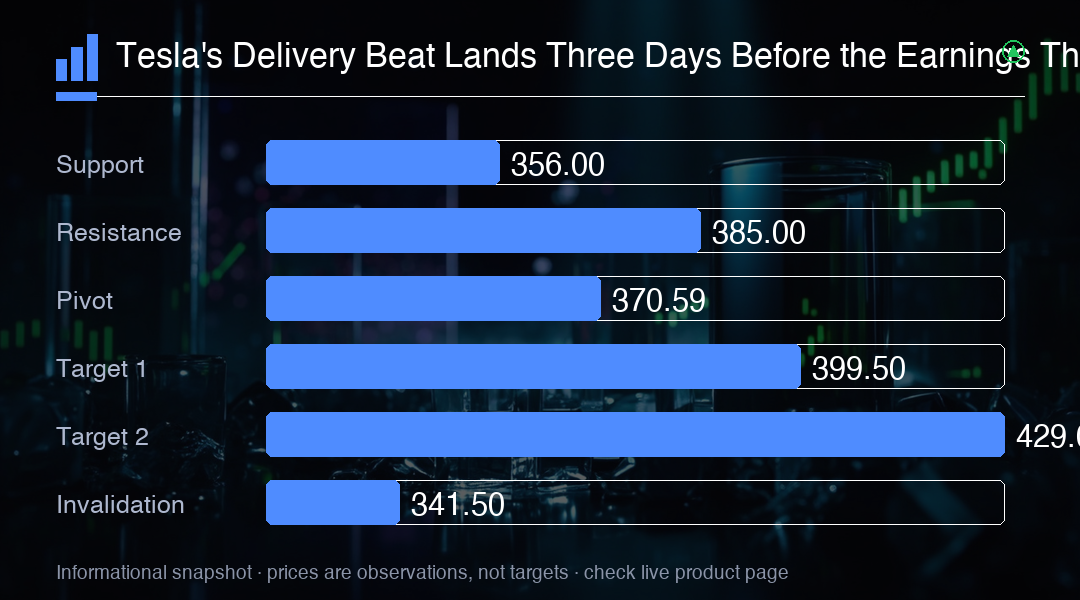
Treat the delivery beat as a repricing of volume risk rather than of profitability: 486,532 units beat the 461,974 consensus, yet deliveries still fell 2.1% from 497,099 a year earlier and outpaced 464,391 of production by 22,141 vehicles. With the stock at $370.59 and still about 18% below where it started the year, the trade is now an earnings one, and Wednesday 21 October after the close is the binary event. Watch automotive gross profit excluding regulatory credits, average selling prices and incentives, and free cash flow against capital spending, because a beat funded by discounts resolves lower. The 15 October Roadster event sits in between and can move the range before the report.