


SpaceX is seeking $40 billion in financing to purchase Nvidia AI chips. Apollo Global Management is expected to lead the deal, with Pimco among the potential lenders. The package would comprise roughly $10 billion in bank loans and $30 billion in investment-grade debt, with completion expected in 2027.
The proposed transaction highlights how much capital Musk's computing ambitions require. It remains a financing plan under discussion rather than a completed deal, and the structure shows a deliberate choice to fund expansion through borrowing rather than issuing new shares. That approach avoids diluting existing shareholders but adds interest payments and repayment obligations that will weigh on the company's finances for years. The 2027 completion timeline suggests the process is still in its early stages, leaving ample room for terms to shift as negotiations progress between SpaceX, Apollo and the lending syndicate.
Apollo Global Management is expected to lead the financing effort and place the debt with investors, with Pimco among the potential lenders in talks. A report indicated that SpaceX carries a BBB credit rating, placing it in investment-grade territory. That rating can broaden the potential lender base to institutions with stricter credit requirements, including pension funds and insurance companies that cannot buy below-investment-grade debt. The involvement of major asset managers signals confidence in the underlying business, though it does not eliminate the need for investors to assess the specific terms of the borrowing.
Musk said last month that SpaceX's supercomputer Colossus 2 could more than double its Nvidia chip count by December. He has also said SpaceX would use Nvidia hardware exclusively for its data centers, a commitment that deepens the strategic partnership between the two companies. The expansion would significantly increase SpaceX's computing capacity, positioning the company as a major player in the AI infrastructure market. For Nvidia, the deal represents another large-scale customer for its chips, reinforcing the dominance that has made it the central beneficiary of the AI buildout.
The financing push fits a broader industry effort to channel capital into AI infrastructure. Nvidia announced partnerships with Apollo, BlackRock, Blackstone, Brookfield, Goldman Sachs and KKR to mobilize more than $500 billion of third-party capital for AI infrastructure over time. That initiative reflects the enormous investment required to build the data centers, power systems and networking equipment needed to support advanced AI models and the computational workloads they generate. SpaceX's borrowing is one piece of a much larger capital formation process that is reshaping the technology and energy landscapes, drawing in traditional financial institutions alongside technology companies.
SpaceX closed Tuesday up 0.49% at $171.92, then fell 1.1% to $170.10 after hours. The after-hours decline suggested that some investors viewed the financing report as a mixed development, balancing the strategic logic of the AI expansion against the cost of the borrowing. Regular-session trading had been positive, but the after-hours move indicated that the initial enthusiasm was tempered by concerns about the debt load and its implications for future profitability.
The regular-session close was about 27% above its $135 IPO price, a solid return for investors who bought at the offering. Monday's 7.6% jump had already lifted expectations, making the financing report another test of investors' appetite for expansion. The stock's volatility reflects the dual nature of SpaceX as both a space company and an AI infrastructure play, with each new development forcing a reassessment of which narrative deserves more weight in the valuation.
Each percentage point of annual interest on $40 billion equals $400 million, assuming the entire amount is outstanding. At a 5 percent rate, the annual interest cost would reach $2 billion, a substantial expense that must be covered by revenue from SpaceX's various businesses. The actual rate will depend on market conditions, the company's credit profile and the specific terms negotiated with lenders. Investors will focus on this figure because it directly affects the return on capital deployed into the AI expansion.
The BBB rating does not settle the economics of this transaction. Investors still need to see the interest rate, maturity schedule and protections attached to the borrowing before they can assess whether the deal creates or destroys value. A longer maturity would reduce near-term repayment pressure but increase total interest costs, while covenants could restrict SpaceX's operational flexibility. The details will determine whether the financing is a prudent investment in future growth or an expensive bet that strains the balance sheet.
More processors can support greater computing output, but profitability also depends on utilization, pricing and operating costs. SpaceX will need to ensure that its expanded data center capacity is fully utilized and priced competitively to generate returns that exceed the cost of the debt. The company's ability to attract and retain AI customers will be critical, as will its power procurement strategy, since energy costs represent a significant portion of data center operating expenses. These operational factors will ultimately determine whether the Nvidia chip purchase translates into sustainable earnings growth or becomes a drag on profitability if demand fails to materialize as expected.
Apparently, landing on Mars is not a top-of-the-list priority for the space startup at the moment. The focus has shifted toward building the computing infrastructure that supports AI development, a pivot that aligns SpaceX with the most powerful technology trend of the era. This strategic reorientation carries both opportunity and risk: the AI infrastructure market is large and growing, but it is also attracting intense competition from established cloud providers and well-capitalized startups. SpaceX's ability to differentiate its offering will be tested as the market matures.
The $40 billion financing plan represents a bold bet that AI infrastructure will generate returns sufficient to justify the borrowing. Apollo's involvement and the BBB rating provide credibility, but the ultimate test will be whether SpaceX can convert its expanded computing capacity into revenue that covers the interest cost and delivers value to shareholders. Investors should watch for the final terms of the debt, the pace of Colossus 2's expansion and early signs of customer demand for SpaceX's AI computing services. The coming months will reveal whether this transaction marks a transformative step or an overreach.
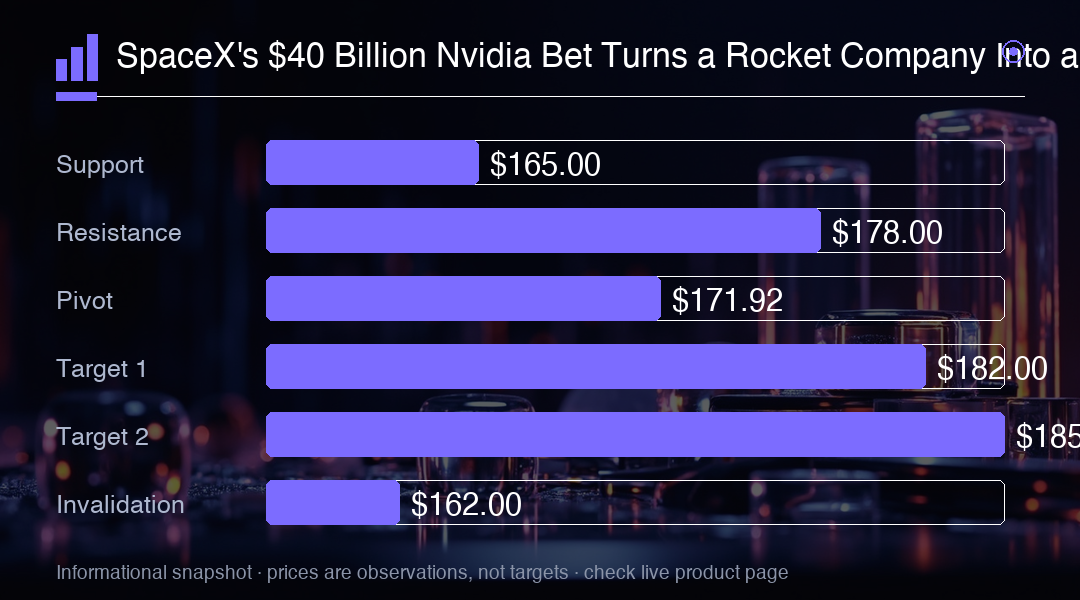
Trading Insight
SpaceX's $40 billion Nvidia financing plan positions the company as a major AI infrastructure player, but the debt load introduces new financial risks. The stock's after-hours decline to $170.10 suggests investors are weighing the strategic benefits against the interest cost, which could reach $2 billion annually at a 5 percent rate. A sustained break above $178 would signal confidence in the AI pivot, while a drop below $165 would indicate concerns about the debt burden are dominating the narrative.