


The euro held near $1.1240 early Wednesday, recovering part of Monday's slide to $1.1160, its lowest since May 2025. French bond markets rallied after a presidential candidate increased proposed spending cuts to €140 billion from €125 billion. Federal Reserve minutes arrive at 2 p.m. ET Wednesday, with markets assigning a 20.5% probability to an October rate increase.
EUR/USD traded near $1.1240 in early Wednesday trading, holding a portion of Tuesday's rebound after the pair slid to $1.1160 on Monday. That Monday low marked the euro's weakest level since May 2025, extending a multi-week decline that has kept sellers firmly in control of the broader trend. The recovery, while welcome to euro bulls, remains modest in scope, with the pair still less than one cent above its recent trough. The single-day bounce has not yet altered the underlying structure of lower highs and lower lows that has defined the euro's trajectory since late summer.
Tuesday produced the euro's strongest daily advance in seven weeks, a notable burst of buying that helped the pair reclaim the psychologically important $1.12 threshold. The gain reflected broad relief across European bond markets rather than any single domestic catalyst, as investors reassessed the political risk premium embedded in French assets and other peripheral European debt. Still, one strong day does not reverse a downtrend, and the pair enters Wednesday's Fed minutes with more questions than answers about the durability of the bounce. Traders will want to see follow-through buying before concluding that the worst of the selling is over.
French bonds rallied after presidential candidate Marine Le Pen increased her proposed spending cuts to €140 billion, up from €125 billion in her earlier platform. The shift signaled a more fiscally disciplined approach than markets had previously priced, reducing concerns about France's debt trajectory and the political feasibility of her economic agenda. A report indicated that the proposal caught many short sellers off guard, triggering a sharp bid for French government debt and a rapid compression in yields across the curve. The announcement removed a significant overhang that had weighed on French assets for weeks.
France's 10-year yield fell approximately 11 basis points on Tuesday, a substantial single-day move for a major sovereign bond market. The French-German 10-year yield spread narrowed to around 132 basis points, down from almost 160 last week, representing a significant compression in the risk premium investors charge for holding French debt. That spread measures the extra return demanded to hold French government bonds relative to German bunds, the benchmark for eurozone credit quality. Its rapid decline reflected a meaningful reduction in perceived sovereign risk and a return of confidence among fixed-income investors who had been demanding a much higher premium.
The decline in French yields helped the euro because it reflected reduced concern about sovereign risk rather than simply expectations for lower interest rates across the eurozone. When yields fall due to improved credit sentiment and fiscal credibility, the currency tends to benefit from capital inflows and reduced hedging demand from international investors. This distinction matters enormously for the euro's outlook: a rally driven by fiscal credibility and reduced political risk is more durable than one driven by rate-cut expectations that may already be fully priced into the market. The nature of the rally determines whether it can sustain itself.
September Fed minutes arrive Wednesday at 2 p.m. ET, and traders will scrutinize the discussion around further tightening and inflation persistence with unusual intensity. The meeting took place before last week's softer inflation and employment releases, so the minutes may sound more hawkish than subsequent commentary from Fed officials who have already incorporated the new data. Market participants will look for any signals about the committee's reaction function, the balance of risks between growth and inflation, and whether recent data shifts have altered the policy path in any meaningful way. The gap between the meeting's timing and current expectations creates potential for surprise.
Markets assign roughly a 20.5% probability to an October rate increase, down from 51% a week ago, reflecting the softer data flow that has emerged since the September meeting. However, the probability of a December hike remains around 84.5%, suggesting that traders still expect the Fed to tighten policy before year-end despite the recent cooling in economic indicators. The dollar's interest-rate support persists even as expectations for another immediate increase have weakened considerably, creating a complex and somewhat contradictory backdrop for currency markets. This divergence between near-term and longer-term expectations adds uncertainty to dollar positioning.
Meanwhile, the US 10-year Treasury yield returned toward 5.3% in Asian trading, a level that continues to attract global capital to dollar-denominated assets and support the greenback's valuation. Brent crude rebounded above $101 per barrel, and higher oil prices can complicate the inflation outlook by raising input costs across the economy and squeezing consumer purchasing power. Elevated US yields and firm crude prices together provide ongoing structural support for the dollar, limiting the euro's recovery potential and making it harder for the single currency to mount a sustained challenge to the prevailing trend.
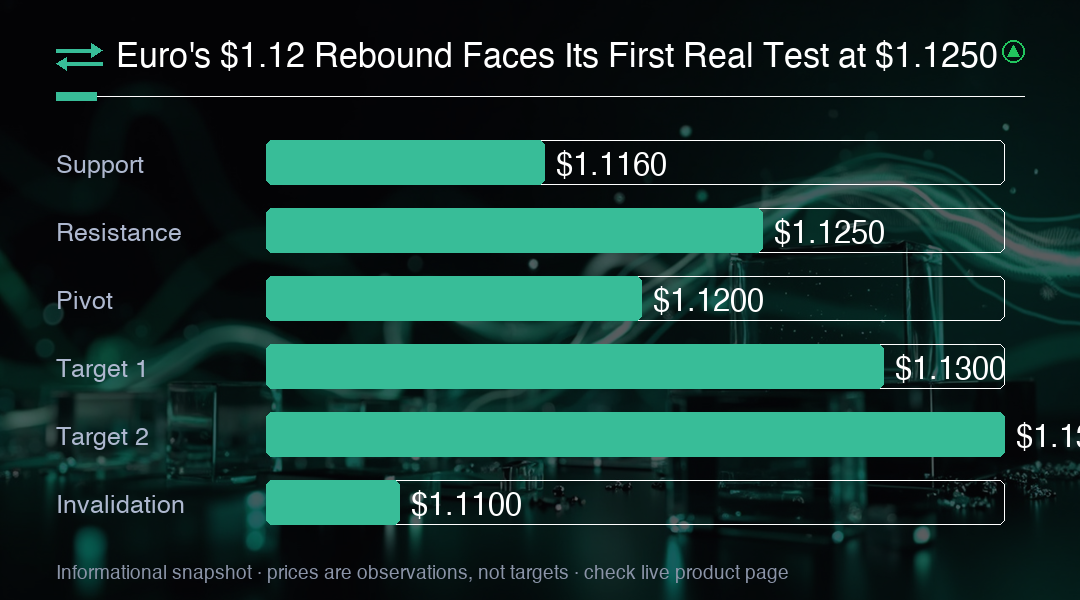
The $1.1250 level is a nearby reference point for the recovery, with $1.1300 the next round-number threshold that would signal stronger momentum and potentially attract additional buying from trend-following accounts. Holding above those levels would strengthen the case for further improvement and suggest that the market is beginning to price a more balanced outlook for the euro. They are practical price markers that traders use to gauge the health of the recovery, but a durable reversal also requires buyers to establish higher lows over subsequent sessions rather than relying on a single day of short covering and technical buying.
Below the market, $1.1200 is the first round-number reference, followed by Monday's $1.1160 low, which represents the immediate line in the sand for the rebound. A break beneath that recent trough would invalidate the immediate recovery and establish a fresh low, likely triggering renewed selling pressure from traders who bought the dip. Brief intraday moves deserve less weight than sustained trading or a daily close beyond the level, so market participants will watch carefully whether any dip below $1.1160 is quickly recovered or sustained into the close, which would signal a failure of the rebound.
Keep the larger decline in view: the euro has fallen for four consecutive weeks and lost 2.5% in September alone, a substantial move for a major currency pair over a single month. A stronger recovery would need support from both calmer European debt markets and softer dollar demand, two conditions that are not yet fully in place despite Tuesday's encouraging price action. Until the pair can establish a series of higher lows and reclaim key resistance levels that have capped previous rallies, the broader downtrend remains intact and rallies are more likely to be corrective than transformative. Patience and confirmation are warranted.
Trading Insight
The euro's rebound from $1.1160 faces a critical test at $1.1250, with $1.1300 as the next resistance threshold. A sustained break above $1.1250 would strengthen the recovery case, while a failure to hold $1.1200 would invalidate the bounce and expose the pair to a retest of Monday's low. The Fed minutes at 2 p.m. ET could provide the catalyst for the next directional move, with hawkish surprises likely to reinforce dollar strength and extend the euro's broader downtrend.